

5 Mithqual – Sinkiang Province
China
Context

Material
References
Y: #Click to copy to clipboard27
Numista: #42037
Value
Bullion value: $49.89
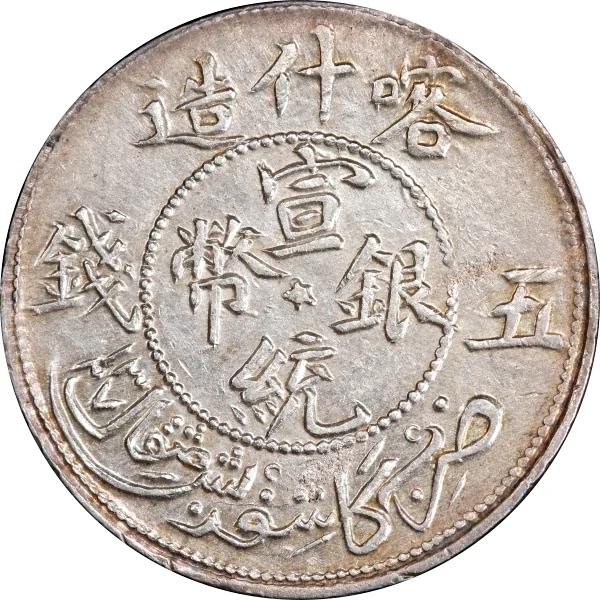
Obverse
Description:
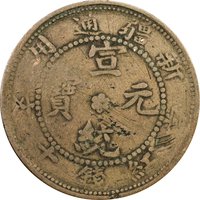
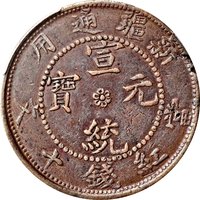
Four Chinese characters read vertically, right to left, surrounding a central star, with more characters around and Arabic text below.
Inscription:
造什喀
錢五
宣
幣銀
統
ضر ب كاشغر بش مثقال ١٣٢٧
錢五
宣
幣銀
統
ضر ب كاشغر بش مثقال ١٣٢٧
Translation:
Struck in Kashgar, 5 misqal, 1327
Unified
Silver Currency
Proclamation
Coin Five
Manufactured
Unified
Silver Currency
Proclamation
Coin Five
Manufactured
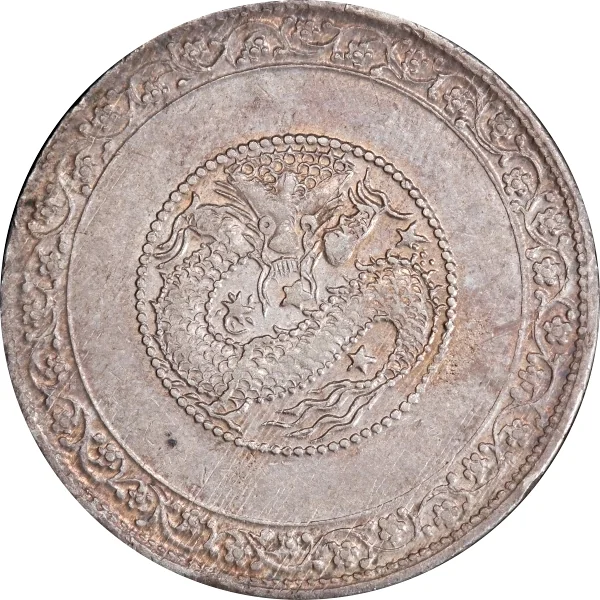
Reverse
Description:
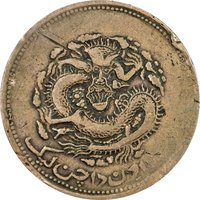
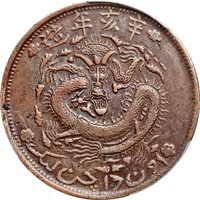
Dragon encircling a star, within a decorative border.
Edge
Categories
| Mythology> Fantastic animal |
Mintings
| Year | Mint Mark | Mintage | Quality | Collection |
|---|---|---|---|---|
| 1909 | — | — | ||
| 1910 | — | — |
Historical background
In 1909, the currency situation in Sinkiang (Xinjiang) Province was characterized by extreme fragmentation and instability, a legacy of its geographical position and political history. The region operated without a unified monetary system, circulating a bewildering array of coins and notes from multiple sources. The primary mediums included red copper cash coins (pūl, or hongqian) minted locally in Kashgar and other centers, silver yambu ingots from Russia, and Chinese silver sycees (shoe-shaped ingots), alongside substantial quantities of Russian tsarist rubles (both paper and silver) and smaller amounts of British Indian rupees and tangas. This created a complex and fluctuating system of exchange where values shifted by location and market.
The provincial authorities, under the late Qing administration, struggled to assert monetary control. The local pūl coins, essential for daily trade, were often debased and minted in varying alloys, leading to severe depreciation, especially in southern oases like Kashgar. Meanwhile, the high-value trade, particularly with Russia, was dominated by silver rubles, which were more trusted and stable. This duality weakened Qing sovereignty and integrated Sinkiang's economy more closely with Russian Central Asia than with Beijing. Attempts to introduce standardized Chinese silver coins (yuan) had made little headway against entrenched local and foreign currencies.
Consequently, the monetary chaos acted as a significant barrier to internal trade and efficient taxation, while benefiting foreign commercial interests. For ordinary inhabitants, it meant daily hardship, transaction uncertainty, and vulnerability to exploitation by money changers. The situation in 1909 thus reflected Sinkiang's transitional and contested status at the twilight of the Qing Dynasty, caught between a weakening imperial center and expanding foreign influence, with its economy hampered by a lack of a sovereign, unified currency.
The provincial authorities, under the late Qing administration, struggled to assert monetary control. The local pūl coins, essential for daily trade, were often debased and minted in varying alloys, leading to severe depreciation, especially in southern oases like Kashgar. Meanwhile, the high-value trade, particularly with Russia, was dominated by silver rubles, which were more trusted and stable. This duality weakened Qing sovereignty and integrated Sinkiang's economy more closely with Russian Central Asia than with Beijing. Attempts to introduce standardized Chinese silver coins (yuan) had made little headway against entrenched local and foreign currencies.
Consequently, the monetary chaos acted as a significant barrier to internal trade and efficient taxation, while benefiting foreign commercial interests. For ordinary inhabitants, it meant daily hardship, transaction uncertainty, and vulnerability to exploitation by money changers. The situation in 1909 thus reflected Sinkiang's transitional and contested status at the twilight of the Qing Dynasty, caught between a weakening imperial center and expanding foreign influence, with its economy hampered by a lack of a sovereign, unified currency.
✨ Legendary