

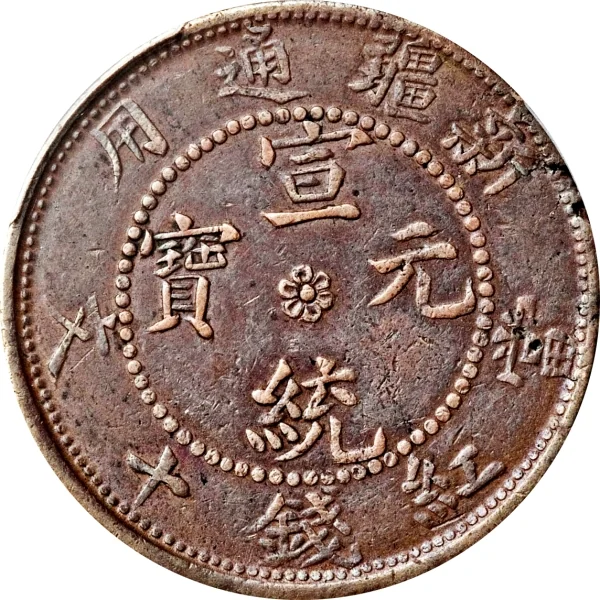

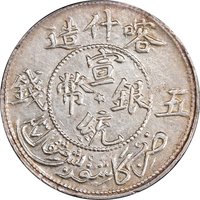
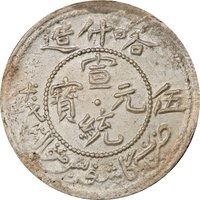
Obverse
Description:
Four Chinese ideograms arranged vertically around a central flower, surrounded by additional characters.
Inscription:
用通疆新
宣
寶元
統
文十錢紅當
宣
寶元
統
文十錢紅當
Translation:
Circulating the frontiers, new.
Proclaimed.
Precious Origin.
Unified.
Ten-cash coin, red, equivalent.
Proclaimed.
Precious Origin.
Unified.
Ten-cash coin, red, equivalent.
Language: Classical Chinese
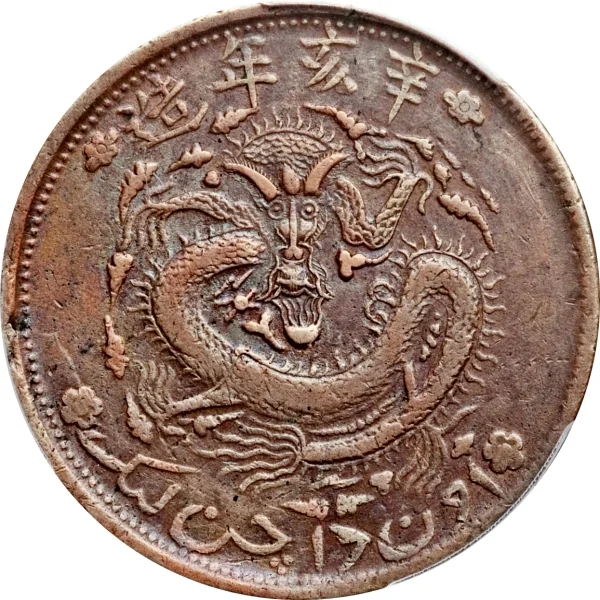
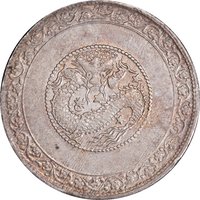
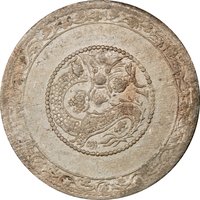
Reverse
Edge
Categories
| Mythology> Fantastic animal |
| Plants> Flower |
Mintings
| Year | Mint Mark | Mintage | Quality | Collection |
|---|---|---|---|---|
| 1910 | — | — | ||
| 1911 | — | — |
Historical background
In 1910, Sinkiang (Xinjiang) Province operated under a complex and fragmented monetary system, a direct reflection of its geographical position as a crossroads of empires and its tenuous administrative control under the late Qing dynasty. The official currency was the Xinjiang tael note, a provincial paper currency issued in liang (tael) units from the Imperial Treasury in Ürümqi and sub-treasuries in major towns like Yarkand and Ili. However, these notes were not backed by a standard metallic reserve and their value fluctuated wildly, especially the further one traveled from the issuing office, leading to significant discounts and confusion in trade.
This paper system coexisted with, and was undermined by, a multitude of physical currencies circulating from beyond Qing control. Russian Tsarist rubles, particularly silver coins, were dominant in northern Xinjiang and the Ili region due to extensive cross-border trade, often holding more trust and stability than local notes. In the south, Indian rupees (along with smaller tanga coins) flowed over the Karakoram passes from British India, anchoring commerce in Kashgar and Yarkand. Additionally, remnants of older local silver and copper coinage from various city mints, along with raw silver ingots (yamboos), completed a chaotic monetary landscape.
The fundamental crisis was one of sovereignty and trust. The Qing state, financially crippled and on the verge of collapse, could not enforce a uniform currency or guarantee the value of its notes. This monetary disarray stifled economic integration within the province, facilitated foreign economic influence, and placed a heavy burden on the local populace through transaction losses and price instability. It was a tangible symptom of the weakening imperial grip in a strategic borderland, where external currencies often held more practical authority than those of the crumbling central government.
This paper system coexisted with, and was undermined by, a multitude of physical currencies circulating from beyond Qing control. Russian Tsarist rubles, particularly silver coins, were dominant in northern Xinjiang and the Ili region due to extensive cross-border trade, often holding more trust and stability than local notes. In the south, Indian rupees (along with smaller tanga coins) flowed over the Karakoram passes from British India, anchoring commerce in Kashgar and Yarkand. Additionally, remnants of older local silver and copper coinage from various city mints, along with raw silver ingots (yamboos), completed a chaotic monetary landscape.
The fundamental crisis was one of sovereignty and trust. The Qing state, financially crippled and on the verge of collapse, could not enforce a uniform currency or guarantee the value of its notes. This monetary disarray stifled economic integration within the province, facilitated foreign economic influence, and placed a heavy burden on the local populace through transaction losses and price instability. It was a tangible symptom of the weakening imperial grip in a strategic borderland, where external currencies often held more practical authority than those of the crumbling central government.
✨ Legendary