

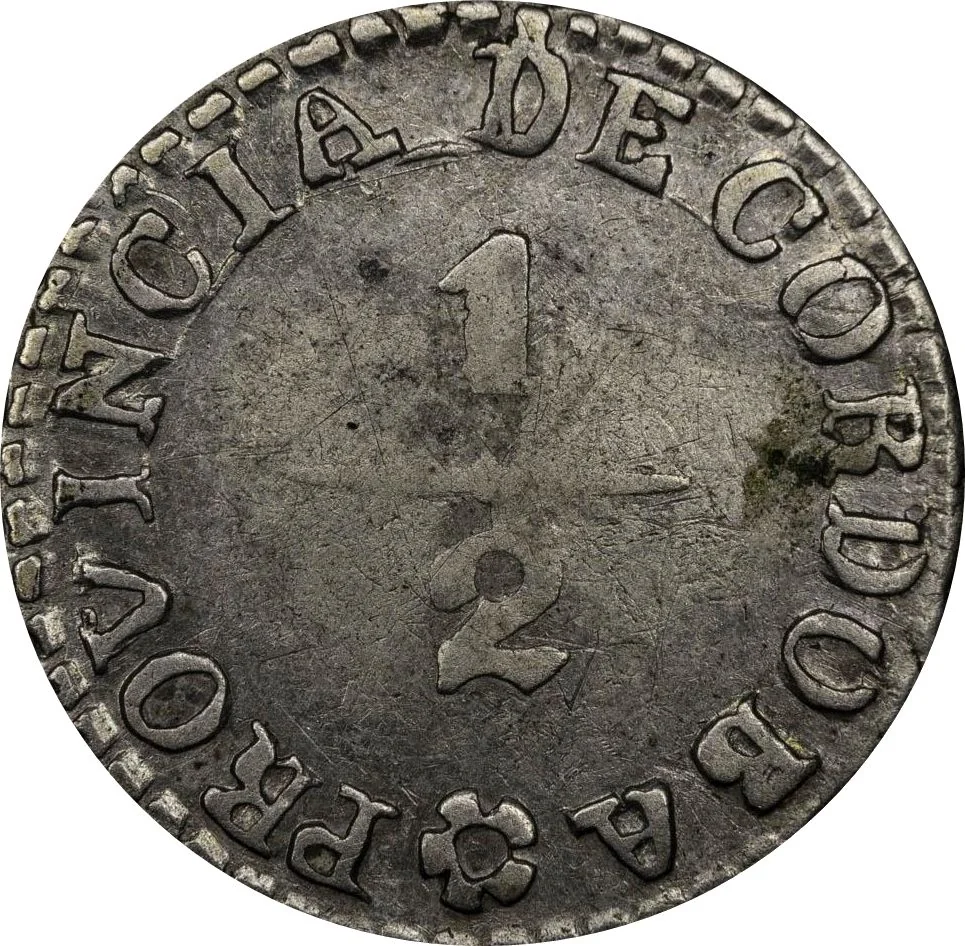
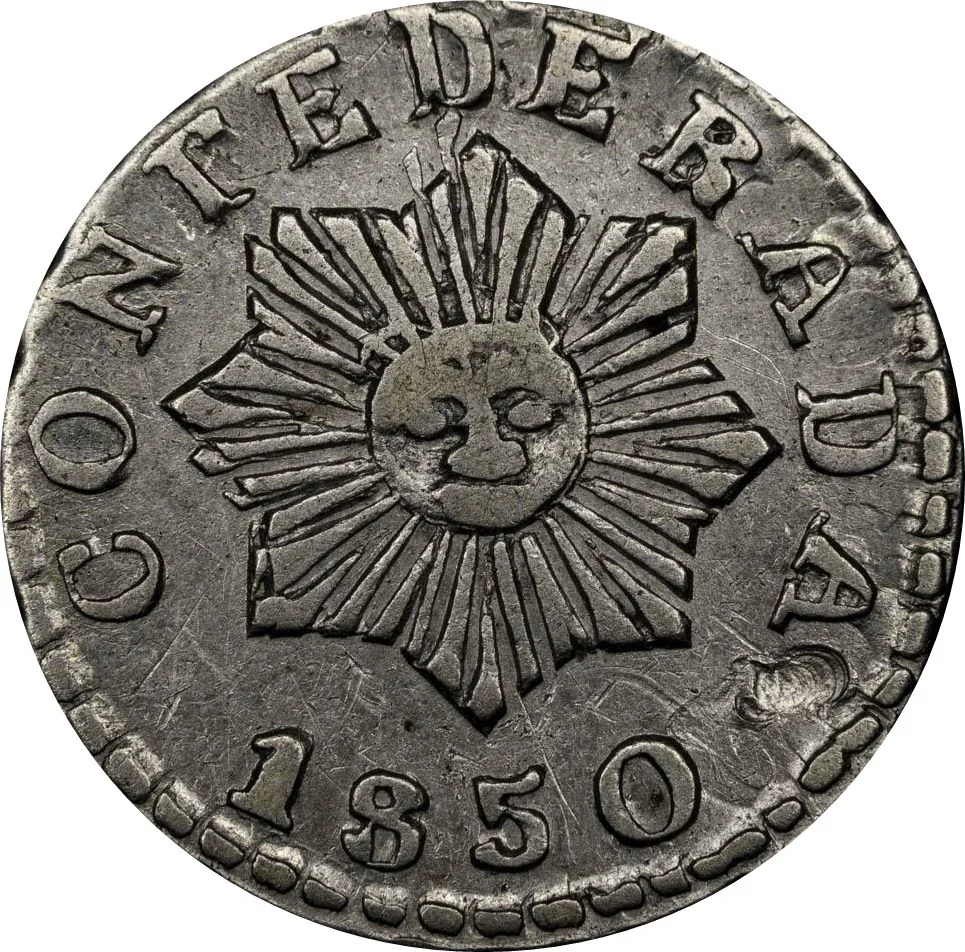
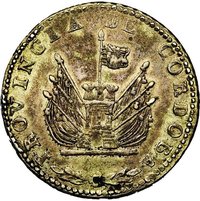
Obverse
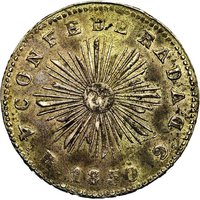
Reverse
Description:
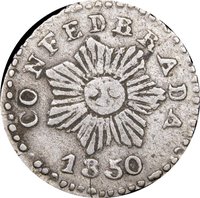
Radiant sun with a face and eight points.
Inscription:
CONFEDERADA
9. 1850 D.
9. 1850 D.
Script: Latin
Edge
Laureate
Mintings
| Year | Mint Mark | Mintage | Quality | Collection |
|---|---|---|---|---|
| 1850 | — | — | ||
| 1851 | — | — | ||
| 1853 | — | — | ||
| 1854 | — | — |
Historical background
In 1850, Córdoba, like much of post-independence Argentina, was mired in a profound monetary crisis characterized by extreme fragmentation and devaluation. The national government in Buenos Aires had failed to establish a unified, trusted currency, leading to a chaotic mix of circulating mediums. These included worn and clipped Spanish colonial coins, a plethora of foreign currencies (especially Bolivian, Chilean, and Peruvian coinage), and a flood of low-quality copper moneda feble (weak money) minted by various provinces. This lack of a standard national tender crippled inter-provincial trade and fostered widespread confusion and distrust in everyday transactions.
The situation was exacerbated by the financial practices of the provincial government itself. To cover chronic budget deficits, the government of Córdoba, under leaders like Manuel López, resorted to issuing its own paper money, known as billetes de corso or papel moneda de Córdoba. These notes were not backed by specie (gold or silver) and were often declared legal tender for all public payments, including taxes. However, their value depreciated rapidly in the private market, creating a dual-price system where goods cost significantly more if paid for with paper than with scarce silver coins. This effectively taxed the populace and eroded economic stability.
Consequently, the economy of Córdoba in 1850 operated on a precarious system of barter and forced credit, severely hindering capital formation and long-term investment. The monetary anarchy reflected the broader political disunity of the Argentine Confederation, where provincial autonomies undermined national economic cohesion. This chaotic financial environment would persist until the forceful national unification and monetary reforms following the Battle of Pavón in 1861, which eventually allowed for the successful introduction of a national peso fuerte.
The situation was exacerbated by the financial practices of the provincial government itself. To cover chronic budget deficits, the government of Córdoba, under leaders like Manuel López, resorted to issuing its own paper money, known as billetes de corso or papel moneda de Córdoba. These notes were not backed by specie (gold or silver) and were often declared legal tender for all public payments, including taxes. However, their value depreciated rapidly in the private market, creating a dual-price system where goods cost significantly more if paid for with paper than with scarce silver coins. This effectively taxed the populace and eroded economic stability.
Consequently, the economy of Córdoba in 1850 operated on a precarious system of barter and forced credit, severely hindering capital formation and long-term investment. The monetary anarchy reflected the broader political disunity of the Argentine Confederation, where provincial autonomies undermined national economic cohesion. This chaotic financial environment would persist until the forceful national unification and monetary reforms following the Battle of Pavón in 1861, which eventually allowed for the successful introduction of a national peso fuerte.
💎 Extremely Rare