

Obverse
Description:
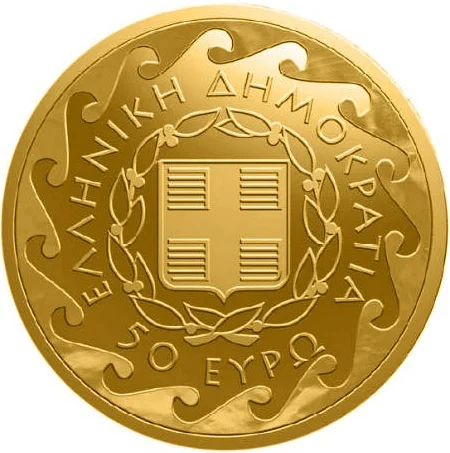
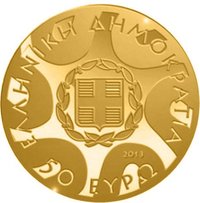
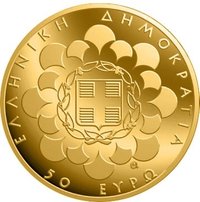
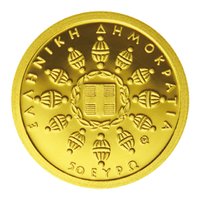
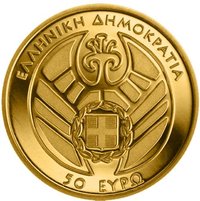
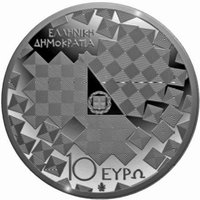
The obverse depicts the Hellenic Republic's coat of arms, encircled by a wave motif from a Hellenistic-era stone tabletop found at the Poseidon shrine in Pella.
Inscription:
ΕΛΛΗΝΙΚΗ ΔΗΜΟΚΡΑΤΙΑ
50 ΕΥΡΩ
50 ΕΥΡΩ
Translation:
HELLENIC REPUBLIC
50 EURO
50 EURO
Script: Greek
Language: Greek
Engraver: Geórgios Stamatópoulos
Reverse
Description:
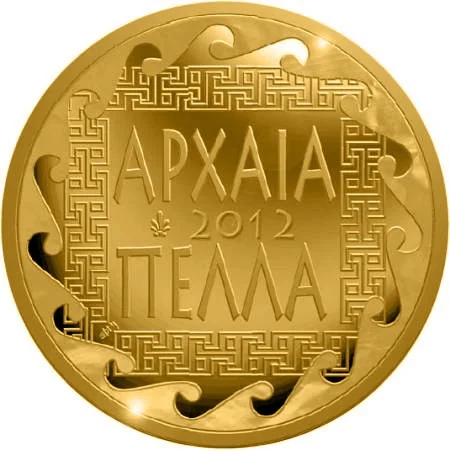
The coin's obverse depicts wave and geometric motifs from a Hellenistic stone tabletop at the shrine in Pella's "House of Poseidon."
Inscription:
APXAIA
2012
ΠΕΛΛΑ
2012
ΠΕΛΛΑ
Translation:
Ancient
2012
Pella
2012
Pella
Script: Greek
Language: Greek
Engraver: Geórgios Stamatópoulos
Edge
Plain
Categories
| Building> Religious building |
| Symbols> Coat of Arms |
Mints
| Name | Mark |
|---|---|
| National Mint of the Bank of Greece | — |
Mintings
| Year | Mint Mark | Mintage | Quality | Collection |
|---|---|---|---|---|
| 2012 | — | 4,000 | Proof |
Historical background
By 2012, Greece was in the fifth year of a profound economic and social crisis, having become the epicenter of the European sovereign debt crisis. The country was burdened by a massive public debt exceeding 160% of its GDP, a consequence of years of fiscal mismanagement, structural weaknesses, and the global financial shock of 2008. To avoid a disorderly default and a potential exit from the Eurozone (a scenario dubbed "Grexit"), Greece had already received two international bailouts totalling over €200 billion from the European Commission, the European Central Bank, and the International Monetary Fund (the "Troika"). In exchange, it implemented severe austerity measures, including deep spending cuts and tax hikes, which led to a deep recession, soaring unemployment, and significant social unrest.
The currency situation was defined by intense speculation and fear of a forced return to the Drachma. Financial markets and citizens alike grappled with the possibility of a "Grexit," which would have involved a complex and chaotic reintroduction of a national currency, almost certainly leading to a drastic devaluation, bank collapses, and a collapse in living standards. This uncertainty triggered massive capital flight, with billions of euros withdrawn from Greek banks, severely straining the banking system's liquidity and forcing increased reliance on emergency liquidity assistance (ELA) from the European Central Bank to keep the financial sector afloat.
The pivotal moment came in the first half of 2012. Following a political crisis and a second round of elections in June, which reaffirmed a pro-bailout government, the European Union moved to stabilize the situation. In a critical decision, Eurozone leaders agreed to a significant debt restructuring for Greece (the largest in history for a sovereign state) and paved the way for a third bailout package. Most importantly, the ECB President Mario Draghi's July 2012 pledge to do "whatever it takes" to preserve the euro calmed markets broadly, effectively ring-fencing the crisis and diminishing the immediate threat of a forced Greek exit from the single currency. Thus, while the economic hardship deepened domestically, the existential threat to Greece's euro membership was, for the time being, averted.
The currency situation was defined by intense speculation and fear of a forced return to the Drachma. Financial markets and citizens alike grappled with the possibility of a "Grexit," which would have involved a complex and chaotic reintroduction of a national currency, almost certainly leading to a drastic devaluation, bank collapses, and a collapse in living standards. This uncertainty triggered massive capital flight, with billions of euros withdrawn from Greek banks, severely straining the banking system's liquidity and forcing increased reliance on emergency liquidity assistance (ELA) from the European Central Bank to keep the financial sector afloat.
The pivotal moment came in the first half of 2012. Following a political crisis and a second round of elections in June, which reaffirmed a pro-bailout government, the European Union moved to stabilize the situation. In a critical decision, Eurozone leaders agreed to a significant debt restructuring for Greece (the largest in history for a sovereign state) and paved the way for a third bailout package. Most importantly, the ECB President Mario Draghi's July 2012 pledge to do "whatever it takes" to preserve the euro calmed markets broadly, effectively ring-fencing the crisis and diminishing the immediate threat of a forced Greek exit from the single currency. Thus, while the economic hardship deepened domestically, the existential threat to Greece's euro membership was, for the time being, averted.
Series: Greek Cultural Heritage


💎 Extremely Rare