

1 speciedaler – Norway
Add to wishlist
Norway
Context
Years: 1826–1836
Issuer: Norway
Ruler: Charles III John
Currency:
(1816—1875)
Demonetized: Yes
Total mintage: 412,232
Material
References
KM: #
Numista: #41764
Value
Bullion value: $63.01
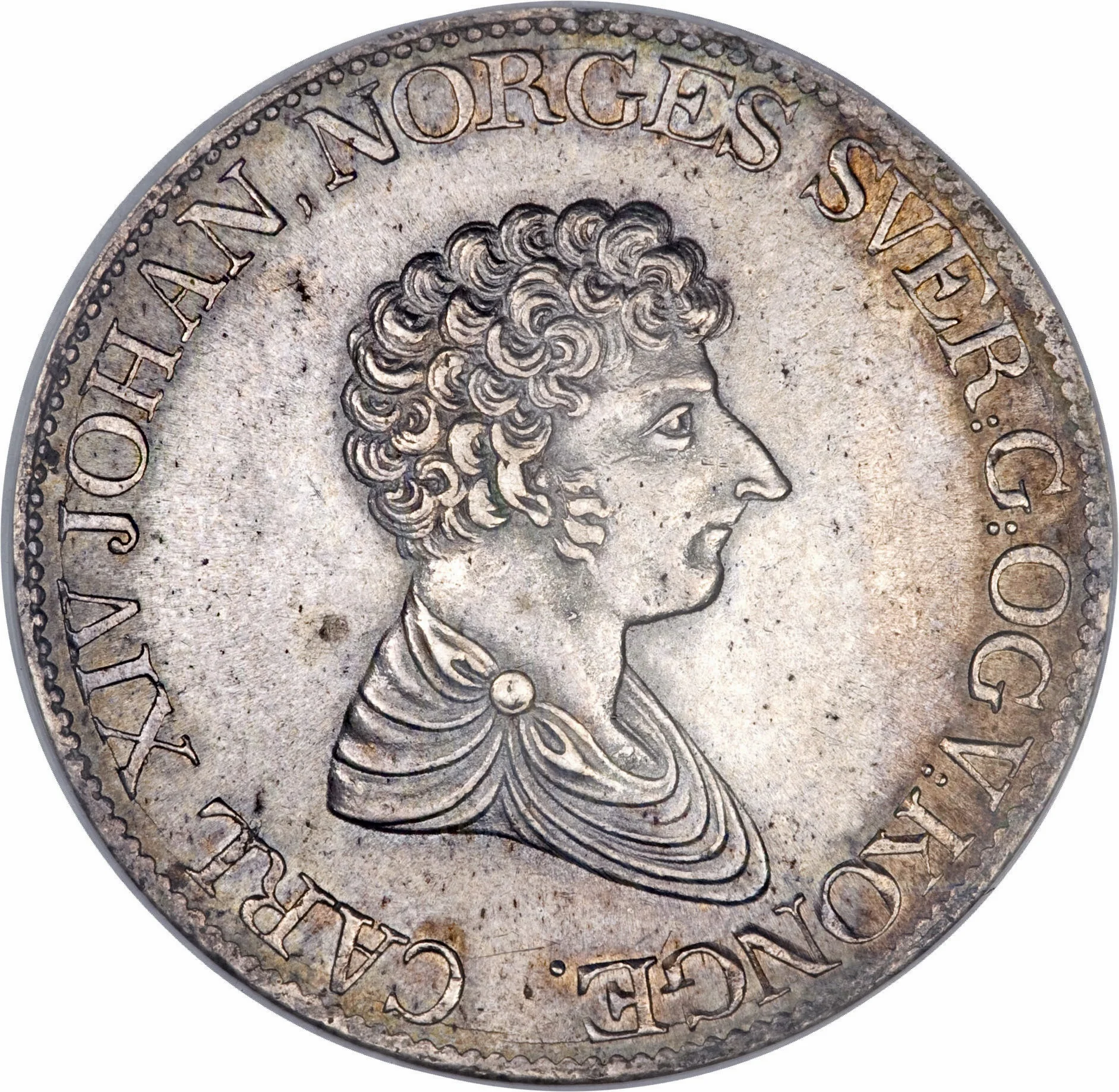
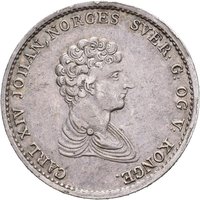
Obverse
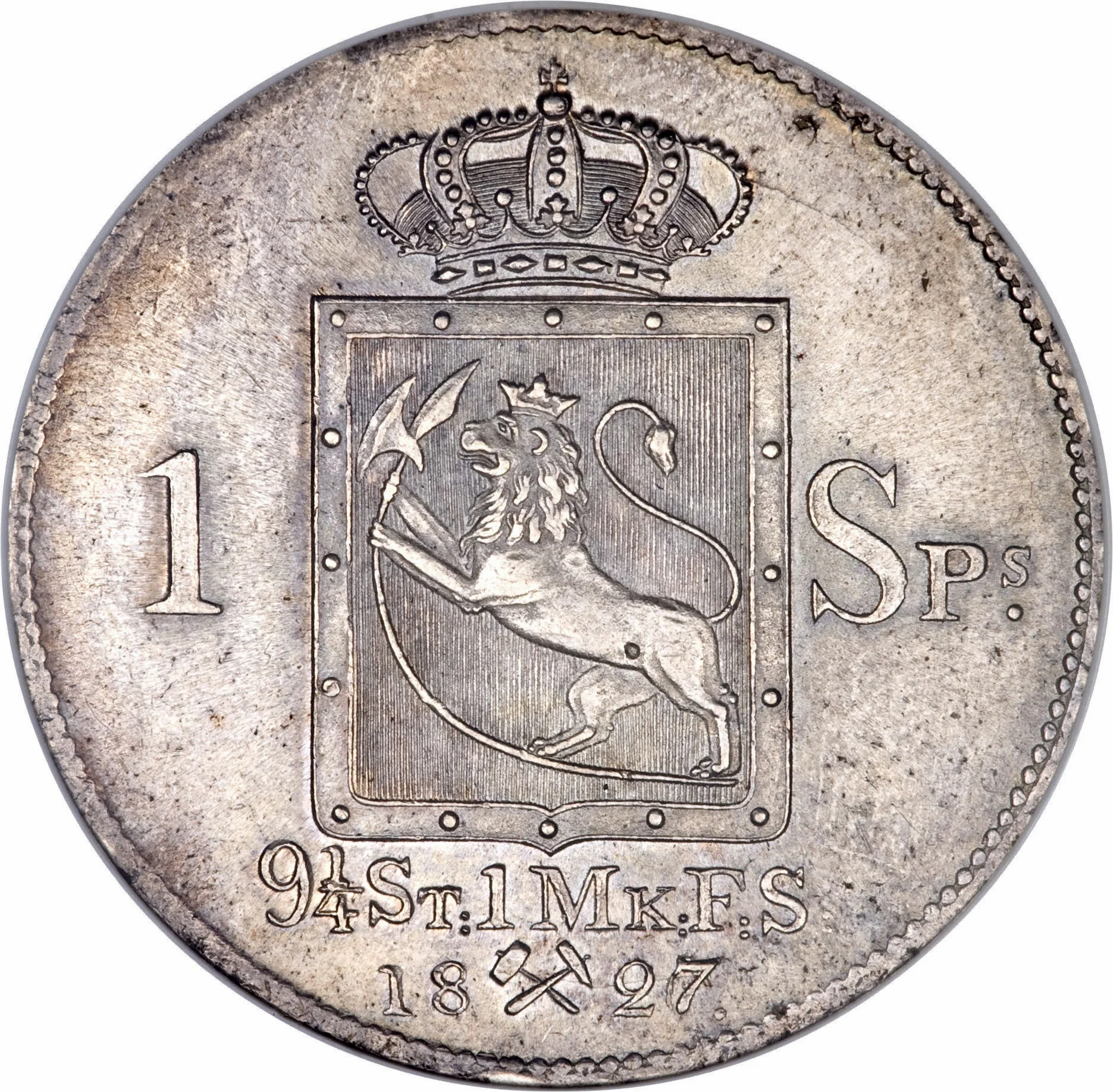
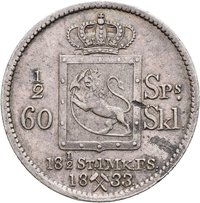
Reverse
Description:
Crowned rectangular shield with beaded border, containing a crowned Norwegian lion holding a halberd left on a lined field. Value flanking shield; description and date (split by mintmark) below. Beaded rim.
Inscription:
1 | SPS.
9 1/4 ST: 1 MK: F: S:
18 ⚒ 27.
9 1/4 ST: 1 MK: F: S:
18 ⚒ 27.
Script: Latin
Edge
Mints
| Name | Mark |
|---|---|
| Norwegian Mint | — |
Mintings
| Year | Mint Mark | Mintage | Quality | Collection |
|---|---|---|---|---|
| 1826 | — | — | BU | |
| 1826 | — | 25,000 | ||
| 1827 | — | 132,200 | ||
| 1829 | — | 16,000 | ||
| 1830 | — | 26,000 | ||
| 1831 | — | 30,800 | ||
| 1832 | — | 24,100 | ||
| 1833 | — | 2,732 | ||
| 1834 | — | 103,400 | ||
| 1835 | — | — | ||
| 1836 | — | 52,000 |
Historical background
In 1826, Norway was navigating a complex monetary landscape as a young nation within a union with Sweden. Following the Napoleonic Wars and the dissolution of the Danish-Norwegian union in 1814, Norway had entered a personal union with Sweden but retained its own constitution, parliament, and separate financial institutions. The currency in circulation was a mixture of older Danish-Norwegian riksdaler and skilling coins, alongside a limited supply of new coins minted by the Norwegian state. However, the system was hampered by a chronic shortage of small change, which disrupted daily commerce and highlighted the need for a more stable and unified national currency.
The situation was further complicated by the existence of two parallel standards: the riksdaler courant, used for everyday transactions, and the riksdaler specie, a silver-based unit used for larger accounts and international trade. The relationship between these units fluctuated, creating uncertainty. Furthermore, the country's first commercial bank, Norges Bank, established in 1816, had introduced the speciedaler as a new monetary unit intended to be on a par with silver. By 1826, this transition was still ongoing, and the bank was working to establish confidence in its notes and manage the money supply in an economy heavily reliant on fluctuating commodity exports like timber and fish.
Therefore, the currency situation in 1826 was one of transition and consolidation. The state and Norges Bank were actively working to phase out older, heterogeneous coins, increase the minting of new national currency, and solidify the speciedaler as a stable silver standard. This period was crucial for laying the foundation for a modern monetary system, though it would take several more decades before a fully unified and trusted currency was achieved across all levels of Norwegian society.
The situation was further complicated by the existence of two parallel standards: the riksdaler courant, used for everyday transactions, and the riksdaler specie, a silver-based unit used for larger accounts and international trade. The relationship between these units fluctuated, creating uncertainty. Furthermore, the country's first commercial bank, Norges Bank, established in 1816, had introduced the speciedaler as a new monetary unit intended to be on a par with silver. By 1826, this transition was still ongoing, and the bank was working to establish confidence in its notes and manage the money supply in an economy heavily reliant on fluctuating commodity exports like timber and fish.
Therefore, the currency situation in 1826 was one of transition and consolidation. The state and Norges Bank were actively working to phase out older, heterogeneous coins, increase the minting of new national currency, and solidify the speciedaler as a stable silver standard. This period was crucial for laying the foundation for a modern monetary system, though it would take several more decades before a fully unified and trusted currency was achieved across all levels of Norwegian society.
💎 Extremely Rare