

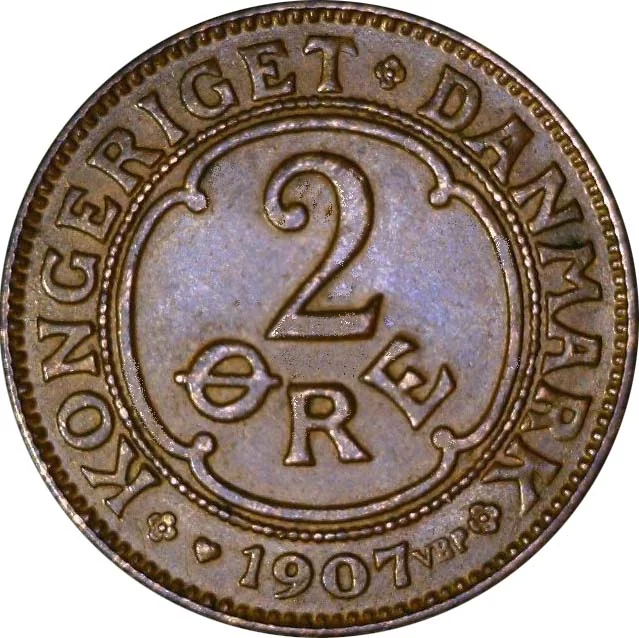
2 øre – Denmark
Add to wishlist
Denmark
Context
Years: 1907–1912
Issuer: Denmark
Ruler: Frederick VIII
Currency:
(since 1873)
Demonetization: 31 March 1973
Total mintage: 7,467,000
Material
References
KM: #
Numista: #4139
Value
Exchange value: 0.02 DKK
Obverse
Description:
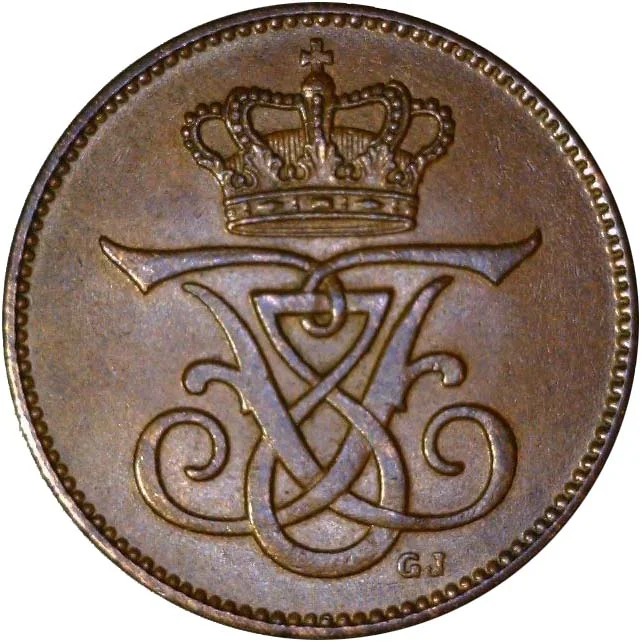
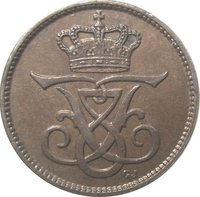
Frederik VIII monogram, King of Denmark (1906–1912).
Inscription:
FF8
Script: Latin
Engraver: Gunnar Jensen
Reverse
Edge
Mintings
| Year | Mint Mark | Mintage | Quality | Collection |
|---|---|---|---|---|
| 1907 | VBP;GJ | 2,502,000 | ||
| 1909 | VBP;GJ | 2,485,000 | ||
| 1912 | VBP;GJ | 2,480,000 |
Historical background
In 1907, Denmark operated under the classical gold standard, a system it had adhered to since 1873. This meant the Danish krone was directly convertible into a fixed quantity of gold, and its value was pegged to other gold-standard currencies like the German mark and the British pound. The country was a member of the Scandinavian Monetary Union (SMU), established with Sweden in 1873 and joined by Norway in 1875. This union created a unified currency area where Danish, Swedish, and Norwegian kroner circulated freely at par, backed by gold, facilitating seamless trade and financial transactions across the three kingdoms.
The period around 1907 was one of relative stability for the krone, but the system's rigidity also presented challenges. Denmark's economy was heavily trade-oriented, particularly in agricultural exports, making it sensitive to international price fluctuations. The fixed exchange rate under the gold standard meant Denmark could not devalue its currency to gain a trade advantage; instead, domestic prices and wages had to adjust to maintain balance. Furthermore, while the SMU functioned well in practice, its underlying legal framework was beginning to show strains, as the member states occasionally adjusted their policies in response to domestic economic pressures, testing the union's cohesion.
Overall, the currency situation in 1907 was characterized by formal stability and international credibility, underpinned by gold. However, this stability came at the cost of limited monetary policy flexibility. The Danish National Bank was primarily tasked with maintaining gold convertibility, which dictated interest rates and money supply. This framework would be severely tested just a few years later with the outbreak of World War I, which ultimately led to the suspension of the gold standard and the gradual dissolution of the Scandinavian Monetary Union.
The period around 1907 was one of relative stability for the krone, but the system's rigidity also presented challenges. Denmark's economy was heavily trade-oriented, particularly in agricultural exports, making it sensitive to international price fluctuations. The fixed exchange rate under the gold standard meant Denmark could not devalue its currency to gain a trade advantage; instead, domestic prices and wages had to adjust to maintain balance. Furthermore, while the SMU functioned well in practice, its underlying legal framework was beginning to show strains, as the member states occasionally adjusted their policies in response to domestic economic pressures, testing the union's cohesion.
Overall, the currency situation in 1907 was characterized by formal stability and international credibility, underpinned by gold. However, this stability came at the cost of limited monetary policy flexibility. The Danish National Bank was primarily tasked with maintaining gold convertibility, which dictated interest rates and money supply. This framework would be severely tested just a few years later with the outbreak of World War I, which ultimately led to the suspension of the gold standard and the gradual dissolution of the Scandinavian Monetary Union.
Series: 1907 Denmark circulation coins
🌱 Common