

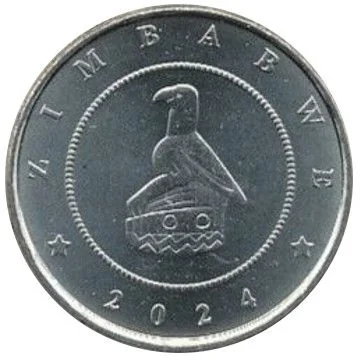
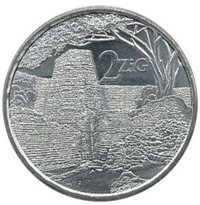
Obverse
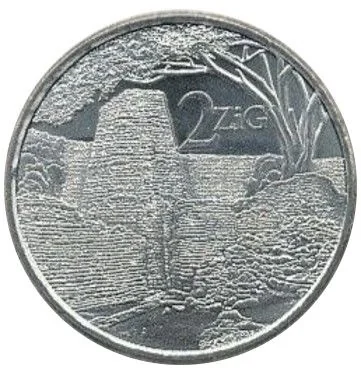
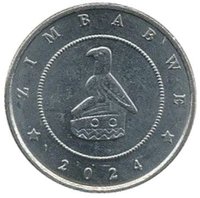
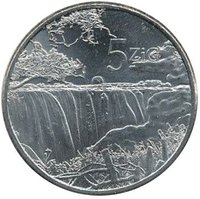
Reverse
Edge
Reeded
Mints
| Name | Mark |
|---|---|
| Zimbabwe Mint | — |
Mintings
| Year | Mint Mark | Mintage | Quality | Collection |
|---|---|---|---|---|
| 2024 | — | — |
Historical background
In 2024, Zimbabwe continues to grapple with a complex and unstable multi-currency system dominated by the US dollar, while its own Zimbabwe Gold (ZiG) currency struggles for legitimacy. The US dollar, which accounts for an estimated 80-85% of all transactions, is the preferred medium for salaries, major purchases, and government payments like taxes. This dollarization provides a crucial anchor for price stability in everyday commerce, but it also starves the local financial system of foreign currency and exposes the economy to external shocks, leaving those without access to greenbacks increasingly marginalized.
The introduction of the ZiG (Zimbabwe Gold) in April 2024 marked the latest attempt to resurrect a functional local currency, following the spectacular failures of the Zimbabwean dollar and its predecessors. Backed by a basket of foreign currencies and gold reserves, the ZiG is designed to be a structured currency to curb the rampant inflation that had returned with the previous ZWL. Initial reception has been skeptical, with widespread reluctance from both businesses and the public who have been traumatized by past currency collapses. Its success hinges entirely on the government's commitment to fiscal and monetary discipline—avoiding the money-printing presses of the past—and building sufficient reserves to maintain the promised gold and forex backing.
The core challenges remain unresolved: a lack of public trust, persistent liquidity crises, and underlying economic fundamentals. While the US dollar brings stability, it also makes Zimbabwean exports less competitive and exacerbates inequality. The informal economy thrives on USD cash, creating a dual-system disadvantageous to the banked population. For 2024, the key indicators to watch are the ZiG's stability on the official and parallel markets, the level of fiscal deficit financing by the central bank, and whether the government can accumulate enough reserves to defend the currency's value, thereby slowly rebuilding the confidence essential for any lasting monetary solution.
The introduction of the ZiG (Zimbabwe Gold) in April 2024 marked the latest attempt to resurrect a functional local currency, following the spectacular failures of the Zimbabwean dollar and its predecessors. Backed by a basket of foreign currencies and gold reserves, the ZiG is designed to be a structured currency to curb the rampant inflation that had returned with the previous ZWL. Initial reception has been skeptical, with widespread reluctance from both businesses and the public who have been traumatized by past currency collapses. Its success hinges entirely on the government's commitment to fiscal and monetary discipline—avoiding the money-printing presses of the past—and building sufficient reserves to maintain the promised gold and forex backing.
The core challenges remain unresolved: a lack of public trust, persistent liquidity crises, and underlying economic fundamentals. While the US dollar brings stability, it also makes Zimbabwean exports less competitive and exacerbates inequality. The informal economy thrives on USD cash, creating a dual-system disadvantageous to the banked population. For 2024, the key indicators to watch are the ZiG's stability on the official and parallel markets, the level of fiscal deficit financing by the central bank, and whether the government can accumulate enough reserves to defend the currency's value, thereby slowly rebuilding the confidence essential for any lasting monetary solution.
🌟 Uncommon