

1 pengo – Hungary
Add to wishlist
Hungary
Context
Years: 1941–1944
Issuer: Hungary
Ruler: Nicolas Horthy
Currency:
(1927—1946)
Demonetization: 31 December 1945
Total mintage: 117,000,000
Material
References
KM: #
Numista: #4125
Obverse
Description:
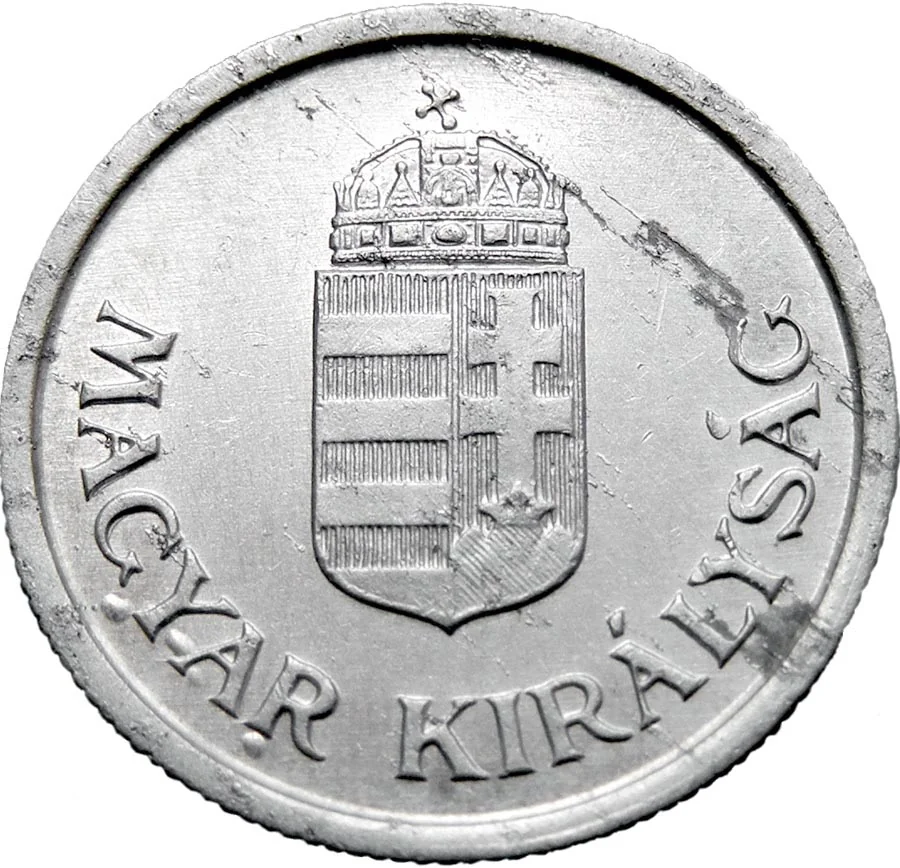
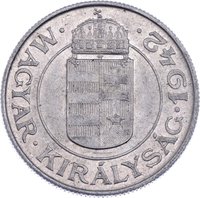
Hungary's coat of arms with the country name beneath.
Inscription:
MAGYAR KIRÁLYSÁG
Translation:
Kingdom of Hungary
Script: Latin
Language: Hungarian
Engraver: Lajos Berán
Reverse
Description:
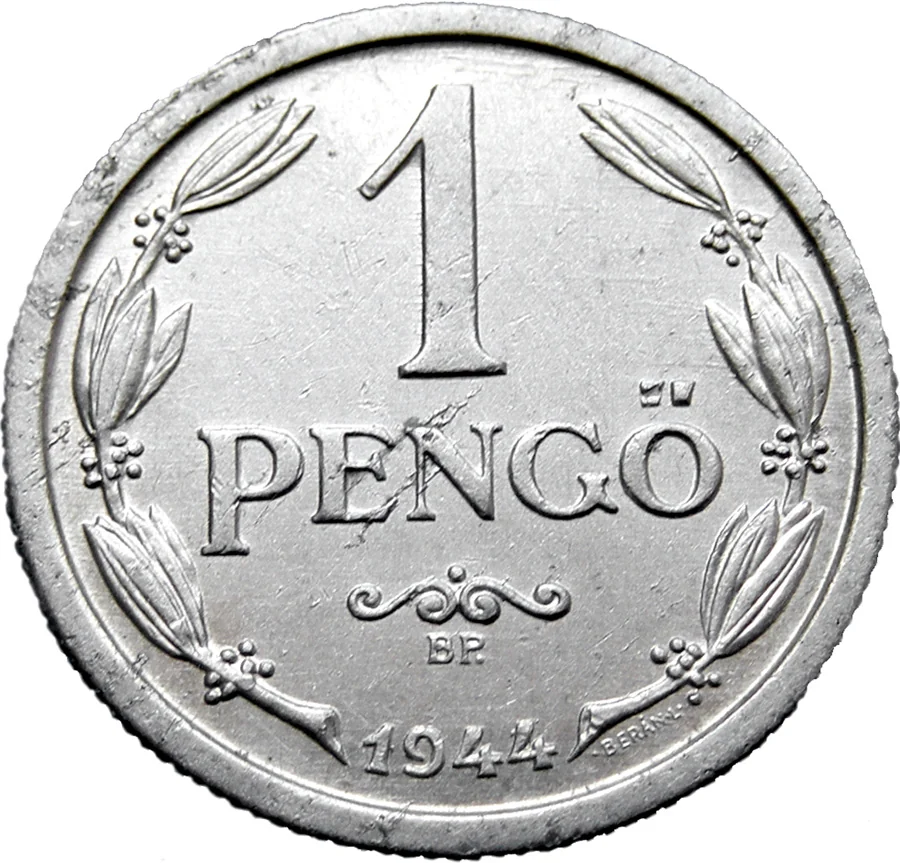
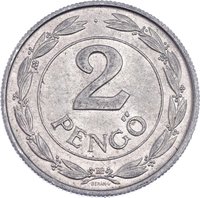
Denomination and date below.
Inscription:
1
PENGŐ
BP.
1944
·BERÁN·L·
PENGŐ
BP.
1944
·BERÁN·L·
Translation:
ONE PENGŐ
BUDAPEST
1944
·BERÁN·L·
BUDAPEST
1944
·BERÁN·L·
Script: Latin
Language: Hungarian
Engraver: Lajos Berán
Edge
Milled (130 mills)
Categories
| Symbols> Coat of Arms |
Mints
| Name | Mark |
|---|---|
| Hungarian mint | BP |
Mintings
Historical background
In 1941, Hungary's currency situation was defined by its complex political and economic alignment with Nazi Germany. The official currency remained the Hungarian pengő, introduced in 1927 to stabilize the economy after the hyperinflation of the post-World War I period. However, by the early 1940s, the pressures of war preparation and Germany's economic dominance were severely straining its stability. Hungary, having regained territory through the Vienna Awards and as a member of the Axis, was increasingly forced to finance its own military expansion and meet extensive material demands from the German war effort, leading to significant inflationary pressures that were being artificially suppressed.
The economy operated under a system of strict exchange controls and was deeply integrated into the German sphere through clearing agreements. These bilateral trade arrangements, meant to avoid hard currency transfers, resulted in large and growing credit balances in favor of Hungary within the German clearing system. Essentially, Hungary was supplying agricultural products, raw materials, and industrial goods to Germany but was unable to draw equivalent value in return due to the Reich's diversion of resources to its war machine. This created a hidden economic strain, as the accumulating pengő-denominated credits within Hungary fueled domestic money supply growth.
Consequently, while overt hyperinflation was not yet present in 1941, the fundamental conditions for severe postwar inflation were being firmly established. The National Bank of Hungary was compelled to finance growing budget deficits through money creation, and the economy was being drained of real resources for the war. The situation was a precarious balancing act, with the pengő's stability maintained by price controls and wartime regulations, masking the underlying erosion of its value that would explode into one of history's worst hyperinflations immediately after the war's conclusion.
The economy operated under a system of strict exchange controls and was deeply integrated into the German sphere through clearing agreements. These bilateral trade arrangements, meant to avoid hard currency transfers, resulted in large and growing credit balances in favor of Hungary within the German clearing system. Essentially, Hungary was supplying agricultural products, raw materials, and industrial goods to Germany but was unable to draw equivalent value in return due to the Reich's diversion of resources to its war machine. This created a hidden economic strain, as the accumulating pengő-denominated credits within Hungary fueled domestic money supply growth.
Consequently, while overt hyperinflation was not yet present in 1941, the fundamental conditions for severe postwar inflation were being firmly established. The National Bank of Hungary was compelled to finance growing budget deficits through money creation, and the economy was being drained of real resources for the war. The situation was a precarious balancing act, with the pengő's stability maintained by price controls and wartime regulations, masking the underlying erosion of its value that would explode into one of history's worst hyperinflations immediately after the war's conclusion.
🌱 Very Common