

4 Pence – United Kingdom
United Kingdom
Context
Year: 1888
Issuer: United Kingdom 
Ruler: Victoria
Currency:
(1158—1970)
Demonetized: Yes
Total mintage: 120,000
Material
References
KM: #Click to copy to clipboard772
Numista: #41181
Value
Bullion value: $4.97
Obverse
Description:
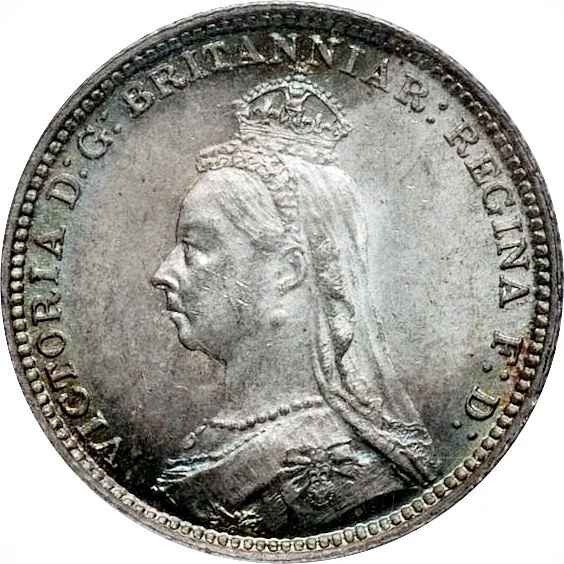
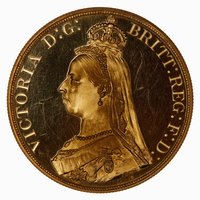
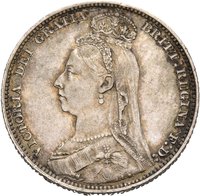
Queen Victoria crowned and veiled left profile, with surrounding legend.
Inscription:
VICTORIA D:G: BRITANNIAR: REGINA F:D:
Translation:
Victoria by the Grace of God, Queen of the Britains, Defender of the Faith.
Script: Latin
Language: Latin
Engraver: Leonard Charles Wyon
Designer: Joseph Edgar Boehm
Reverse
Description:
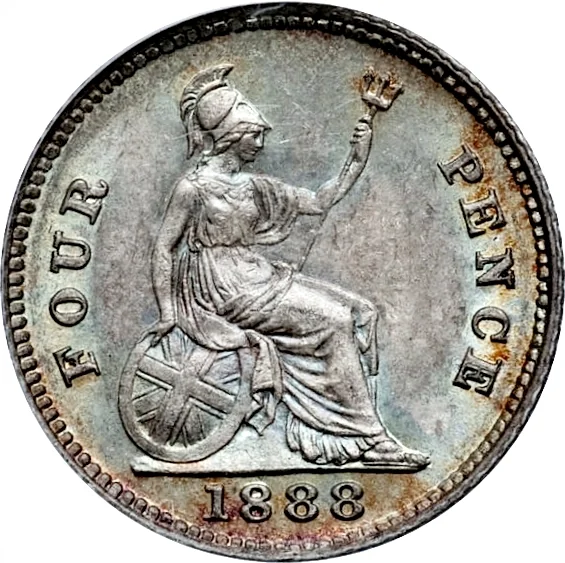
Britannia seated right, holding trident and shield with Union flag, denomination around, date below.
Inscription:
FOUR PENCE
1888
1888
Script: Latin
Edge
Reeded
Categories
| Object> Armour |
| Object> Cold weapons |
Mints
| Name | Mark |
|---|---|
| Royal Mint (Tower Hill) | — |
Mintings
| Year | Mint Mark | Mintage | Quality | Collection |
|---|---|---|---|---|
| 1888 | — | 120,000 | ||
| 1888 | — | — | Proof |
Historical background
In 1888, the United Kingdom operated under the classical gold standard, a system it had effectively pioneered and which underpinned its global financial dominance. The pound sterling was legally defined as a specific weight of gold (approximately 7.3 grams), and Bank of England notes were freely convertible into gold coin upon demand. This convertibility created immense confidence in sterling, making it the world's premier reserve and trading currency. The system was largely automatic: international trade imbalances were settled in gold, influencing domestic money supply and price levels, which in turn were supposed to self-correct the imbalances.
Domestically, the currency in circulation was a mix of gold sovereigns and half-sovereigns, Bank of England notes (primarily for larger transactions), and, significantly, a vast array of private banknotes issued by commercial banks in England, Wales, Scotland, and Ireland under various regulations. While the Bank of England had a monopoly on note issuance in England and Wales from 1844, many older private banks retained issuing rights, and Scottish and Irish banks issued their own distinctive notes, all backed by and convertible into gold. This created a complex but generally stable monetary landscape centred on the gold anchor.
The period was one of remarkable monetary stability, with the value of the pound fixed in terms of gold and thus stable against other gold-backed currencies. However, this stability came with trade-offs, as the Bank of England's primary duty was to maintain gold reserves, often prioritising this over domestic economic concerns like unemployment. The system faced occasional strains, but in 1888, it was at its zenith, symbolising British economic power and providing a predictable environment for the vast international trade and investment flows of the British Empire. The debates that would later challenge the gold standard's rigidity were, at this time, largely confined to academic and fringe political circles.
Domestically, the currency in circulation was a mix of gold sovereigns and half-sovereigns, Bank of England notes (primarily for larger transactions), and, significantly, a vast array of private banknotes issued by commercial banks in England, Wales, Scotland, and Ireland under various regulations. While the Bank of England had a monopoly on note issuance in England and Wales from 1844, many older private banks retained issuing rights, and Scottish and Irish banks issued their own distinctive notes, all backed by and convertible into gold. This created a complex but generally stable monetary landscape centred on the gold anchor.
The period was one of remarkable monetary stability, with the value of the pound fixed in terms of gold and thus stable against other gold-backed currencies. However, this stability came with trade-offs, as the Bank of England's primary duty was to maintain gold reserves, often prioritising this over domestic economic concerns like unemployment. The system faced occasional strains, but in 1888, it was at its zenith, symbolising British economic power and providing a predictable environment for the vast international trade and investment flows of the British Empire. The debates that would later challenge the gold standard's rigidity were, at this time, largely confined to academic and fringe political circles.
⭐ Somewhat Rare