

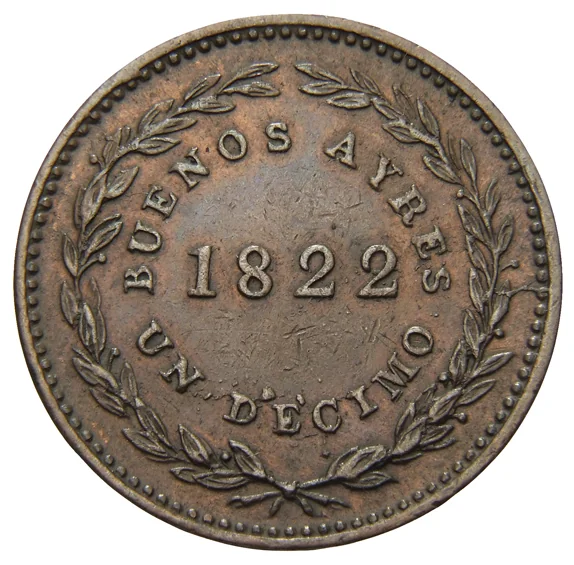
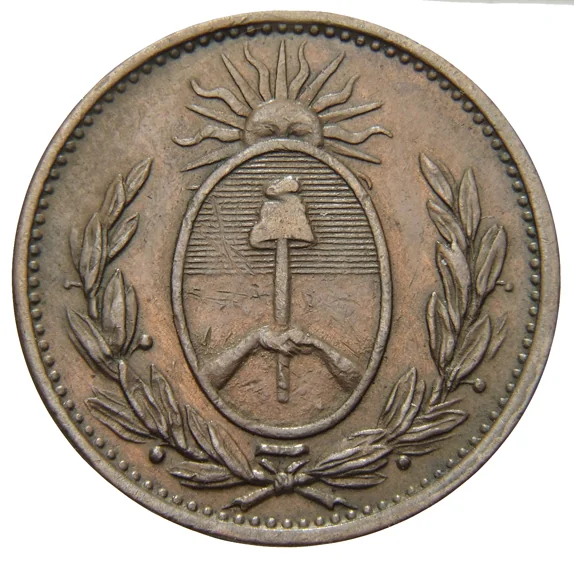
1 decimo de real – Buenos Aires
Add to wishlist
Argentina
Context
Years: 1822–1823
Country: Argentina
Issuer: Buenos Aires
Period:
(1810—1831)
Currency:
(1822—1861)
Demonetization: 1827
Material
References
KM: #
Numista: #4089
Obverse
Reverse
Description:
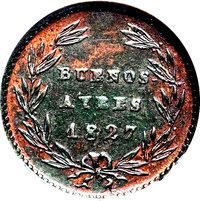
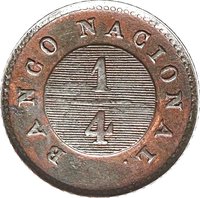
Arms: A radiant sun above a wreath.
Edge
Plain
Categories
| Symbol> Hand |
| Symbols> Coat of Arms |
| Symbol> Phrygian cap |
| Symbol> Sun |
| Symbol> Wreath |
Mints
| Name | Mark |
|---|---|
| Soho Mint | — |
Mintings
| Year | Mint Mark | Mintage | Quality | Collection |
|---|---|---|---|---|
| 1822 | — | — | ||
| 1823 | — | — |
Historical background
In 1822, Buenos Aires was grappling with a profound and chaotic currency crisis, a direct legacy of the independence wars and the collapse of Spanish colonial authority. The provincial government, led by Minister Bernardino Rivadavia, faced empty coffers and immense debts from the military campaigns. To finance the war effort and early state functions, successive governments had resorted to printing vast quantities of paper money, known as pesos fuertes or "patacones," without any metallic backing. This led to severe inflation and a disastrous loss of public confidence, creating a wide and volatile gap between the value of paper money and scarce silver coin.
The situation was characterized by a disruptive monetary duality. While daily transactions were conducted in the depreciating paper notes, international trade and significant contracts were anchored to silver pesos fuertes. This created a complex system of exchange rates that fluctuated wildly, harming commerce and creating social tension. The government's attempts to stabilize the currency, including short-lived loans and mandates to accept paper at face value, failed to address the core issue of oversupply and lack of fiscal discipline. The result was an economy where the real value of salaries and savings eroded rapidly, causing widespread economic uncertainty.
Against this backdrop, the year 1822 was a pivotal moment of attempted reform. Rivadavia, influenced by British financial models, established the Banco de Buenos Aires (later the Banco de la Provincia de Buenos Aires). Its central mission was to absorb the circulating paper money and replace it with new, convertible banknotes, theoretically redeemable for precious metal. While a bold institutional step toward order, the bank's success was immediately hampered by the government's continued need for funds, leading to new loans and note issues that undermined the promised convertibility. Thus, 1822 represents not a resolution, but the beginning of a long and fraught struggle to establish monetary stability in the nascent Argentine state.
The situation was characterized by a disruptive monetary duality. While daily transactions were conducted in the depreciating paper notes, international trade and significant contracts were anchored to silver pesos fuertes. This created a complex system of exchange rates that fluctuated wildly, harming commerce and creating social tension. The government's attempts to stabilize the currency, including short-lived loans and mandates to accept paper at face value, failed to address the core issue of oversupply and lack of fiscal discipline. The result was an economy where the real value of salaries and savings eroded rapidly, causing widespread economic uncertainty.
Against this backdrop, the year 1822 was a pivotal moment of attempted reform. Rivadavia, influenced by British financial models, established the Banco de Buenos Aires (later the Banco de la Provincia de Buenos Aires). Its central mission was to absorb the circulating paper money and replace it with new, convertible banknotes, theoretically redeemable for precious metal. While a bold institutional step toward order, the bank's success was immediately hampered by the government's continued need for funds, leading to new loans and note issues that undermined the promised convertibility. Thus, 1822 represents not a resolution, but the beginning of a long and fraught struggle to establish monetary stability in the nascent Argentine state.
🌱 Common