

Denmark
Context
Year: 1868
Issuer: Denmark 
Ruler: Christian IX
Currency:
(1854—1873)
Subdivision: ½ Skilling Rigsmont = 1⁄32 Rigsdaler courant = 1⁄192 Rigsdaler
Demonetized: Yes
Material
References
KM: #Click to copy to clipboard776
Numista: #40838
Obverse
Description:
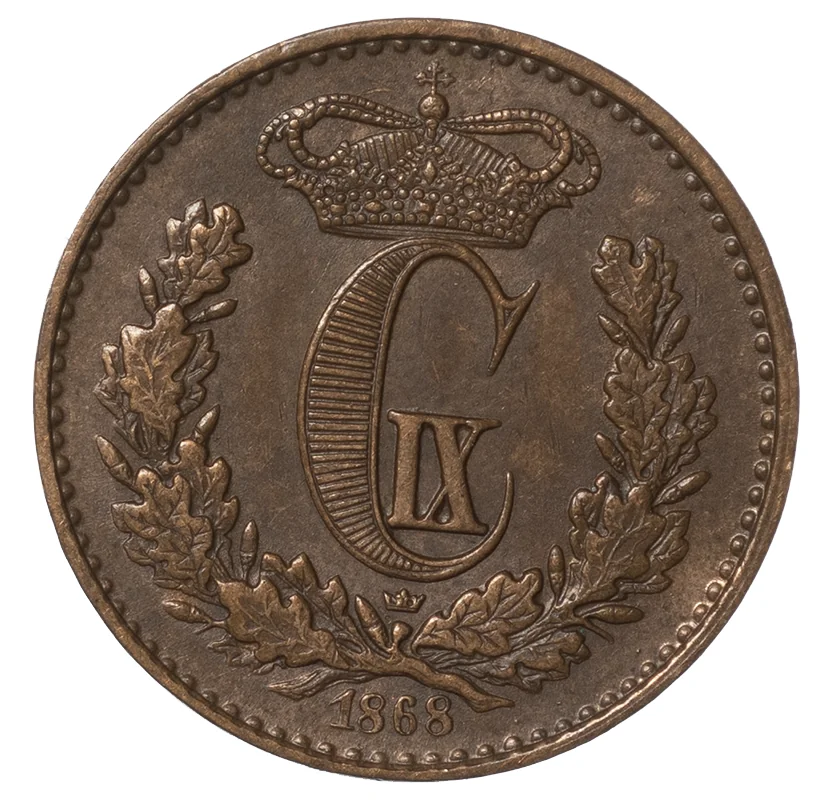
King's crowned monogram above an oak leaf half-wreath, with mintmark below. Date at the bottom.
Inscription:
C IX
1868
1868
Script: Latin
Reverse
Description:
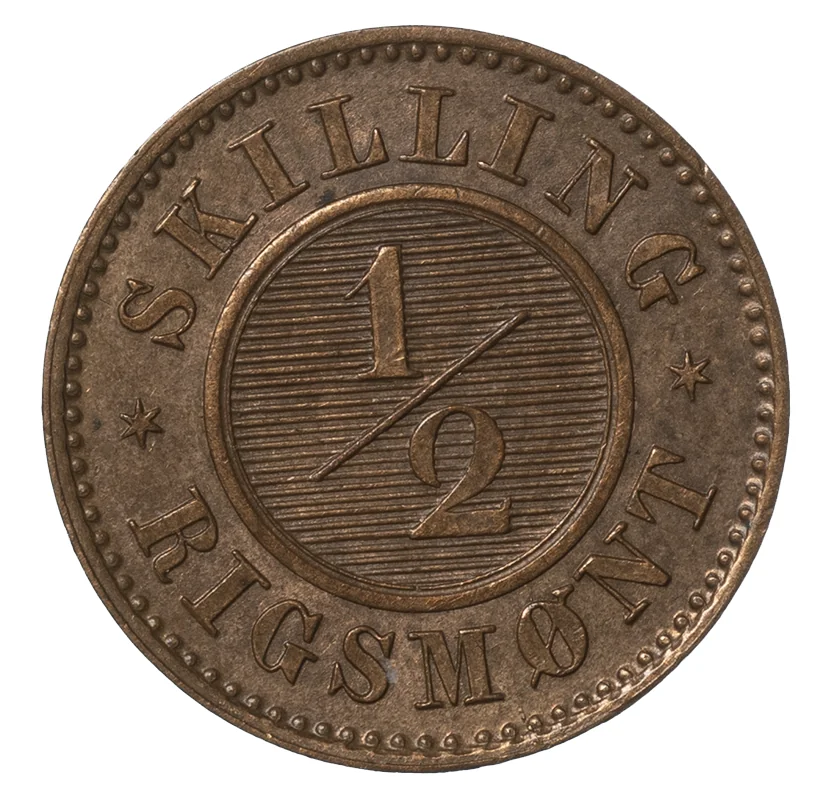
Circle with horizontal line and number inside, letters outside.
Inscription:
1/2
🟌 SKILLING 🟌 RIGSMONT 🟌
🟌 SKILLING 🟌 RIGSMONT 🟌
Script: Latin
Edge
Plain
Mints
| Name | Mark |
|---|---|
| Royal Danish Mint | ♔ |
Mintings
| Year | Mint Mark | Mintage | Quality | Collection |
|---|---|---|---|---|
| 1868 | ♔ | — |
Historical background
In 1868, Denmark operated under the silver standard, having formally adopted it with the Currency Act of 1854. This law established the rigsdaler as the national unit of account, divided into 96 skilling, and pegged its value to a specific quantity of fine silver. The system was a response to the monetary chaos of the earlier 19th century, providing much-needed stability. However, a significant complication arose from the concurrent circulation of older, depreciated paper money known as kurantrigsdaler, which traded at a discount to the silver rigsdaler. This created a de facto dual-currency system that complicated commerce and accounting.
The international monetary landscape was beginning to shift during this period, with the discovery of large silver reserves causing its value to fluctuate relative to gold. While the great European scramble for the gold standard would accelerate in the 1870s, Denmark in 1868 was still firmly committed to silver. The country's monetary policy was conservative, focused on maintaining the integrity of its silver coinage and managing the gradual retirement of the old paper notes. This stability was crucial for post-war reconstruction and economic development following the significant territorial losses of the Second Schleswig War in 1864.
Consequently, the Danish currency situation in 1868 was one of orderly transition and hard-money orthodoxy. The state was successfully consolidating the monetary system around the silver rigsdaler, laying a stable foundation for trade and industry. This period of silver-based stability would, however, be relatively short-lived, as the impending global shift to gold would soon force Denmark, along with the rest of Scandinavia, to re-evaluate its monetary foundations in the following decade.
The international monetary landscape was beginning to shift during this period, with the discovery of large silver reserves causing its value to fluctuate relative to gold. While the great European scramble for the gold standard would accelerate in the 1870s, Denmark in 1868 was still firmly committed to silver. The country's monetary policy was conservative, focused on maintaining the integrity of its silver coinage and managing the gradual retirement of the old paper notes. This stability was crucial for post-war reconstruction and economic development following the significant territorial losses of the Second Schleswig War in 1864.
Consequently, the Danish currency situation in 1868 was one of orderly transition and hard-money orthodoxy. The state was successfully consolidating the monetary system around the silver rigsdaler, laying a stable foundation for trade and industry. This period of silver-based stability would, however, be relatively short-lived, as the impending global shift to gold would soon force Denmark, along with the rest of Scandinavia, to re-evaluate its monetary foundations in the following decade.
🌟 Uncommon