

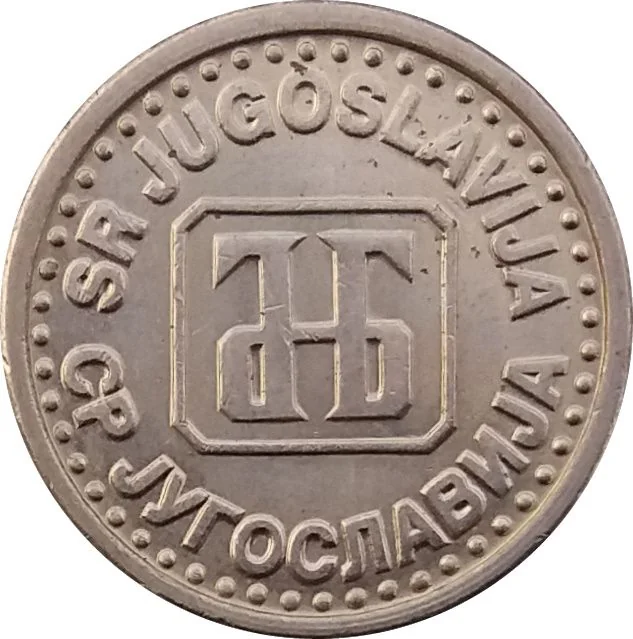
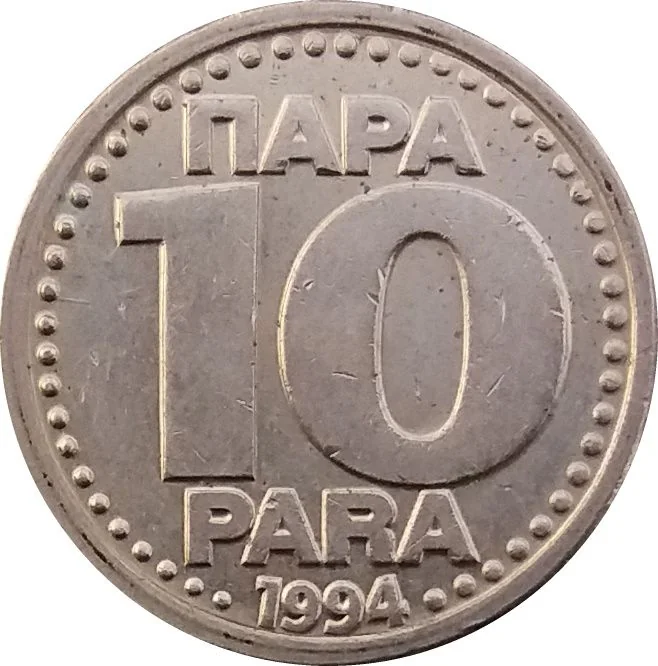
10 paras – Yugoslavia
Add to wishlist
Context
Year: 1994
Issuer: Yugoslavia
Period:
(1992—2003)
Currency:
(1994—2003)
Demonetized: Yes
Total mintage: 52,161,000
Material
Diameter: 18 mm
Weight: 3.38 g
Thickness: 1.6 mm
Shape: Round
Composition: Nickel brass
Magnetic: No
Technique: Milled
Alignment: Medal alignment
flip
References
KM: #
Numista: #4080
Value
Exchange value: 0.10 YUM
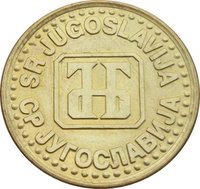
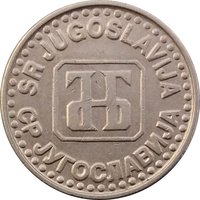
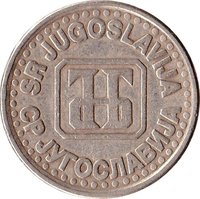
Obverse
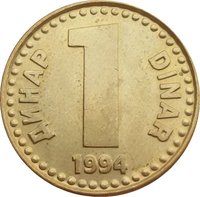
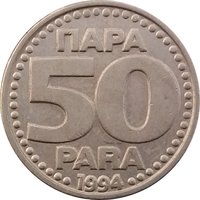
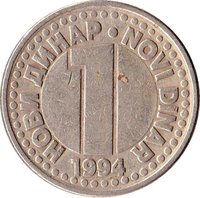
Reverse
Edge
Plain
Mintings
| Year | Mint Mark | Mintage | Quality | Collection |
|---|---|---|---|---|
| 1994 | — | 52,161,000 |
Historical background
In 1994, the Federal Republic of Yugoslavia (consisting of Serbia and Montenegro) was in the throes of a hyperinflationary collapse, marking one of the most severe monetary disasters in modern history. This crisis was the direct result of years of economic mismanagement, the devastating impact of international sanctions imposed due to the Balkan Wars, and the collapse of the internal Yugoslav market. The National Bank of Yugoslavia, effectively under the control of Slobodan Milošević's government, financed massive public spending and propped up failing state-owned enterprises by printing money with reckless abandon, utterly decimating the value of the dinar.
The scale of the inflation was astronomical, peaking in January 1994 at a staggering rate of 313 million percent per month. Prices doubled within hours, and the currency became virtually worthless, leading to a complete regression to barter trade and the widespread use of stable foreign currencies like the German Deutsche Mark for any meaningful transaction. The government issued a series of new dinar notes, each lopping zeros off the old currency, but these measures were merely cosmetic and failed to address the underlying fiscal indiscipline, causing public confidence in the dinar to evaporate entirely.
In response to this chaos, the government enacted a radical monetary reform on January 24, 1994, introducing the "novi dinar" (new dinar). This currency was uniquely pegged one-to-one to the Deutsche Mark and was theoretically backed by the National Bank's hard currency reserves and future government privatization revenues. The immediate effect was dramatic, halting hyperinflation in its tracks and restoring a degree of monetary stability. However, this stability was artificial and fragile, as it was not supported by fundamental fiscal reform or economic productivity, leaving the underlying structural problems of the Yugoslav economy unresolved.
The scale of the inflation was astronomical, peaking in January 1994 at a staggering rate of 313 million percent per month. Prices doubled within hours, and the currency became virtually worthless, leading to a complete regression to barter trade and the widespread use of stable foreign currencies like the German Deutsche Mark for any meaningful transaction. The government issued a series of new dinar notes, each lopping zeros off the old currency, but these measures were merely cosmetic and failed to address the underlying fiscal indiscipline, causing public confidence in the dinar to evaporate entirely.
In response to this chaos, the government enacted a radical monetary reform on January 24, 1994, introducing the "novi dinar" (new dinar). This currency was uniquely pegged one-to-one to the Deutsche Mark and was theoretically backed by the National Bank's hard currency reserves and future government privatization revenues. The immediate effect was dramatic, halting hyperinflation in its tracks and restoring a degree of monetary stability. However, this stability was artificial and fragile, as it was not supported by fundamental fiscal reform or economic productivity, leaving the underlying structural problems of the Yugoslav economy unresolved.
🌱 Very Common