

5 Dollars – United States
United States
Context
Years: 1834–1838
Issuer: United States 
Period:
(since 1776)
Currency:
(since 1785)
Total mintage: 1,456,152
Material
References
KM: #Click to copy to clipboard57
Numista: #40781
Value
Exchange value: 5 USD = $5.00
Bullion value: $1254.50
Obverse
Description:
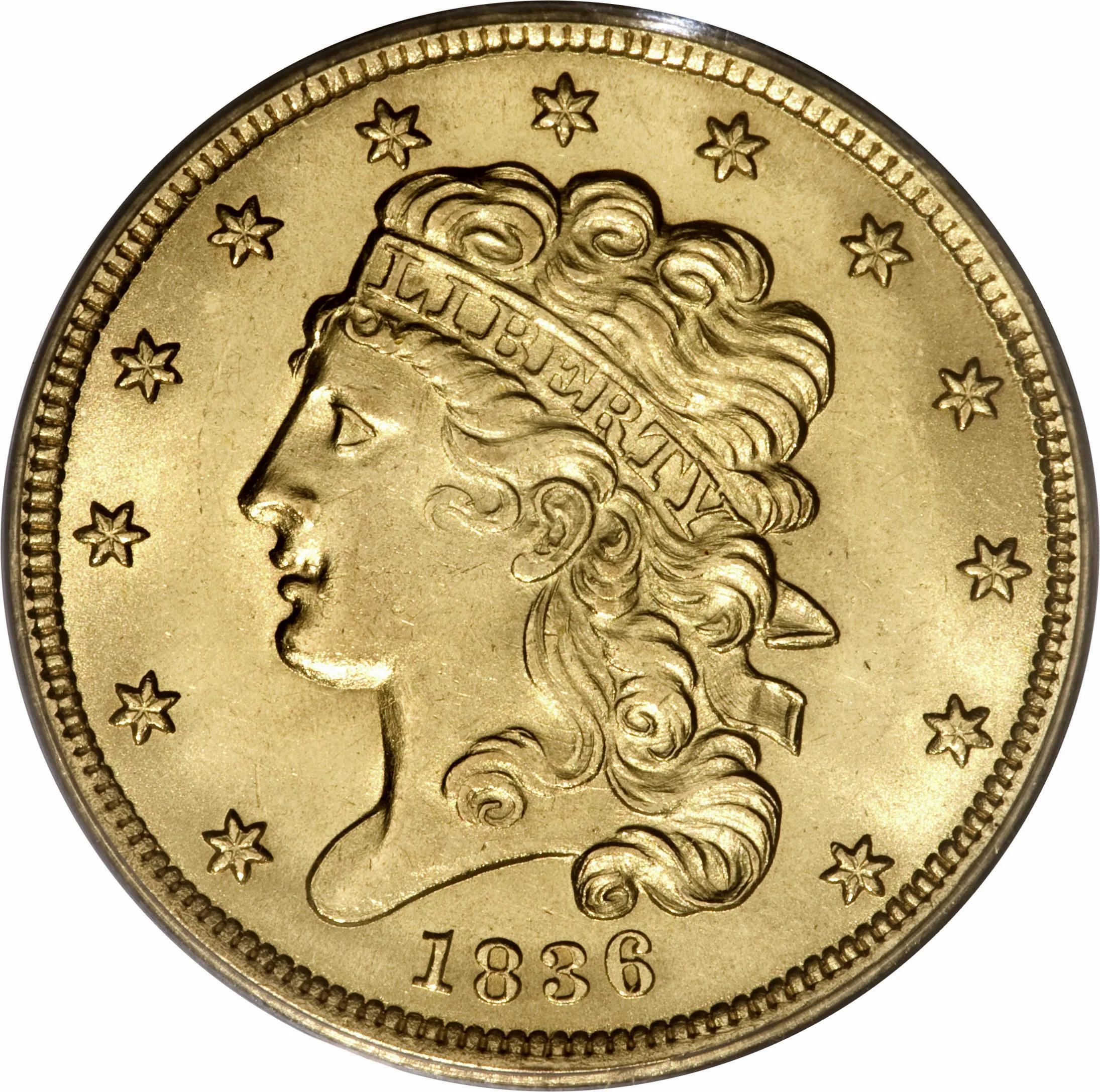
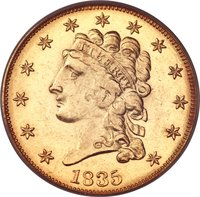
Liberty left, encircled by 13 stars, date below.
Inscription:
LIBERTY
1836
1836
Script: Latin
Engraver: William Kneass
Reverse
Description:
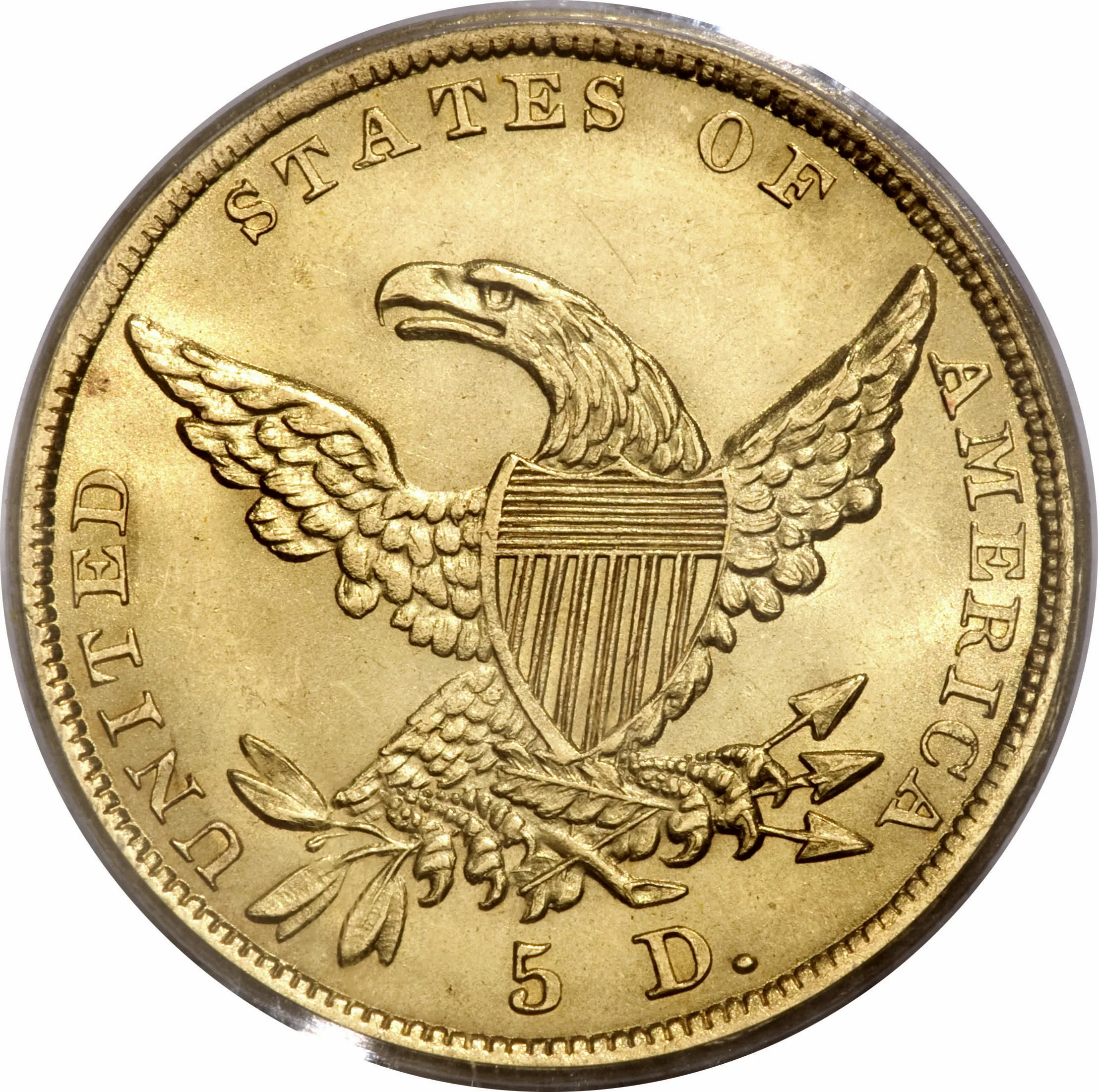
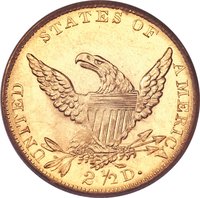
Eagle with U.S. shield, arrows, and olive branch.
Inscription:
UNITED STATES OF AMERICA
5 D.
5 D.
Script: Latin
Engraver: William Kneass
Edge
Reeded
Mints
| Name | Mark |
|---|---|
| United States Mint of Philadelphia | — |
| United States Mint of Charlotte | C |
| United States Mint of Dahlonega | D |
Mintings
Historical background
In 1834, the United States operated under a bimetallic standard, where both gold and silver were legal tender, but the system was dysfunctional. The Coinage Act of 1792 had established a fixed mint ratio of 15-to-1, meaning 15 ounces of silver were valued the same as 1 ounce of gold. However, the global market ratio had shifted to approximately 15.625-to-1, making gold officially overvalued at the U.S. Mint. Consequently, silver coins, being undervalued, were either exported or hoarded, leading to a practical scarcity of circulating specie. The nation's everyday currency was a chaotic mix of foreign coins (primarily Spanish silver), private banknotes of wildly varying reliability, and a limited supply of small U.S. coins.
President Andrew Jackson, deeply suspicious of paper money and centralized banking, sought to rectify this metallic shortage and undermine the Second Bank of the United States. The Coinage Act of 1834, driven by his allies in Congress, aimed to attract gold back into circulation by altering the mint ratio. The act revalued the gold eagle ($10 coin) and effectively changed the legal ratio to 16-to-1. This adjustment now slightly overvalued gold relative to the market, achieving its goal of drawing gold coins into domestic circulation. However, it further undervalued silver, effectively pushing the full-weight silver dollar out of circulation entirely and moving the U.S. toward a de facto gold standard.
The immediate aftermath of the 1834 act was a surge in gold coinage, which pleased Jackson's hard-money supporters. Yet, the legislation failed to create a stable, uniform currency. It exacerbated the flight of silver and did nothing to regulate the proliferating state banknotes that fueled land speculation. Combined with Jackson's subsequent withdrawal of federal deposits from the Second Bank and his distribution of surplus funds to state banks, the currency situation grew more volatile, setting the stage for the inflationary boom and catastrophic Panic of 1837. Thus, the 1834 currency "solution" addressed one metallic imbalance while contributing to broader financial instability.
President Andrew Jackson, deeply suspicious of paper money and centralized banking, sought to rectify this metallic shortage and undermine the Second Bank of the United States. The Coinage Act of 1834, driven by his allies in Congress, aimed to attract gold back into circulation by altering the mint ratio. The act revalued the gold eagle ($10 coin) and effectively changed the legal ratio to 16-to-1. This adjustment now slightly overvalued gold relative to the market, achieving its goal of drawing gold coins into domestic circulation. However, it further undervalued silver, effectively pushing the full-weight silver dollar out of circulation entirely and moving the U.S. toward a de facto gold standard.
The immediate aftermath of the 1834 act was a surge in gold coinage, which pleased Jackson's hard-money supporters. Yet, the legislation failed to create a stable, uniform currency. It exacerbated the flight of silver and did nothing to regulate the proliferating state banknotes that fueled land speculation. Combined with Jackson's subsequent withdrawal of federal deposits from the Second Bank and his distribution of surplus funds to state banks, the currency situation grew more volatile, setting the stage for the inflationary boom and catastrophic Panic of 1837. Thus, the 1834 currency "solution" addressed one metallic imbalance while contributing to broader financial instability.
💎 Very Rare