

1 Cent – United States
United States
Context
Years: 1835–1839
Issuer: United States 
Period:
(since 1776)
Currency:
(since 1785)
Total mintage: 14,039,200
Material
References
KM: #Click to copy to clipboard45.2
Numista: #19856
Value
Exchange value: 0.01 USD = $0.01
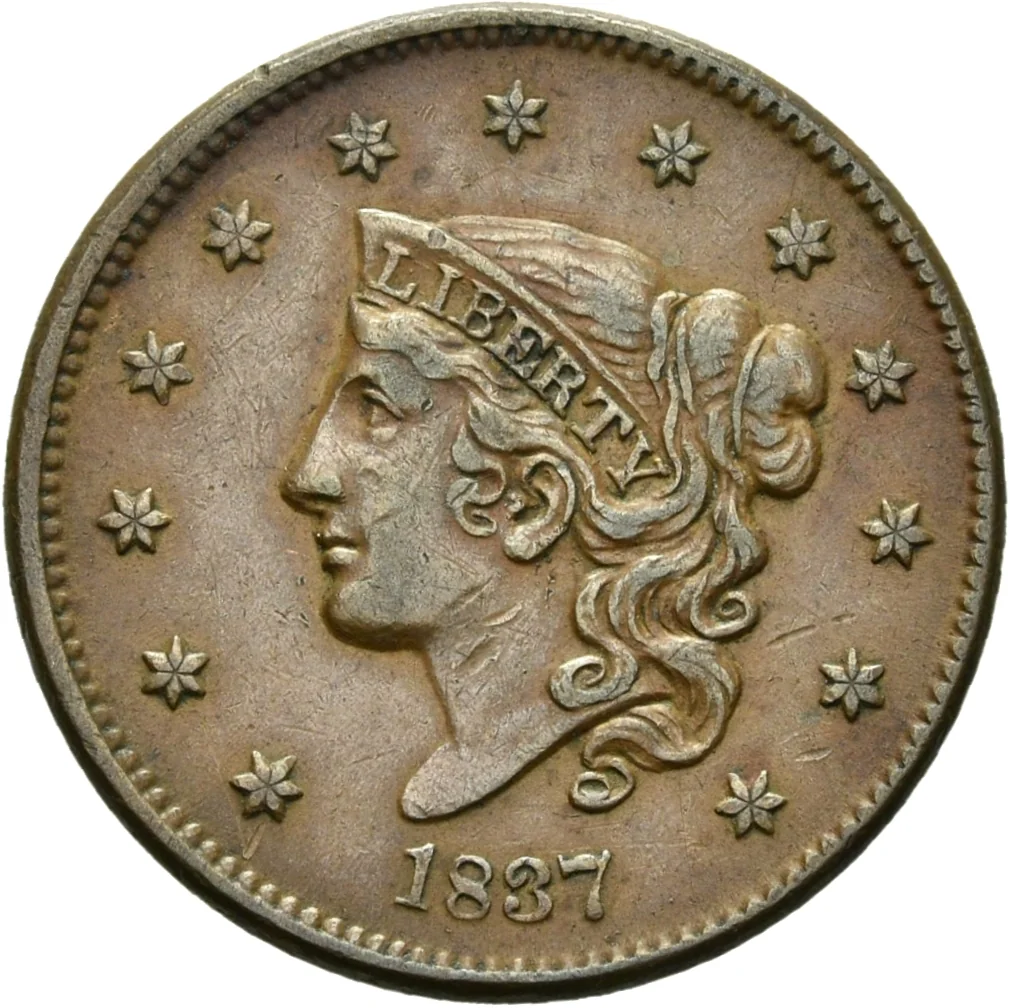
Obverse
Description:
Left-facing portrait, date beneath.
Inscription:
1837
Script: Latin
Engraver: Christian Gobrecht
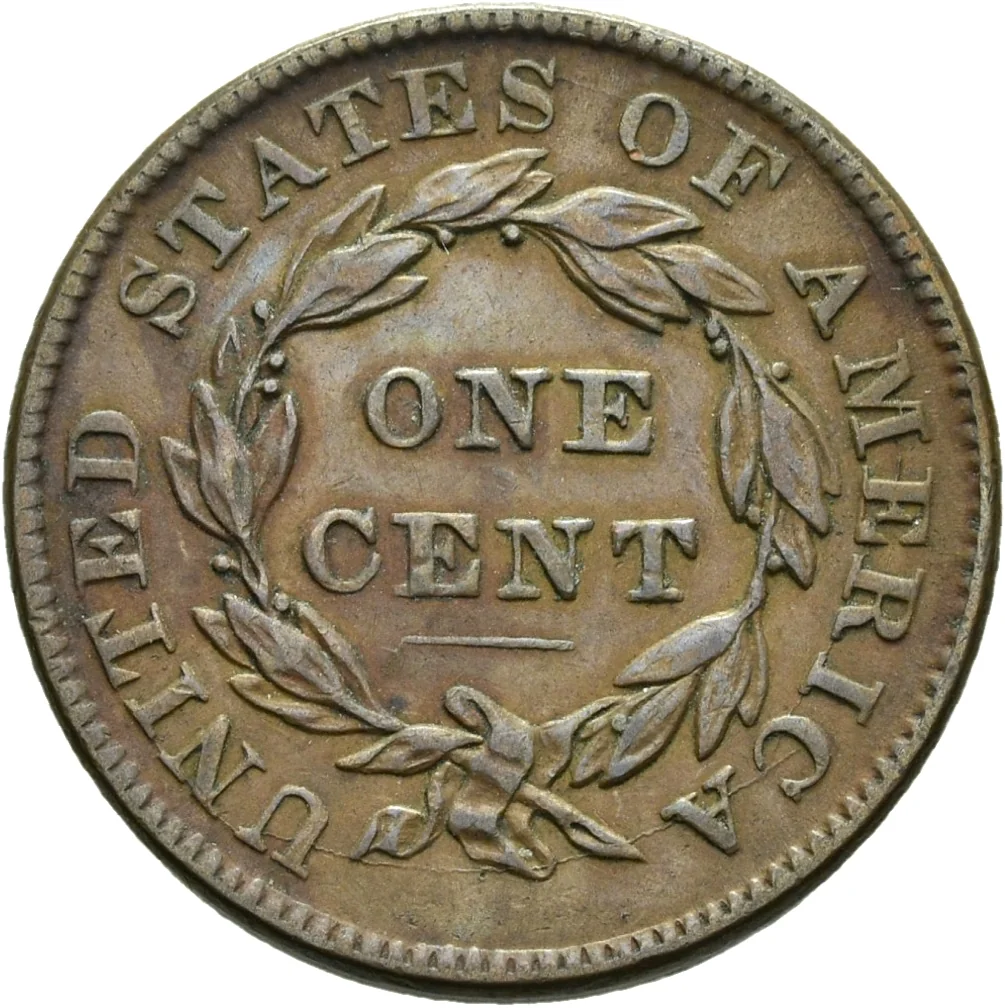
Reverse
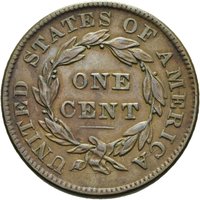
Description:
Denomination inside wreath, country name around rim.
Inscription:
UNITED STATES OF AMERICA
ONE CENT
ONE CENT
Script: Latin
Engraver: Christian Gobrecht
Edge
Plain
Mints
| Name | Mark |
|---|---|
| United States Mint of Philadelphia | — |
Mintings
| Year | Mint Mark | Mintage | Quality | Collection |
|---|---|---|---|---|
| 1835 | — | — | ||
| 1836 | — | 2,111,000 | ||
| 1837 | — | 5,558,000 | ||
| 1838 | — | 6,370,200 | ||
| 1839 | — | — |
Historical background
In 1835, the United States was in a period of significant monetary transition and expansion, operating under the framework of the Second Bank of the United States. The nation lacked a uniform federal paper currency; instead, money consisted primarily of gold and silver coins, supplemented by a vast and often chaotic array of paper banknotes issued by hundreds of state-chartered private banks. The Second Bank, with its federal charter, acted as a quasi-central bank, attempting to maintain monetary stability by regulating the volume of state bank notes in circulation and ensuring they were redeemable for specie (gold or silver). This system aimed to prevent the over-issuance of paper money and the inflation that had plagued earlier periods.
However, this stability was under direct political assault. President Andrew Jackson, a staunch opponent of the Bank whom he viewed as a corrupt and unconstitutional monopoly favoring elite interests, had vetoed the recharter of the Bank in 1832. By 1835, Jackson had successfully withdrawn all federal deposits from the institution, redistributing them to various state-chartered banks, which his critics derisively called "pet banks." This action effectively crippled the Second Bank’s regulatory power and unleashed a dramatic expansion of credit and state bank note issuance, as the "pet banks," flush with federal funds, lent money more freely.
Consequently, the currency situation in 1835 was one of precarious boom. The removal of federal restraints, combined with rampant speculation in western lands and a large influx of foreign capital, led to a rapid increase in the money supply and rising prices. While the economy appeared robust, the foundation was unstable. The proliferation of banknotes of varying and often dubious quality made commerce risky, as the public had to constantly assess the true value and redeemability of the paper they accepted. This volatile expansion set the stage for the severe economic contraction that would follow in the Panic of 1837, triggered when the bubble burst and banks could no longer redeem their notes for hard currency.
However, this stability was under direct political assault. President Andrew Jackson, a staunch opponent of the Bank whom he viewed as a corrupt and unconstitutional monopoly favoring elite interests, had vetoed the recharter of the Bank in 1832. By 1835, Jackson had successfully withdrawn all federal deposits from the institution, redistributing them to various state-chartered banks, which his critics derisively called "pet banks." This action effectively crippled the Second Bank’s regulatory power and unleashed a dramatic expansion of credit and state bank note issuance, as the "pet banks," flush with federal funds, lent money more freely.
Consequently, the currency situation in 1835 was one of precarious boom. The removal of federal restraints, combined with rampant speculation in western lands and a large influx of foreign capital, led to a rapid increase in the money supply and rising prices. While the economy appeared robust, the foundation was unstable. The proliferation of banknotes of varying and often dubious quality made commerce risky, as the public had to constantly assess the true value and redeemability of the paper they accepted. This volatile expansion set the stage for the severe economic contraction that would follow in the Panic of 1837, triggered when the bubble burst and banks could no longer redeem their notes for hard currency.
🌱 Common