

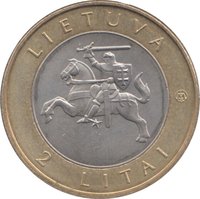
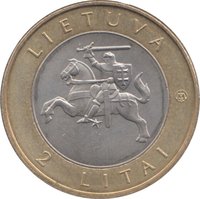
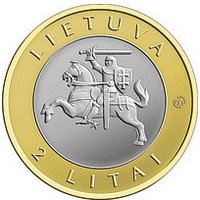
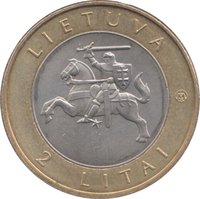
Obverse
Description:
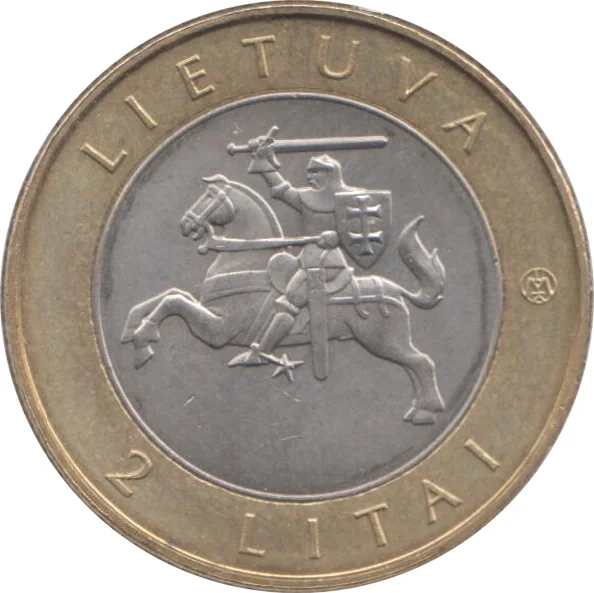
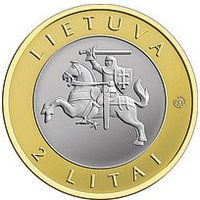
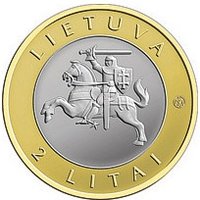
National emblem in circle
Inscription:
LIETUVA
LMK
2 LITAI
LMK
2 LITAI
Translation:
2 LITAS
Script: Latin
Languages: Lithuanian, English
Designer: Giedrius Paulauskis
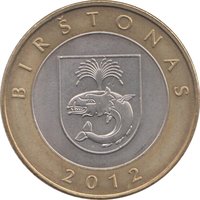
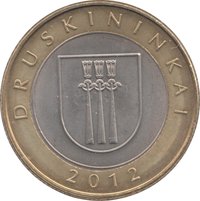
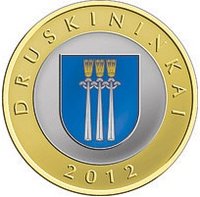
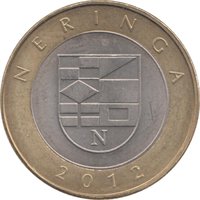
Reverse
Description:
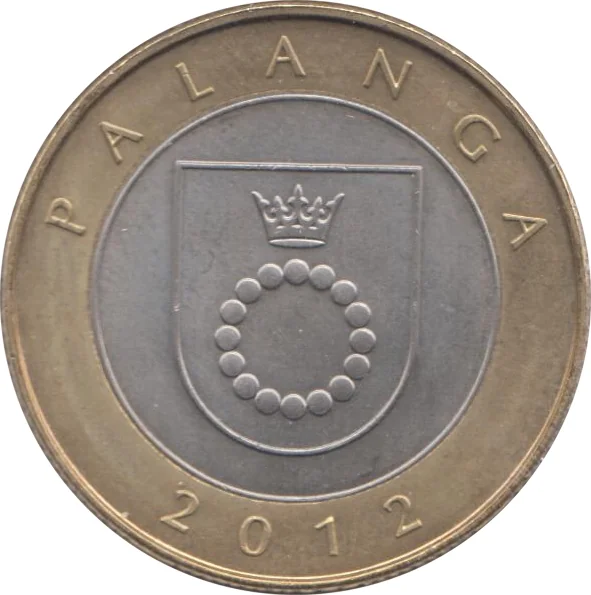
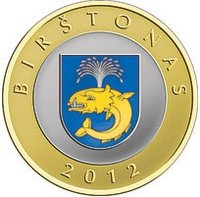
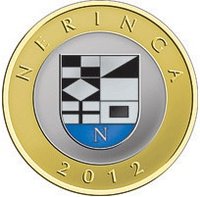
Palaga coat of arms encircled.
Inscription:
PALANGA
2012
2012
Script: Latin
Designer: Giedrius Paulauskis
Edge
Segmented reeding
Categories
| Symbols> Coat of Arms |
Mints
| Name | Mark |
|---|---|
| Lithuanian Mint | (LMK) |
Mintings
| Year | Mint Mark | Mintage | Quality | Collection |
|---|---|---|---|---|
| 2012 | LMK | 100,000 |
Historical background
In 2012, Lithuania was in the final stages of its strategic path towards adopting the euro, operating under a fixed exchange rate regime as part of the European Exchange Rate Mechanism II (ERM II). The country had pegged its currency, the litas (LTL), to the euro at a rate of 3.4528 since 2002, a move that provided crucial monetary stability, especially during the global financial crisis of 2008-2009. This unwavering peg was the cornerstone of Lithuania's economic policy, managed by the Bank of Lithuania, and was widely seen as a preparatory step for full eurozone membership. The primary focus for authorities was maintaining strict fiscal discipline and meeting the Maastricht convergence criteria, particularly controlling inflation, which had been a stumbling block in a previous 2007 application.
The year was characterized by careful economic calibration to satisfy the euro adoption requirements. After the severe recession, Lithuania's economy was recovering, but policymakers vigilantly guarded against inflationary pressures that could derail their euro ambitions. The fixed exchange rate limited independent monetary policy, meaning the central bank could not adjust interest rates for domestic needs, relying instead on fiscal measures and macroprudential tools to manage the economy. Public and political debate on euro adoption was active, with supporters arguing it would reduce transaction costs, eliminate currency risk, and solidify Lithuania's place in the European core, while opponents expressed concerns about perceived loss of sovereignty and potential for higher prices.
Ultimately, 2012 was a year of successful convergence. Lithuania met all the Maastricht criteria, and in July, the European Commission gave a positive assessment, setting the stage for a final decision. This successful navigation paved the way for the European Council's formal approval in 2013 for Lithuania to become the 19th eurozone member on January 1, 2015. Therefore, the currency situation in 2012 was one of a nation in a holding pattern, confidently maintaining its euro peg while meticulously fulfilling the last technical obligations to transition from a national currency to the single European currency.
The year was characterized by careful economic calibration to satisfy the euro adoption requirements. After the severe recession, Lithuania's economy was recovering, but policymakers vigilantly guarded against inflationary pressures that could derail their euro ambitions. The fixed exchange rate limited independent monetary policy, meaning the central bank could not adjust interest rates for domestic needs, relying instead on fiscal measures and macroprudential tools to manage the economy. Public and political debate on euro adoption was active, with supporters arguing it would reduce transaction costs, eliminate currency risk, and solidify Lithuania's place in the European core, while opponents expressed concerns about perceived loss of sovereignty and potential for higher prices.
Ultimately, 2012 was a year of successful convergence. Lithuania met all the Maastricht criteria, and in July, the European Commission gave a positive assessment, setting the stage for a final decision. This successful navigation paved the way for the European Council's formal approval in 2013 for Lithuania to become the 19th eurozone member on January 1, 2015. Therefore, the currency situation in 2012 was one of a nation in a holding pattern, confidently maintaining its euro peg while meticulously fulfilling the last technical obligations to transition from a national currency to the single European currency.
Series: Lithuanian Resorts
🌱 Common