

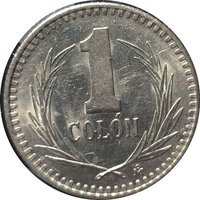
1 Colón – El Salvador
El Salvador
Context
Years: 1984–1985
Issuer: El Salvador 
Issuing organization: Central Reserve Bank of El Salvador
Period:
(since 1841)
Currency:
(since 1892)
Demonetization: 1 January 2001
Total mintage: 30,000,000
Material
References
KM: #Click to copy to clipboard153
Numista: #4055
Value
Exchange value: 1 SVC
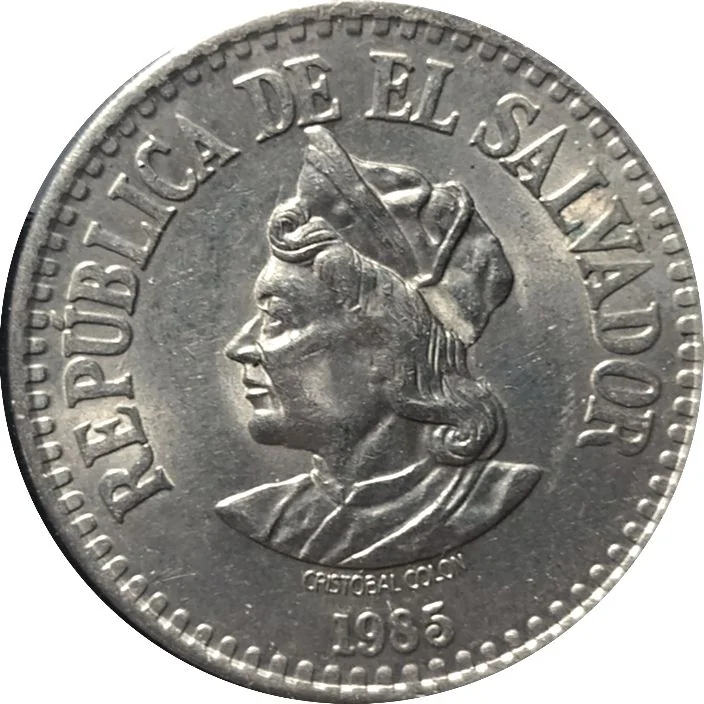
Obverse
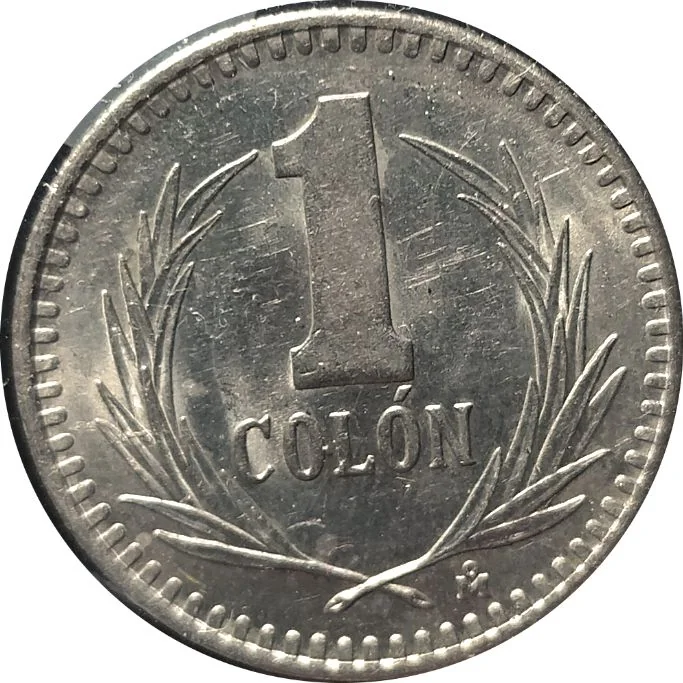
Reverse
Edge
Reeded
Mints
| Name | Mark |
|---|---|
| Mexican Mint | (Mo) |
Mintings
| Year | Mint Mark | Mintage | Quality | Collection |
|---|---|---|---|---|
| 1984 | Mo | 10,000,000 | ||
| 1984 | Mo | — | Proof | |
| 1985 | Mo | 20,000,000 | ||
| 1985 | Mo | — | Proof |
Historical background
In 1984, El Salvador was in the midst of a devastating civil war, and its currency situation was characterized by severe instability and devaluation. The economic foundation was crippled by conflict, which destroyed infrastructure, displaced populations, and diverted resources to military spending. This context led to rampant inflation, a large fiscal deficit, and a heavy reliance on U.S. economic aid to prevent total collapse. The official currency, the colón, was under intense pressure, with its value being artificially maintained by the government at a fixed exchange rate.
The government of President José Napoleón Duarte operated a multi-tiered exchange rate system, a common tool in economic crises. The most important rate was the official fixed rate of 2.5 colónes to the U.S. dollar, used for essential imports like oil, medicine, and food. However, a parallel, much less favorable free market rate existed for all other transactions, where the colón traded at a significant discount, reflecting its true weakened value. This system created distortions, encouraged a black market for dollars, and masked the currency's rapid loss of purchasing power for ordinary Salvadorans.
Ultimately, the currency situation of 1984 was unsustainable. The fixed rate drained central bank reserves, as the government sold dollars far cheaper than their market value. This policy, combined with the war's destruction, led to a profound economic crisis. The following year, in 1985, the government was forced to implement a major devaluation, abandoning the 2.5:1 peg and unifying the exchange rates—a stark admission that the colón's official value was a fiction unsustainable amidst the realities of war and economic mismanagement.
The government of President José Napoleón Duarte operated a multi-tiered exchange rate system, a common tool in economic crises. The most important rate was the official fixed rate of 2.5 colónes to the U.S. dollar, used for essential imports like oil, medicine, and food. However, a parallel, much less favorable free market rate existed for all other transactions, where the colón traded at a significant discount, reflecting its true weakened value. This system created distortions, encouraged a black market for dollars, and masked the currency's rapid loss of purchasing power for ordinary Salvadorans.
Ultimately, the currency situation of 1984 was unsustainable. The fixed rate drained central bank reserves, as the government sold dollars far cheaper than their market value. This policy, combined with the war's destruction, led to a profound economic crisis. The following year, in 1985, the government was forced to implement a major devaluation, abandoning the 2.5:1 peg and unifying the exchange rates—a stark admission that the colón's official value was a fiction unsustainable amidst the realities of war and economic mismanagement.
🌱 Common