

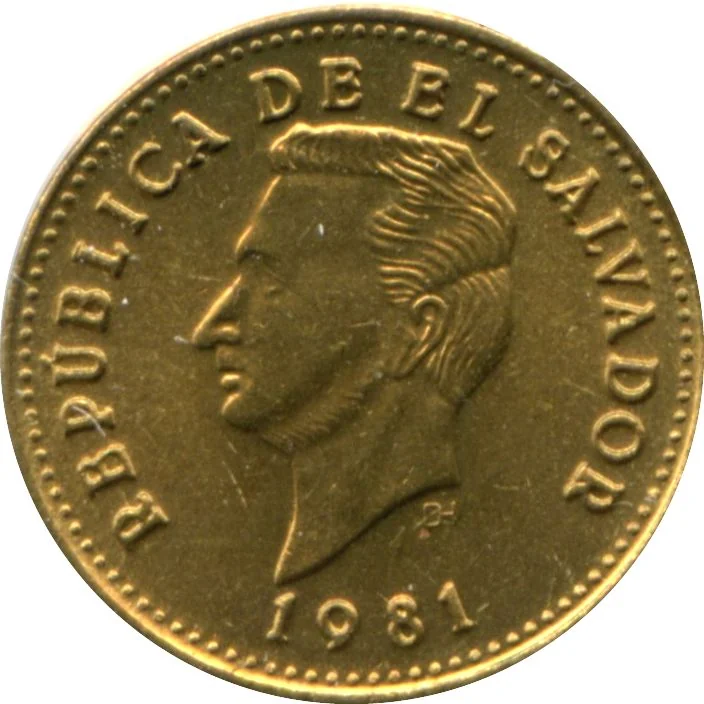
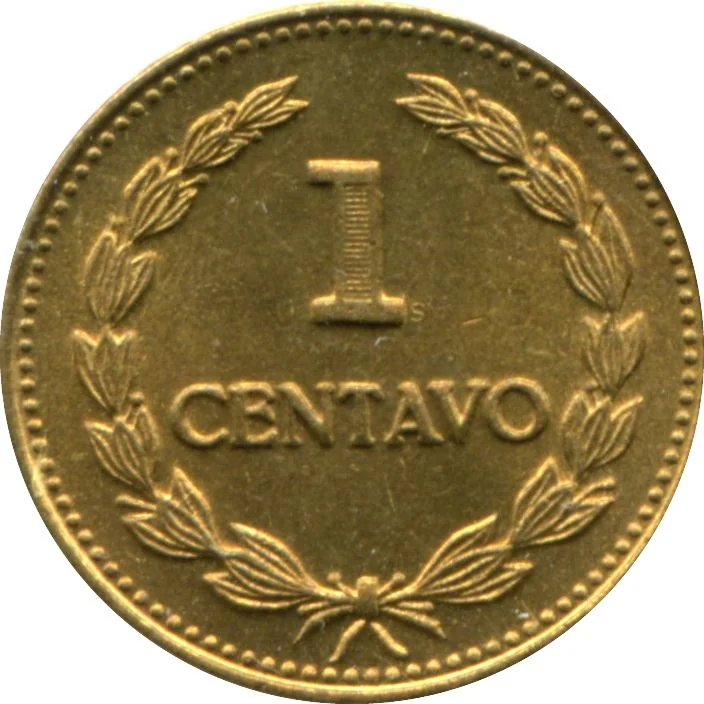
1 Centavo – El Salvador
El Salvador
Context
Year: 1981
Issuer: El Salvador 
Issuing organization: Central Reserve Bank of El Salvador
Period:
(since 1841)
Currency:
(since 1892)
Demonetization: 1 January 2001
Total mintage: 50,000,000
Material
References
KM: #Click to copy to clipboard135.2a
Numista: #9703
Value
Exchange value: 0.01 SVC
Obverse
Reverse
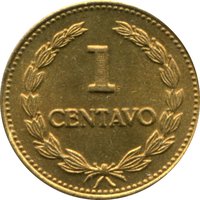
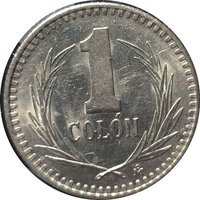
Description:
Value in wreath; tiny SM at right.
Inscription:
1 SM
CENTAVO
CENTAVO
Script: Latin
Engraver: Mirsa Soto
Edge
Plain
Categories
| Symbol> Wreath |
| Symbols> Coat of Arms |
Mints
| Name | Mark |
|---|---|
| Casa de Moneda de Guatemala | — |
Mintings
| Year | Mint Mark | Mintage | Quality | Collection |
|---|---|---|---|---|
| 1981 | — | 50,000,000 |
Historical background
In 1981, El Salvador's currency situation was deeply unstable, reflecting the nation's profound political and economic crisis. The country was embroiled in a brutal civil war between the U.S.-backed military government and leftist guerrilla factions, which devastated infrastructure, displaced populations, and crippled economic production. This conflict, coupled with long-standing structural inequalities and falling prices for key agricultural exports like coffee and sugar, led to severe fiscal deficits, capital flight, and rampant inflation. The economic chaos was both a cause and a consequence of the wider social unrest.
The official currency was the Salvadoran colón, which was pegged to the U.S. dollar at a fixed exchange rate of 2.5 colones to 1 dollar. However, this peg was increasingly artificial and unsustainable. The central bank's foreign reserves were being rapidly depleted to maintain the fixed rate in the face of overwhelming economic pressures. A parallel black market for foreign exchange flourished, where the U.S. dollar traded at a significant premium, highlighting the lack of confidence in the national currency and the government's economic management.
Ultimately, the currency regime of 1981 was on borrowed time. The fixed exchange rate acted as a straitjacket, limiting monetary policy options while failing to curb inflation or restore confidence. The situation demanded a drastic choice between implementing severe austerity to defend the peg or abandoning it to devalue the currency. This precarious financial backdrop intensified the nation's turmoil, setting the stage for the major economic reforms and currency devaluations that would follow in the mid-1980s as the war continued to rage.
The official currency was the Salvadoran colón, which was pegged to the U.S. dollar at a fixed exchange rate of 2.5 colones to 1 dollar. However, this peg was increasingly artificial and unsustainable. The central bank's foreign reserves were being rapidly depleted to maintain the fixed rate in the face of overwhelming economic pressures. A parallel black market for foreign exchange flourished, where the U.S. dollar traded at a significant premium, highlighting the lack of confidence in the national currency and the government's economic management.
Ultimately, the currency regime of 1981 was on borrowed time. The fixed exchange rate acted as a straitjacket, limiting monetary policy options while failing to curb inflation or restore confidence. The situation demanded a drastic choice between implementing severe austerity to defend the peg or abandoning it to devalue the currency. This precarious financial backdrop intensified the nation's turmoil, setting the stage for the major economic reforms and currency devaluations that would follow in the mid-1980s as the war continued to rage.
🌱 Common