

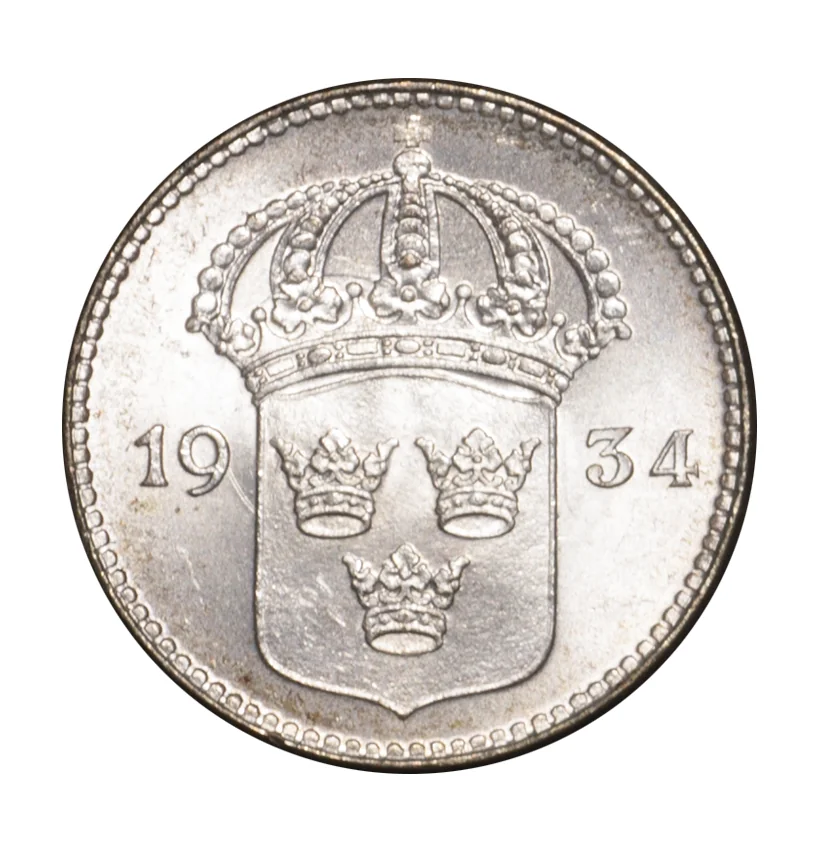
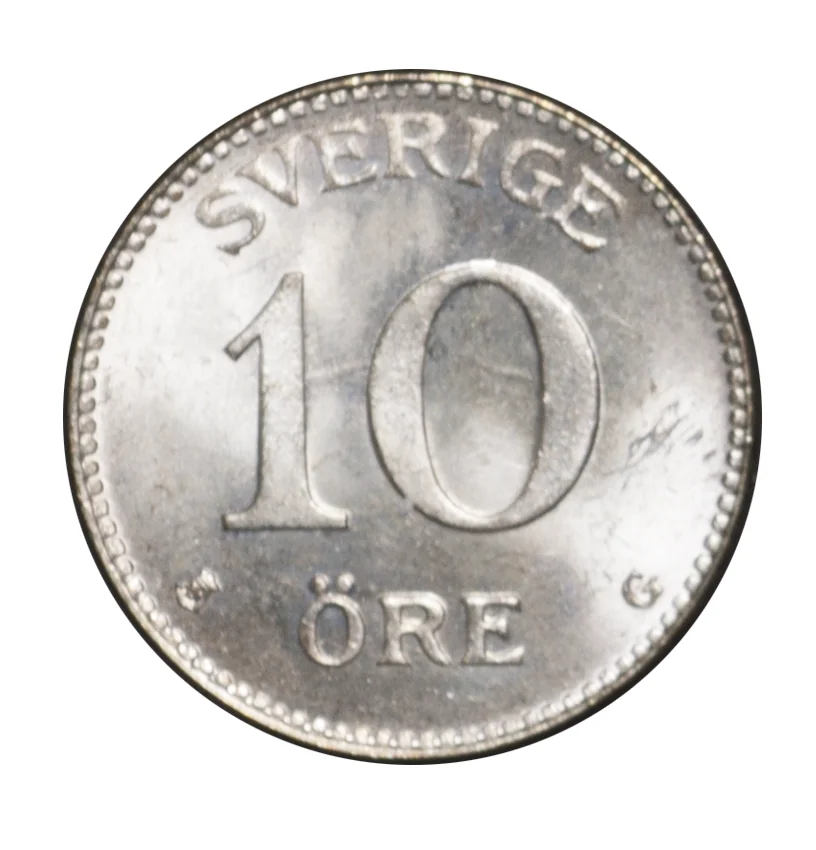
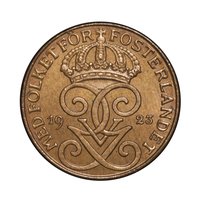
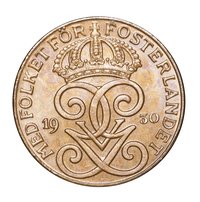
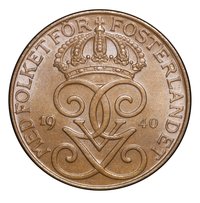
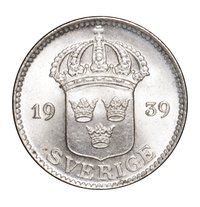
Obverse
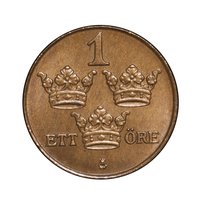
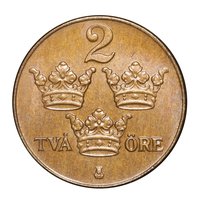
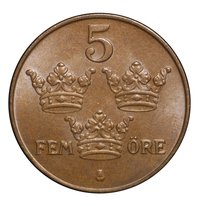
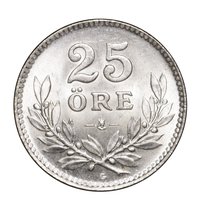
Reverse
Edge
Plain
Mints
| Name | Mark |
|---|---|
| Kungliga Myntet | — |
Mintings
| Year | Mint Mark | Mintage | Quality | Collection |
|---|---|---|---|---|
| 1909 | — | 1,610,460 | ||
| 1911 | — | 3,180,650 | ||
| 1913 | — | 1,580,900 | ||
| 1914 | — | 1,571,330 | ||
| 1915 | — | 1,546,950 | ||
| 1916 | — | 3,034,880 | ||
| 1917 | — | 4,996,139 | ||
| 1918 | — | 4,114,180 | ||
| 1919 | — | 5,737,020 | ||
| 1927 | — | 2,509,590 | ||
| 1928 | — | 2,901,183 | ||
| 1929 | — | 5,505,200 | ||
| 1930 | — | 3,222,713 | ||
| 1931 | — | 4,272,073 | ||
| 1933 | — | 1,948,090 | ||
| 1934 | — | 4,059,293 | ||
| 1935 | — | 2,426,283 | ||
| 1936 | — | — | ||
| 1937 | — | 5,116,920 | ||
| 1938 | — | 7,428,140 | ||
| 1938 | — | — | Proof | |
| 1939 | — | — | Proof | |
| 1939 | — | 2,020,670 | ||
| 1940 | — | 3,017,320 | ||
| 1941 | — | 9,106,380 | ||
| 1942 | — | 3,691,640 |
Historical background
In 1909, Sweden operated under the classical gold standard, a system it had adhered to since 1873. This meant the Swedish krona (kronor) had a fixed value defined by a specific quantity of gold, ensuring domestic price stability and facilitating predictable international trade. The Riksbank, Sweden's central bank, was legally obligated to exchange banknotes for gold upon demand, which anchored the entire monetary system. This framework was widely seen as a cornerstone of economic credibility and was shared by most major industrial powers of the era.
However, this stability existed against a backdrop of significant domestic social and economic tension. The period leading up to 1909 was marked by rapid industrialization, a growing labour movement, and stark inequalities. These pressures culminated in the Great Strike of 1909 (Den stora strejken), a massive, month-long general strike involving over 300,000 workers. This unprecedented social conflict caused major economic disruption but, crucially, did not directly trigger a monetary crisis. The gold standard held firm, and there was no run on the Riksbank's gold reserves, demonstrating the system's perceived robustness even during severe domestic upheaval.
Looking forward, the currency situation was on the cusp of profound change. The outbreak of World War I in 1914 would soon force Sweden, like other nations, to suspend gold convertibility to preserve its bullion reserves, ending the era of the classical gold standard. Thus, the 1909 landscape represents the final chapter of an unwavering pre-war monetary orthodoxy, a system that provided a stable—though inflexible—foundation even as the society it served was being convulsed by the forces of modern industrial conflict.
However, this stability existed against a backdrop of significant domestic social and economic tension. The period leading up to 1909 was marked by rapid industrialization, a growing labour movement, and stark inequalities. These pressures culminated in the Great Strike of 1909 (Den stora strejken), a massive, month-long general strike involving over 300,000 workers. This unprecedented social conflict caused major economic disruption but, crucially, did not directly trigger a monetary crisis. The gold standard held firm, and there was no run on the Riksbank's gold reserves, demonstrating the system's perceived robustness even during severe domestic upheaval.
Looking forward, the currency situation was on the cusp of profound change. The outbreak of World War I in 1914 would soon force Sweden, like other nations, to suspend gold convertibility to preserve its bullion reserves, ending the era of the classical gold standard. Thus, the 1909 landscape represents the final chapter of an unwavering pre-war monetary orthodoxy, a system that provided a stable—though inflexible—foundation even as the society it served was being convulsed by the forces of modern industrial conflict.
Series: 1909 Sweden circulation coins
🌱 Very Common