

2 Denars – North Macedonia
North Macedonia
Context
Years: 1993–2014
Issuer: North Macedonia 
Period:
(since 1993)
Currency:
(since 1993)
Total mintage: 20,670,000
Material
References
KM: #Click to copy to clipboard3
Numista: #4028
Value
Exchange value: 2 MKD
Obverse
Description:
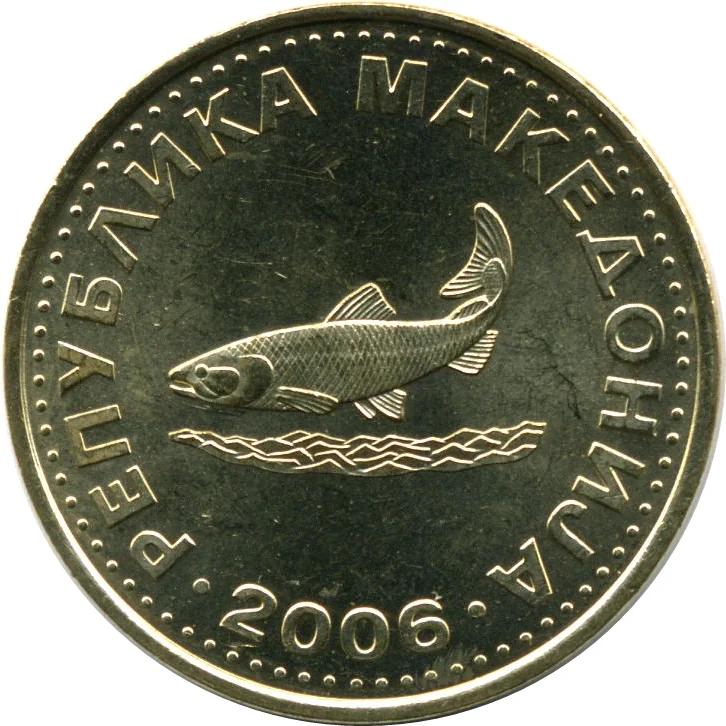
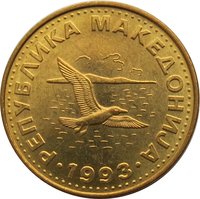
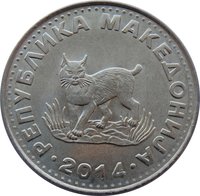
Ohrid trout, an endemic species, above country name and below date.
Inscription:
РЕПУБЛИКА МАКЕДОНИJА
• 2006 •
• 2006 •
Translation:
REPUBLIC OF MACEDONIA
• 2006 •
• 2006 •
Script: Cyrillic
Language: Macedonian
Engraver: Biljana Unkovska
Reverse
Description:
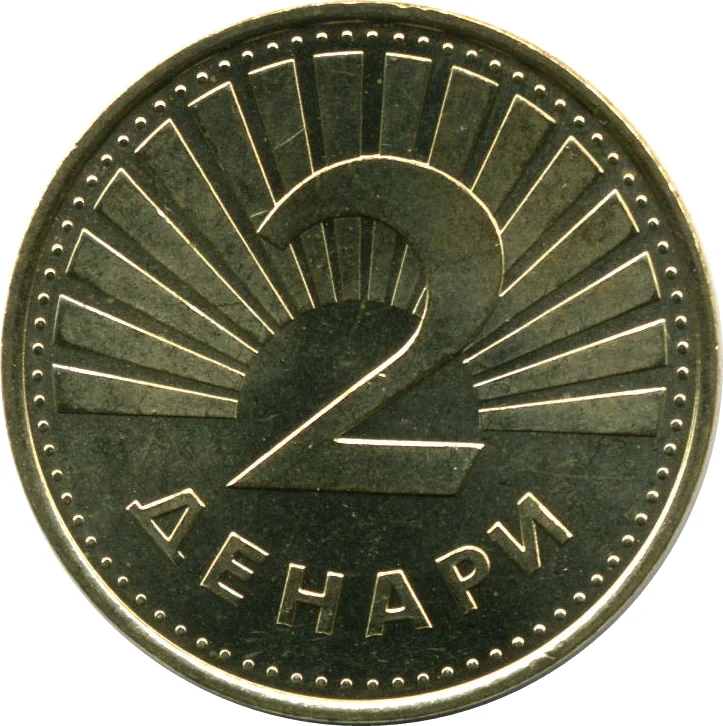
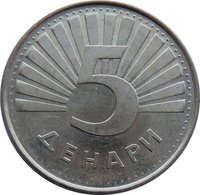
Radiant worth
Inscription:
2
ДЕНАРИ
ДЕНАРИ
Translation:
Denarius
Script: Cyrillic
Language: Russian
Engraver: Biljana Unkovska
Edge
Plain
Mints
| Name | Mark |
|---|---|
| Fabrika Suvenir | — |
Mintings
| Year | Mint Mark | Mintage | Quality | Collection |
|---|---|---|---|---|
| 1993 | — | 8,998,000 | ||
| 2001 | — | 11,672,000 | ||
| 2006 | — | — | ||
| 2008 | — | — | ||
| 2014 | — | — |
Historical background
In 1993, the Republic of Macedonia (officially recognized at the UN under the provisional reference "The former Yugoslav Republic of Macedonia") was navigating its first full year of independence amidst the turbulent dissolution of Yugoslavia. Its monetary situation was defined by a critical transition. Having left the Yugoslav dinar zone, which was collapsing under hyperinflation, the country introduced a temporary national currency, the Macedonian denar (MKD), in April 1992. However, this first iteration was not a stable, independent currency but a "coupon" or interim currency, pegged 1:1 to the last stable Yugoslav dinar, intended as a stopgap measure.
The primary challenge throughout 1993 was severe inflation, inherited from the Yugoslav breakdown and exacerbated by the shocks of independence. These included the loss of the Yugoslav market, a United Nations embargo on Serbia (affecting a major trading partner), and the cost of building new state institutions. The National Bank of the Republic of Macedonia struggled to maintain monetary control, and inflation surged, eroding savings and purchasing power. This period was characterized by a reliance on the interim denar while authorities prepared a comprehensive monetary reform.
Consequently, 1993 served as the final preparatory phase for a fundamental monetary overhaul. The government and central bank used the year to build the necessary institutional framework and accumulate foreign currency reserves. This groundwork culminated in May 1994, when a new, permanent Macedonian denar was introduced, replacing the interim currency at a rate of 100 old denars to 1 new denar. This redenomination, coupled with a strict stabilization program, was the decisive step in taming hyperinflation and establishing true monetary sovereignty.
The primary challenge throughout 1993 was severe inflation, inherited from the Yugoslav breakdown and exacerbated by the shocks of independence. These included the loss of the Yugoslav market, a United Nations embargo on Serbia (affecting a major trading partner), and the cost of building new state institutions. The National Bank of the Republic of Macedonia struggled to maintain monetary control, and inflation surged, eroding savings and purchasing power. This period was characterized by a reliance on the interim denar while authorities prepared a comprehensive monetary reform.
Consequently, 1993 served as the final preparatory phase for a fundamental monetary overhaul. The government and central bank used the year to build the necessary institutional framework and accumulate foreign currency reserves. This groundwork culminated in May 1994, when a new, permanent Macedonian denar was introduced, replacing the interim currency at a rate of 100 old denars to 1 new denar. This redenomination, coupled with a strict stabilization program, was the decisive step in taming hyperinflation and establishing true monetary sovereignty.
🌱 Very Common