

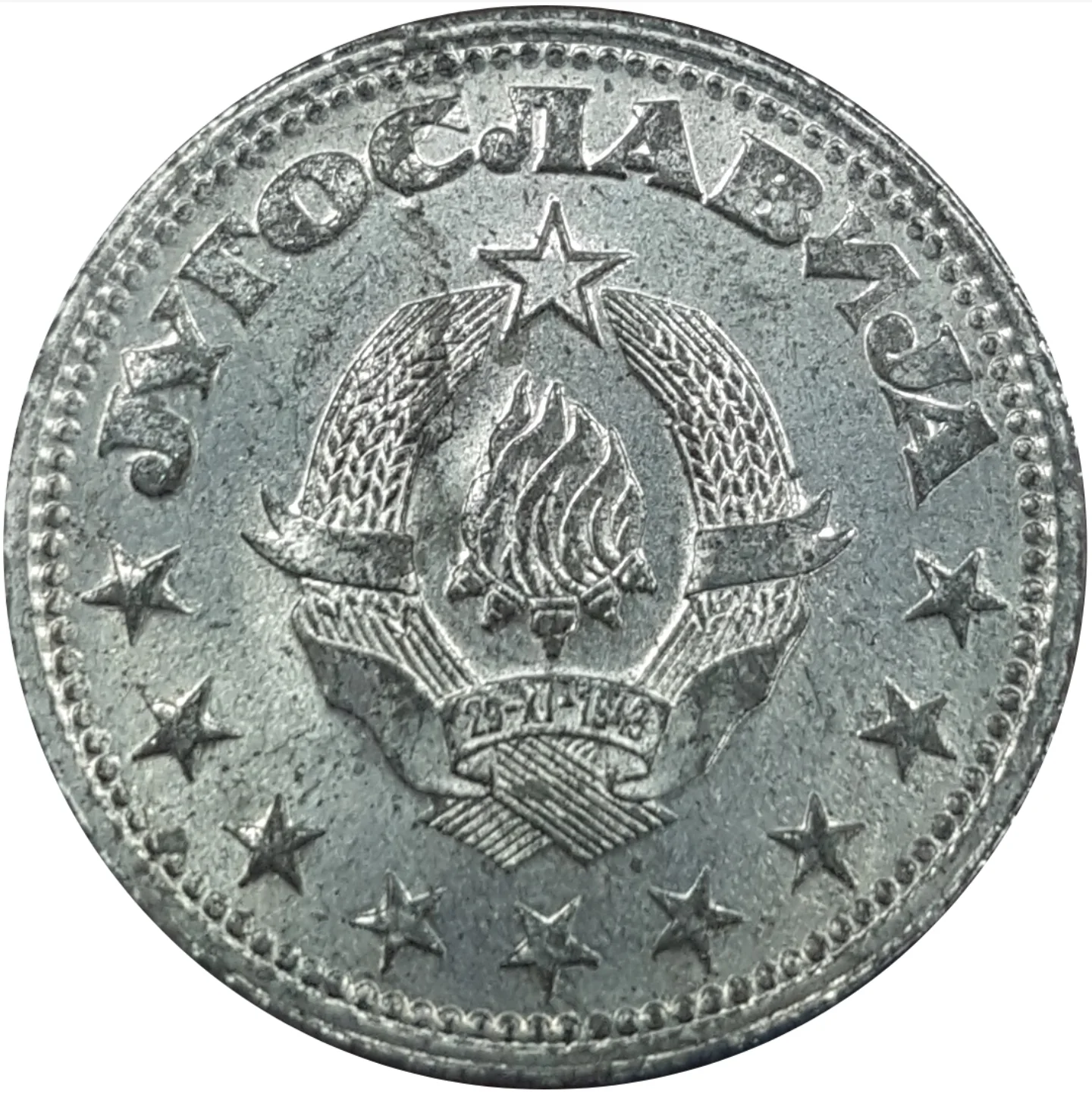
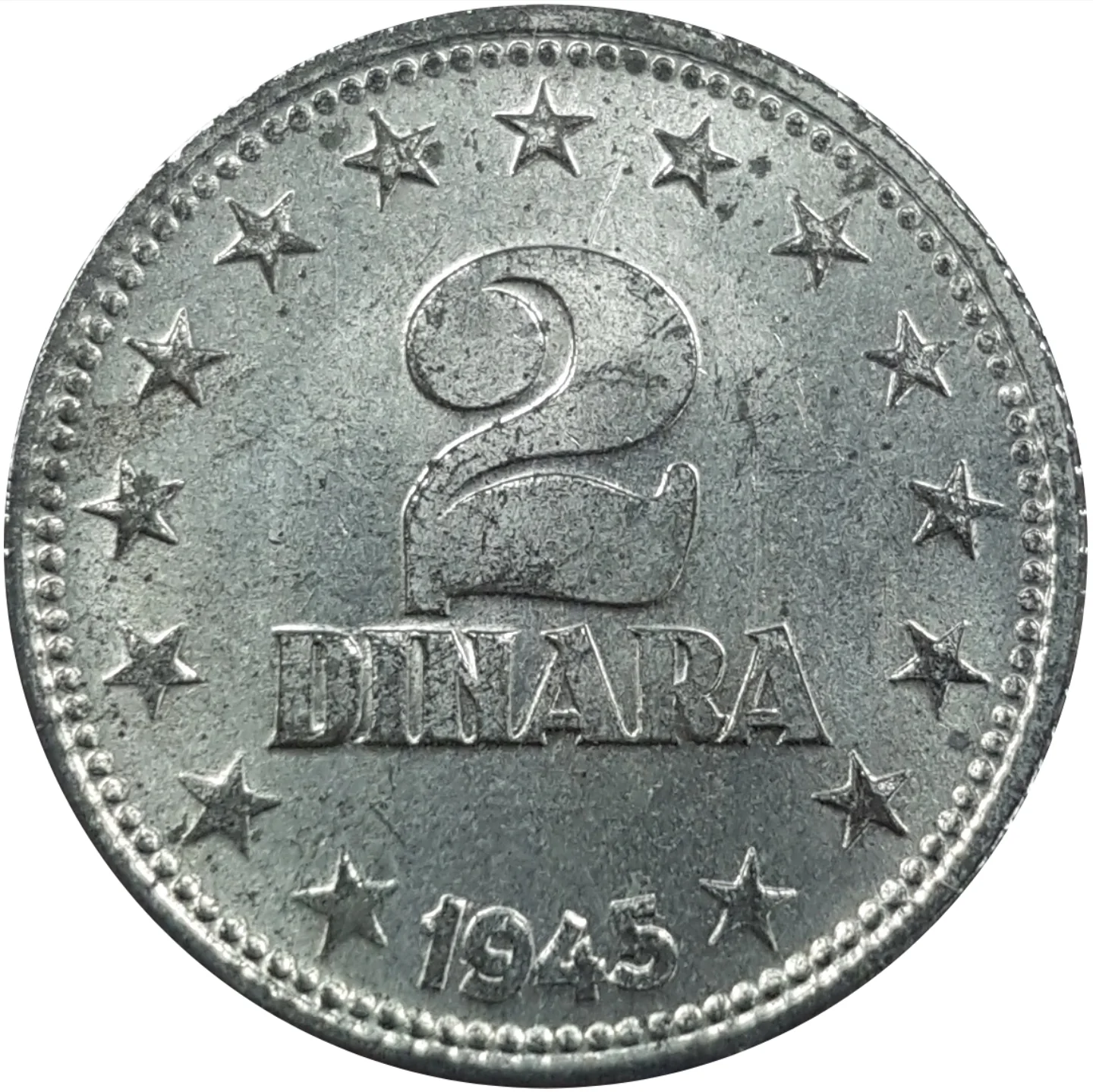
2 dinars – Yugoslavia
Add to wishlist
Context
Year: 1945
Issuer: Yugoslavia
Period:
(1943—1945)
Currency:
(1944—1965)
Demonetization: 31 December 1956
Total mintage: 70,000,000
Material
References
KM: #
Numista: #4026
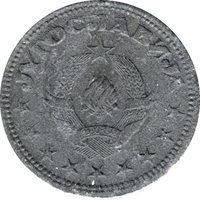
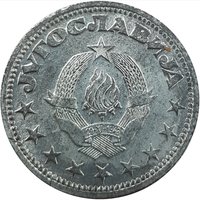
Obverse
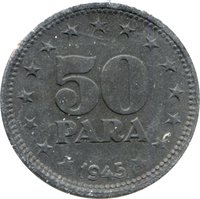
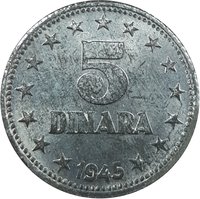
Reverse
Edge
Reeded
Categories
| Symbols> Coat of Arms |
Mints
| Name | Mark |
|---|---|
| Belgrade | — |
Mintings
| Year | Mint Mark | Mintage | Quality | Collection |
|---|---|---|---|---|
| 1945 | — | 70,000,000 |
Historical background
Following the liberation of Yugoslavia in 1945, the new communist government under Josip Broz Tito inherited a catastrophic monetary situation. The country was devastated by war, with industrial output at a fraction of pre-war levels, and it suffered from hyperinflation caused by years of occupation and competing currencies. The fascist Ustaše regime in Croatia, the Serbian collaborationist government, and the various occupying forces (German, Italian, Hungarian, and Bulgarian) had all issued their own banknotes, creating a chaotic and devalued monetary landscape alongside pre-war Yugoslav dinars.
To assert control and symbolize a radical break with the past, the new authorities undertook a swift and decisive currency reform in April 1945. The government declared all former banknotes invalid, replacing them with a new Yugoslav dinar. This was not a simple exchange; it was a politically charged measure designed to wipe out the wealth of collaborators, war profiteers, and the old bourgeoisie. The conversion rates were highly discriminatory: holdings of old currency by ordinary citizens were exchanged at a modest rate, while larger sums, presumed to be the fruit of collaboration or speculation, were either exchanged at a far worse rate or confiscated entirely.
This draconian reform successfully stabilized the currency in the short term and provided the state with crucial capital for reconstruction. However, it also served as a key instrument of socialist revolution, effectively destroying the existing financial structure and facilitating the nationalization of the economy. The 1945 reform laid the foundation for a state-controlled monetary system, though it came at a significant cost to many private savers and established the model for future, less successful, monetary reforms in socialist Yugoslavia.
To assert control and symbolize a radical break with the past, the new authorities undertook a swift and decisive currency reform in April 1945. The government declared all former banknotes invalid, replacing them with a new Yugoslav dinar. This was not a simple exchange; it was a politically charged measure designed to wipe out the wealth of collaborators, war profiteers, and the old bourgeoisie. The conversion rates were highly discriminatory: holdings of old currency by ordinary citizens were exchanged at a modest rate, while larger sums, presumed to be the fruit of collaboration or speculation, were either exchanged at a far worse rate or confiscated entirely.
This draconian reform successfully stabilized the currency in the short term and provided the state with crucial capital for reconstruction. However, it also served as a key instrument of socialist revolution, effectively destroying the existing financial structure and facilitating the nationalization of the economy. The 1945 reform laid the foundation for a state-controlled monetary system, though it came at a significant cost to many private savers and established the model for future, less successful, monetary reforms in socialist Yugoslavia.
🌱 Very Common