

Denmark
Context
Year: 1857
Issuer: Denmark 
Ruler: Frederick VII
Currency:
(1854—1873)
Subdivision: ½ Skilling Rigsmont = 1⁄32 Rigsdaler courant = 1⁄192 Rigsdaler
Demonetized: Yes
Material
References
KM: #Click to copy to clipboard767
Numista: #40131
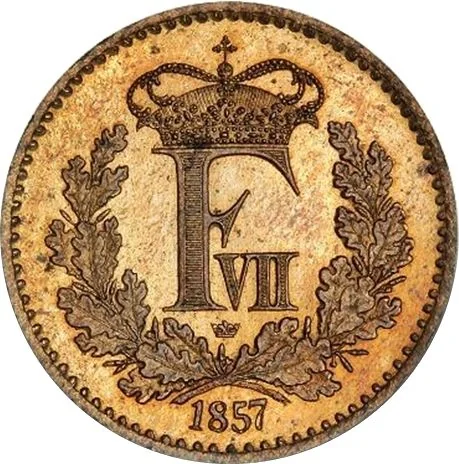
Obverse
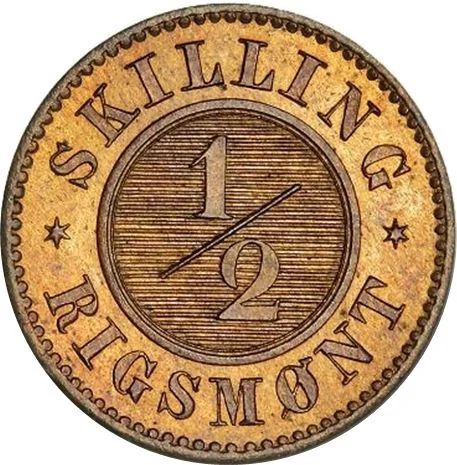
Reverse
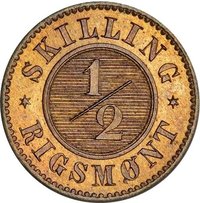
Description:
Circle with horizontal line and number inside, letters outside.
Inscription:
1/2
🟌 SKILLING 🟌 RIGSMONT 🟌
🟌 SKILLING 🟌 RIGSMONT 🟌
Script: Latin
Edge
Plain
Mints
| Name | Mark |
|---|---|
| Altona, Schleswig-Holstein | ♁ |
| Royal Danish Mint | ♔ |
Historical background
In 1857, Denmark found itself at a critical juncture in its monetary history, caught between two competing currency systems. Since the 1840s, the country had officially operated on a silver standard (the rigsdaler), but in practice, a parallel gold standard was gaining dominance due to international trade. The Danish state bank, Nationalbanken, founded in 1818, issued notes redeemable in silver, yet major commercial banks and the public increasingly conducted large transactions using gold-based currencies like the British sovereign. This created a complex and unstable bimetallic environment where the fluctuating market values of gold and silver caused uncertainty for merchants, bankers, and the state.
The immediate catalyst for change was a severe international financial crisis in 1857, which originated in the United States and quickly spread to Europe, impacting Copenhagen—a significant Baltic trading hub. The crisis exposed the vulnerabilities of Denmark's dual system, straining liquidity and highlighting the need for a modern, unified currency to stabilize the economy and facilitate clearer trade relations. Furthermore, the neighboring German states and much of the commercial world were moving towards the gold standard, making Denmark's adherence to silver increasingly inconvenient for foreign exchange and economic integration.
Consequently, the crisis accelerated legislative action. In early 1858, the Danish government passed a law formally adopting the gold standard, effective from January 1859. This law defined the new currency, the krone, in terms of gold and demonetized silver for large transactions, decisively aligning Denmark with the emerging international monetary order. Thus, the turmoil of 1857 served as the final push to resolve the longstanding currency duality, setting Denmark on a stable monetary path for the decades to come.
The immediate catalyst for change was a severe international financial crisis in 1857, which originated in the United States and quickly spread to Europe, impacting Copenhagen—a significant Baltic trading hub. The crisis exposed the vulnerabilities of Denmark's dual system, straining liquidity and highlighting the need for a modern, unified currency to stabilize the economy and facilitate clearer trade relations. Furthermore, the neighboring German states and much of the commercial world were moving towards the gold standard, making Denmark's adherence to silver increasingly inconvenient for foreign exchange and economic integration.
Consequently, the crisis accelerated legislative action. In early 1858, the Danish government passed a law formally adopting the gold standard, effective from January 1859. This law defined the new currency, the krone, in terms of gold and demonetized silver for large transactions, decisively aligning Denmark with the emerging international monetary order. Thus, the turmoil of 1857 served as the final push to resolve the longstanding currency duality, setting Denmark on a stable monetary path for the decades to come.
🌱 Fairly Common