

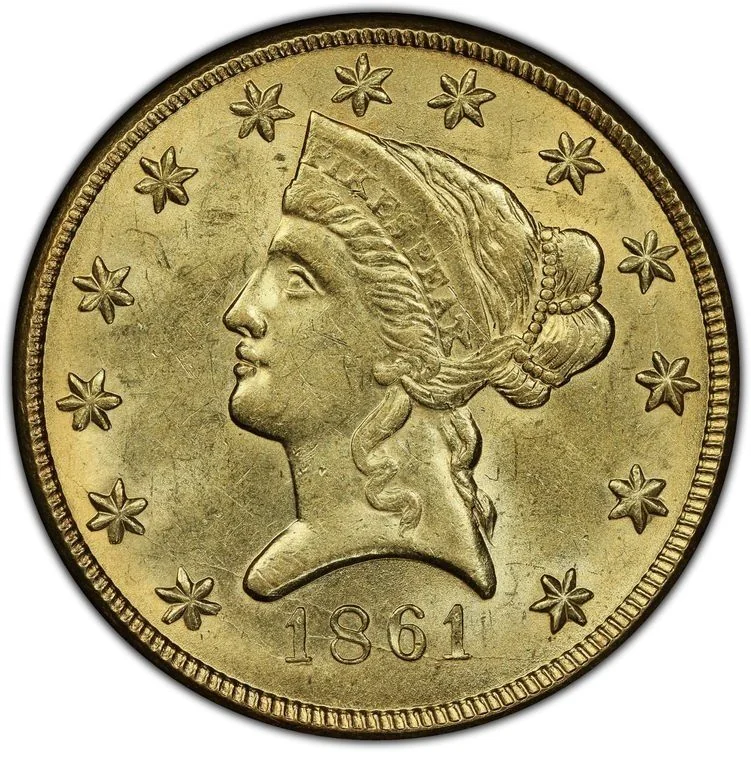
10 Dollars – Colorado
United States
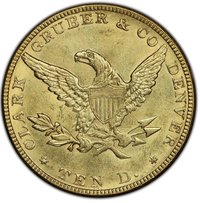
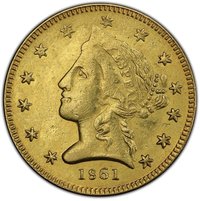
Obverse
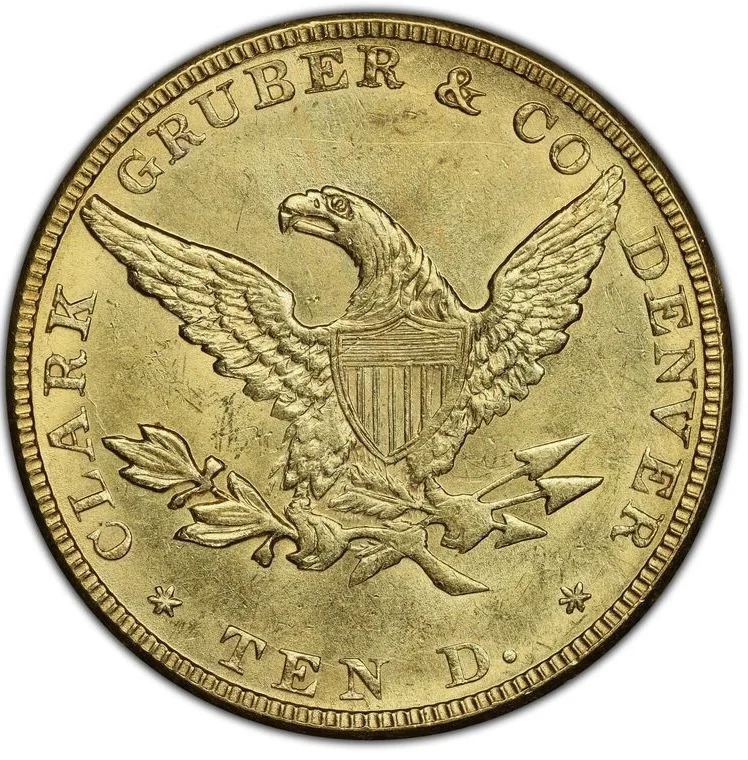
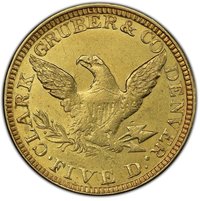
Reverse
Description:
Heraldic eagle.
Inscription:
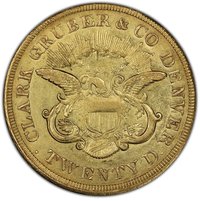
CLARK GRUBER & CO DENVER
TEN D.
TEN D.
Edge
Mintings
| Year | Mint Mark | Mintage | Quality | Collection |
|---|---|---|---|---|
| 1861 | — | — |
Historical background
In 1861, Colorado was a newly formed territory in the midst of a gold rush, yet it faced a severe and chaotic currency crisis. The region lacked a federally chartered bank, and the outbreak of the Civil War in April of that year shattered the nation's financial system. Crucially, the U.S. government suspended specie payments, meaning that paper money could no longer be reliably redeemed for gold or silver coin. This action rendered the already scarce supply of federal coins virtually extinct in the remote Rocky Mountain territory, crippling everyday commerce.
The vacuum was filled by a bewildering array of unreliable paper. Merchants, mining companies, and municipalities issued their own private scrip and "due bills" to pay workers and settle debts. More problematically, banks in neighboring states, particularly from Kansas and Nebraska, flooded Colorado with their own notes, often at steep discounts. These "wildcat" banknotes were of dubious value, as the distance and war made it impossible to verify the solvency of the issuing institutions back east. Citizens and businesses had to reference regularly published "bank note detectors" to navigate a daily gamble on the worth of the paper in their hands.
This unstable environment severely hampered the territory's economy, creating distrust in transactions and hindering growth. In response, the Colorado territorial government took a radical step in the fall of 1861 by authorizing the issuance of its own paper currency—Territorial Demand Notes. These notes, backed not by gold but by the territory's credit and future tax revenues, were an attempt to create a reliable local medium of exchange. Thus, Colorado entered 1862 operating on a fragile, three-tiered monetary system: worthless or heavily discounted foreign banknotes, various private scrip, and its own experimental fiat currency, all while the bedrock of gold dug from its mountains was largely hoarded or shipped out of the territory.
The vacuum was filled by a bewildering array of unreliable paper. Merchants, mining companies, and municipalities issued their own private scrip and "due bills" to pay workers and settle debts. More problematically, banks in neighboring states, particularly from Kansas and Nebraska, flooded Colorado with their own notes, often at steep discounts. These "wildcat" banknotes were of dubious value, as the distance and war made it impossible to verify the solvency of the issuing institutions back east. Citizens and businesses had to reference regularly published "bank note detectors" to navigate a daily gamble on the worth of the paper in their hands.
This unstable environment severely hampered the territory's economy, creating distrust in transactions and hindering growth. In response, the Colorado territorial government took a radical step in the fall of 1861 by authorizing the issuance of its own paper currency—Territorial Demand Notes. These notes, backed not by gold but by the territory's credit and future tax revenues, were an attempt to create a reliable local medium of exchange. Thus, Colorado entered 1862 operating on a fragile, three-tiered monetary system: worthless or heavily discounted foreign banknotes, various private scrip, and its own experimental fiat currency, all while the bedrock of gold dug from its mountains was largely hoarded or shipped out of the territory.
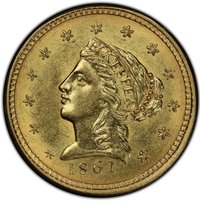
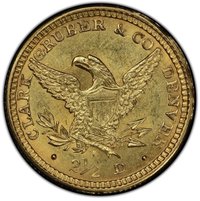
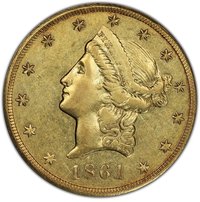
Series: 1861 Colorado) circulation coins
✨ Legendary