

20 kroner (Magnus VI Lagabøte's national legal code) – Norway
Add to wishlist
Circulating commemorative coins
Commemoration: 750th anniversary of the national legal code of Magnus VI Lagabøte
Norway
Material
References
KM: #
Numista: #398454
Value
Exchange value: 20 NOK
Inflation-adjusted value: 20.89 NOK
Obverse
Description:
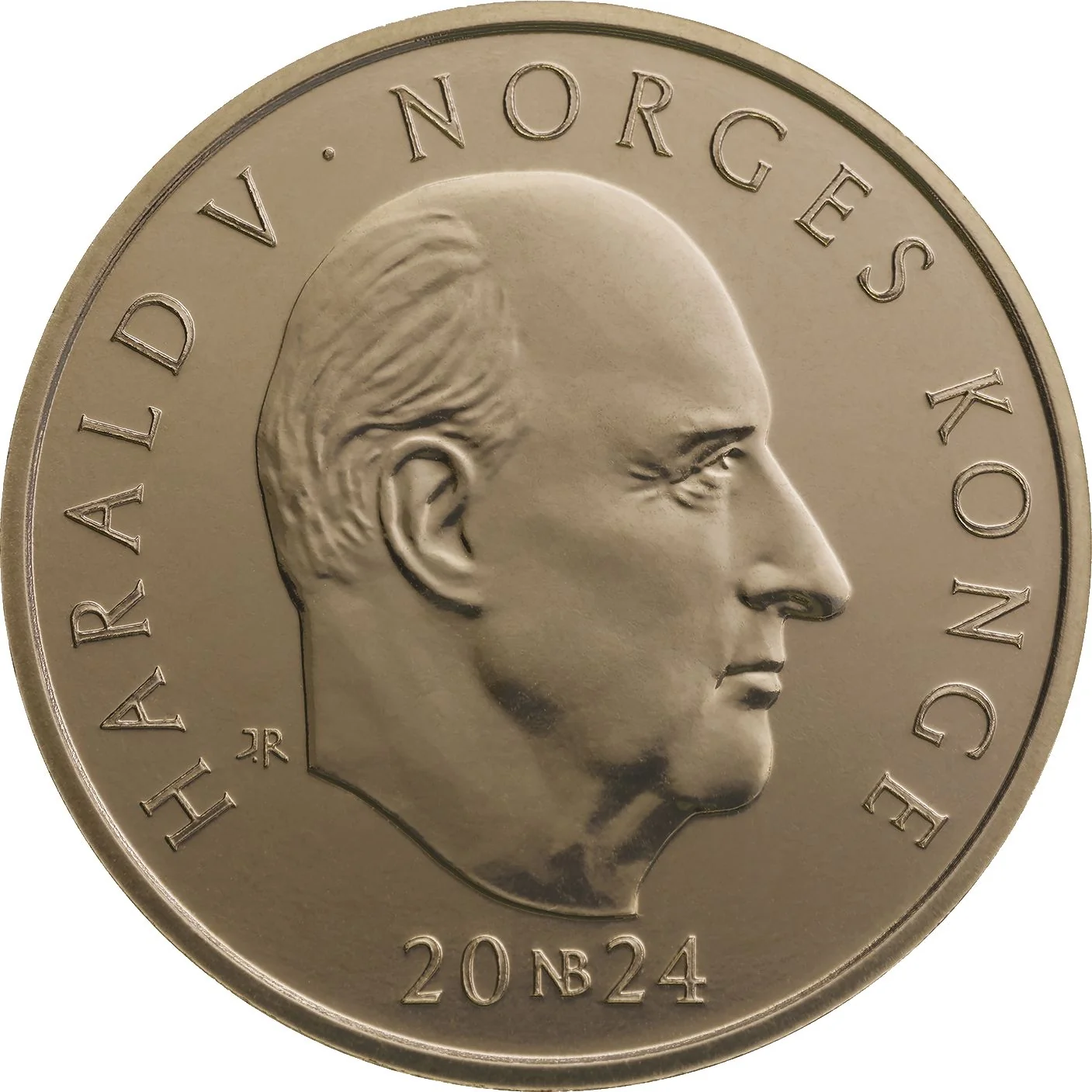
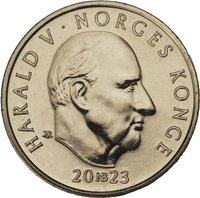
King Harald V bust facing right. Engraver's initials behind bust. Inscription surrounds. Date flanking "NB" below. Solid rim ring.
Inscription:
HARALD V ∙ NORGES KONGE
IAR
20 NB 24
IAR
20 NB 24
Translation:
Harald V, Norway's King
IAR
20 NB 24
IAR
20 NB 24
Script: Latin
Engraver: Ingrid Austlid Rise
Reverse
Description:
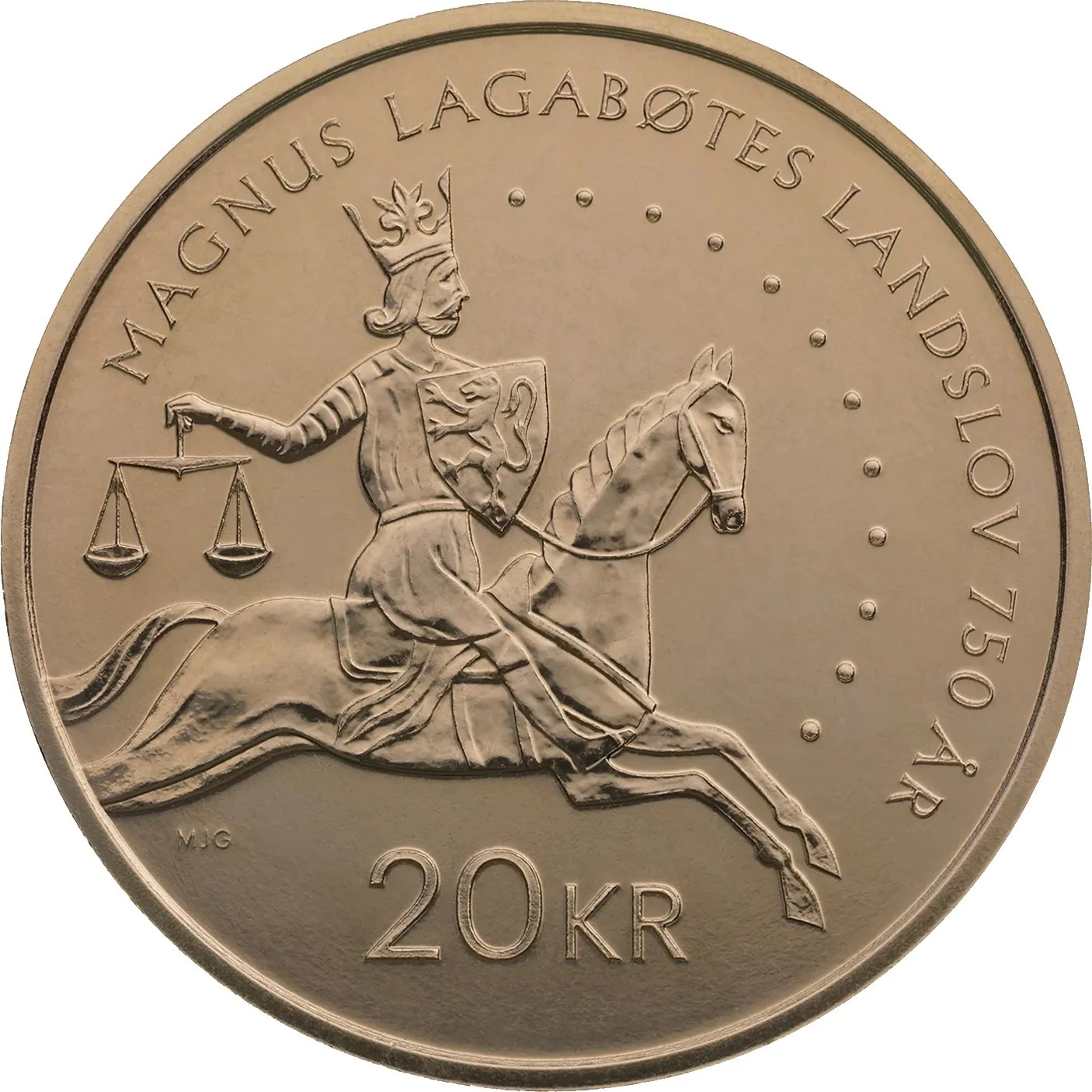
Modern version of King Magnus VI’s 1278 equestrian seal, showing the mounted king holding scales and a shield. Twelve dots symbolize the Court of Appeal. Includes inscription, engraver’s initials under the horse, value at bottom, and a solid rim ring.
Inscription:
Magnus Lagabøtes landslov 750 år
MJG
20 KR
MJG
20 KR
Translation:
Magnus Lagabøte's National Law 750 Years
MJG
20 KR
MJG
20 KR
Script: Latin
Engraver: Michael Guilfoyle
Edge
Plain
Mints
| Name | Mark |
|---|---|
| Norwegian Mint | — |
Mintings
| Year | Mint Mark | Mintage | Quality | Collection |
|---|---|---|---|---|
| 2024 | — | — | ||
| 2024 | — | 2,000 | Proof |
Historical background
In 2024, Norway's currency situation is primarily defined by the strength and stability of the Norwegian krone (NOK), though it remains sensitive to external energy markets and central bank policy. The krone's value is fundamentally underpinned by the nation's substantial sovereign wealth fund, the Government Pension Fund Global (often called the Oil Fund), which buffers the economy and provides long-term financial security. However, the NOK has historically exhibited volatility, often weakening against major currencies like the Euro and US Dollar during periods of lower risk appetite or when global oil and gas prices—a key export—face downward pressure.
The current monetary policy of Norges Bank, the country's central bank, is a dominant factor. With inflation remaining above its 2% target, though moderating from previous highs, Norges Bank has maintained a relatively hawkish stance compared to other developed economies. Having raised its key policy rate to 4.5% in December 2023, the highest level since 2008, the bank has signaled a prolonged period of high rates to anchor inflation expectations. This has provided support for the krone by attracting foreign capital, though the currency has not strengthened as much as some analysts expected, a phenomenon often referred to as the "krone paradox."
Looking forward, the currency's trajectory in 2024 hinges on the interplay between global energy demand, the pace of disinflation, and the central bank's next moves. A significant decline in oil and gas prices could test the krone's resilience, while any earlier-than-anticipated rate cuts by Norges Bank could lead to depreciation. Conversely, persistent inflationary pressures or a renewed surge in energy prices could extend the period of monetary tightening and bolster the NOK. Overall, Norway's currency benefits from robust economic fundamentals but continues to navigate the dual influences of its commodity-linked exports and its independent, data-dependent monetary policy.
The current monetary policy of Norges Bank, the country's central bank, is a dominant factor. With inflation remaining above its 2% target, though moderating from previous highs, Norges Bank has maintained a relatively hawkish stance compared to other developed economies. Having raised its key policy rate to 4.5% in December 2023, the highest level since 2008, the bank has signaled a prolonged period of high rates to anchor inflation expectations. This has provided support for the krone by attracting foreign capital, though the currency has not strengthened as much as some analysts expected, a phenomenon often referred to as the "krone paradox."
Looking forward, the currency's trajectory in 2024 hinges on the interplay between global energy demand, the pace of disinflation, and the central bank's next moves. A significant decline in oil and gas prices could test the krone's resilience, while any earlier-than-anticipated rate cuts by Norges Bank could lead to depreciation. Conversely, persistent inflationary pressures or a renewed surge in energy prices could extend the period of monetary tightening and bolster the NOK. Overall, Norway's currency benefits from robust economic fundamentals but continues to navigate the dual influences of its commodity-linked exports and its independent, data-dependent monetary policy.
🌟 Limited