

2 euro (Franc Coins Feierstëppler) – Luxembourg
Add to wishlist
Circulating commemorative coins
Commemoration: 100th Anniversary of the Introduction of the Franc Coins bearing of the image of the Feierstëppler
Luxembourg
Context
Material
References
KM: #
Numista: #398220
Value
Exchange value: 2 EUR
Inflation-adjusted value: 2.08 EUR
Obverse
Description:
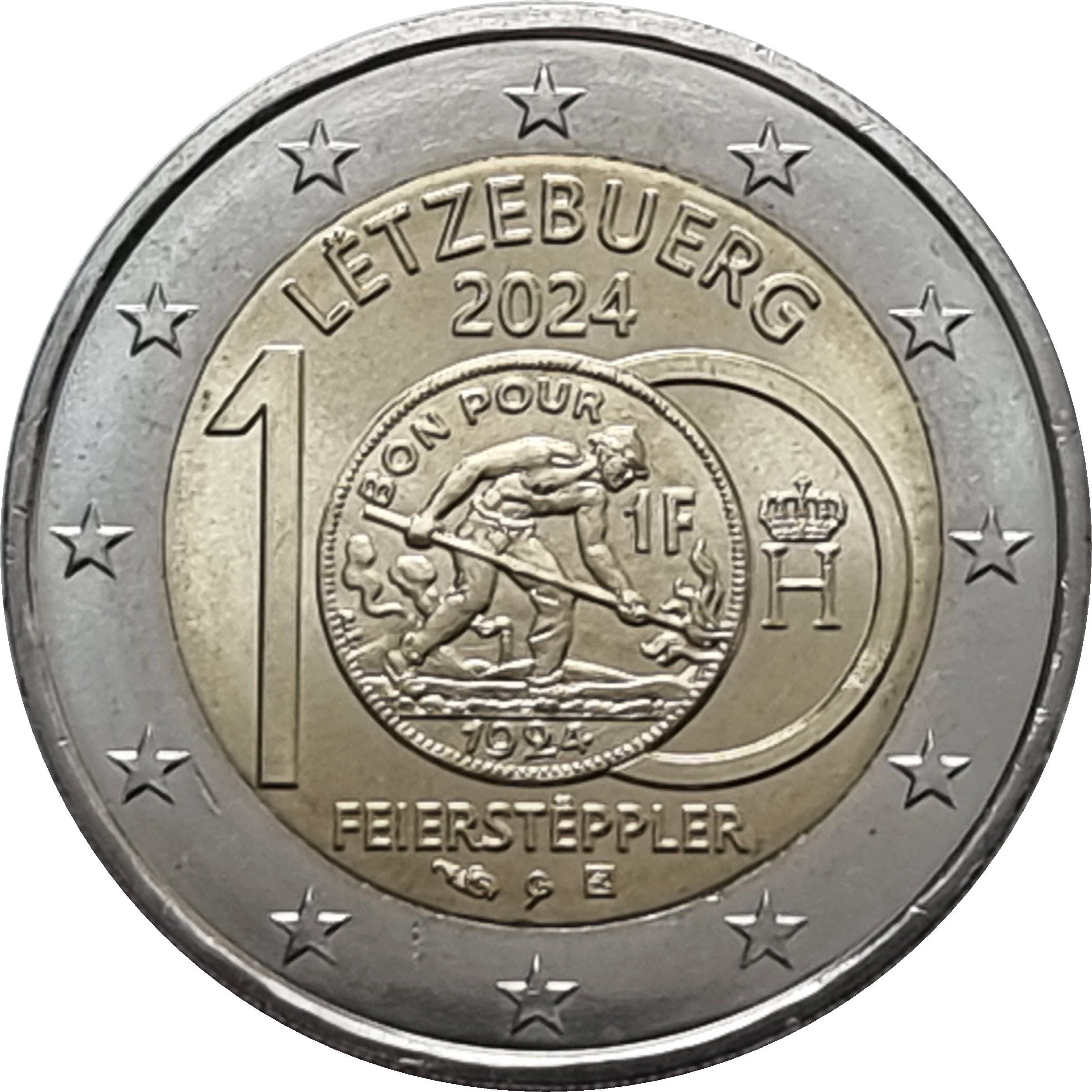
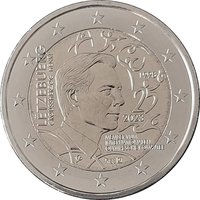
The centre features Luxembourg’s 1924 steelworker coin, integrated into a ‘100’ to mark the anniversary of this long-circulating franc. ‘LÉTZEBUERG 2024’ appears at the top, with the popular name ‘FEIERSTÉPPLER’ at the bottom. Grand Duke Henri’s crowned ‘H’ monogram is shown. Mint marks will be added later in the placeholder space. The outer ring bears the 12 stars of the European flag.
Inscription:
LËTZEBUERG
2024
BON POUR 1 F 1924
H
FEIERSTËPPLER
CP
2024
BON POUR 1 F 1924
H
FEIERSTËPPLER
CP
Translation:
GOOD FOR 1 F 1924
H
FEIERSTËPPLER
CP
H
FEIERSTËPPLER
CP
Script: Latin
Languages: French, Luxembourgish
Designer: Chiara Principe
Reverse
Edge
The sequence "2 ★ ★" repeated six times alternately upright and inverted
Legend:
2★★2★★2★★2★★2★★2★★
Mints
| Name | Mark |
|---|---|
| Monnaie de Paris | — |
| Royal Dutch Mint | — |
Mintings
| Year | Mint Mark | Mintage | Quality | Collection |
|---|---|---|---|---|
| 2024 | — | 7,500 | BU | |
| 2024 | — | 1,000 | Proof | |
| 2024 | — | 120,000 |
🌱 Common