

10 Haléřů / Halierov – Czechoslovakia
Context
Years: 1922–1938
Issuer: Czechoslovakia 
Period:
(1918—1938)
Currency:
(1919—1939)
Demonetization: 30 September 1941
Total mintage: 195,790,000
Material

References
KM: #Click to copy to clipboard3
Numista: #3977
Obverse
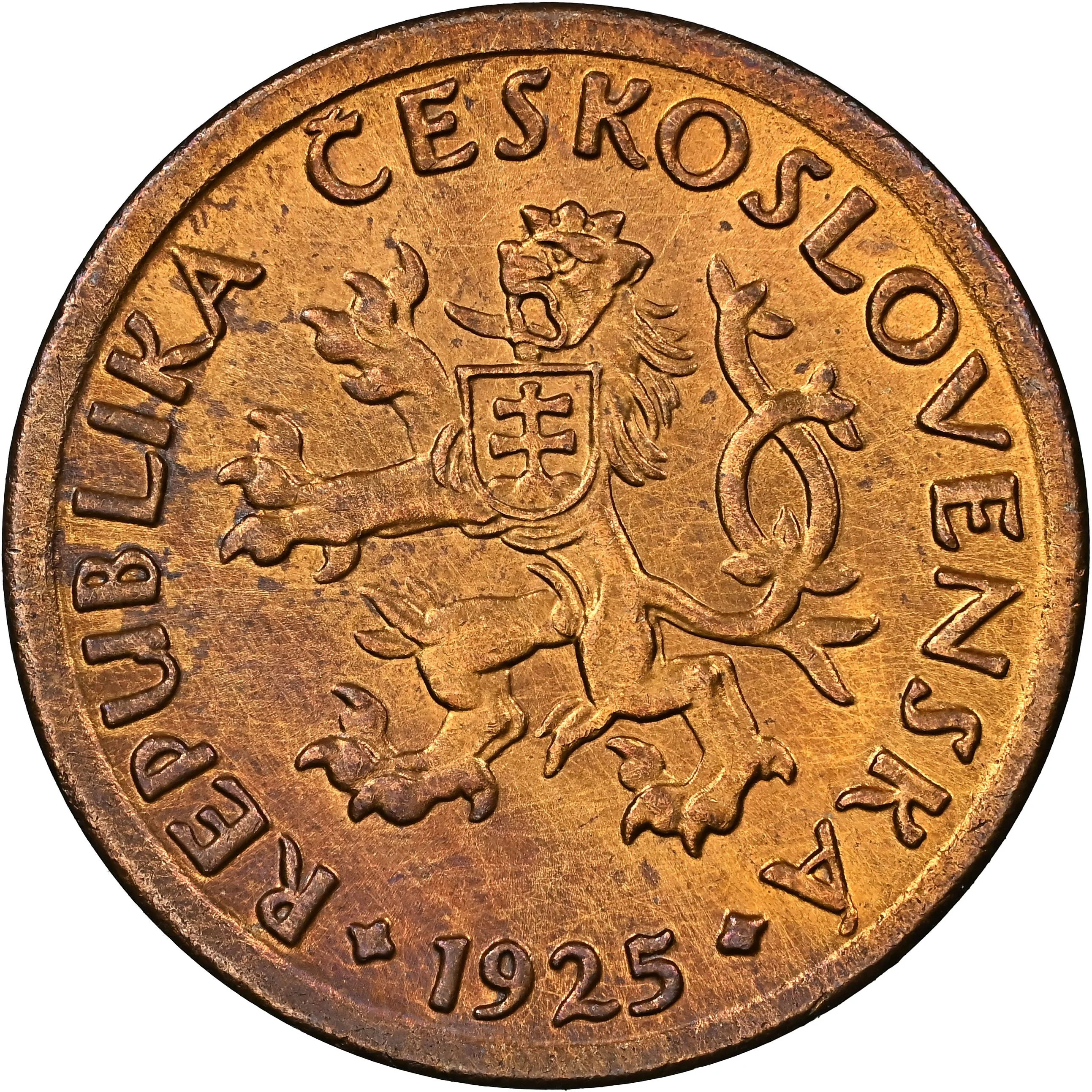
Description:
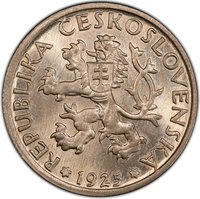
Czech lion, Slovak shield.
Inscription:
REPUBLIKA ČESKOSLOVENSKÁ 1925
Translation:
CZECHOSLOVAK REPUBLIC 1925
Script: Latin
Language: Czech
Engraver: Otakar Španiel
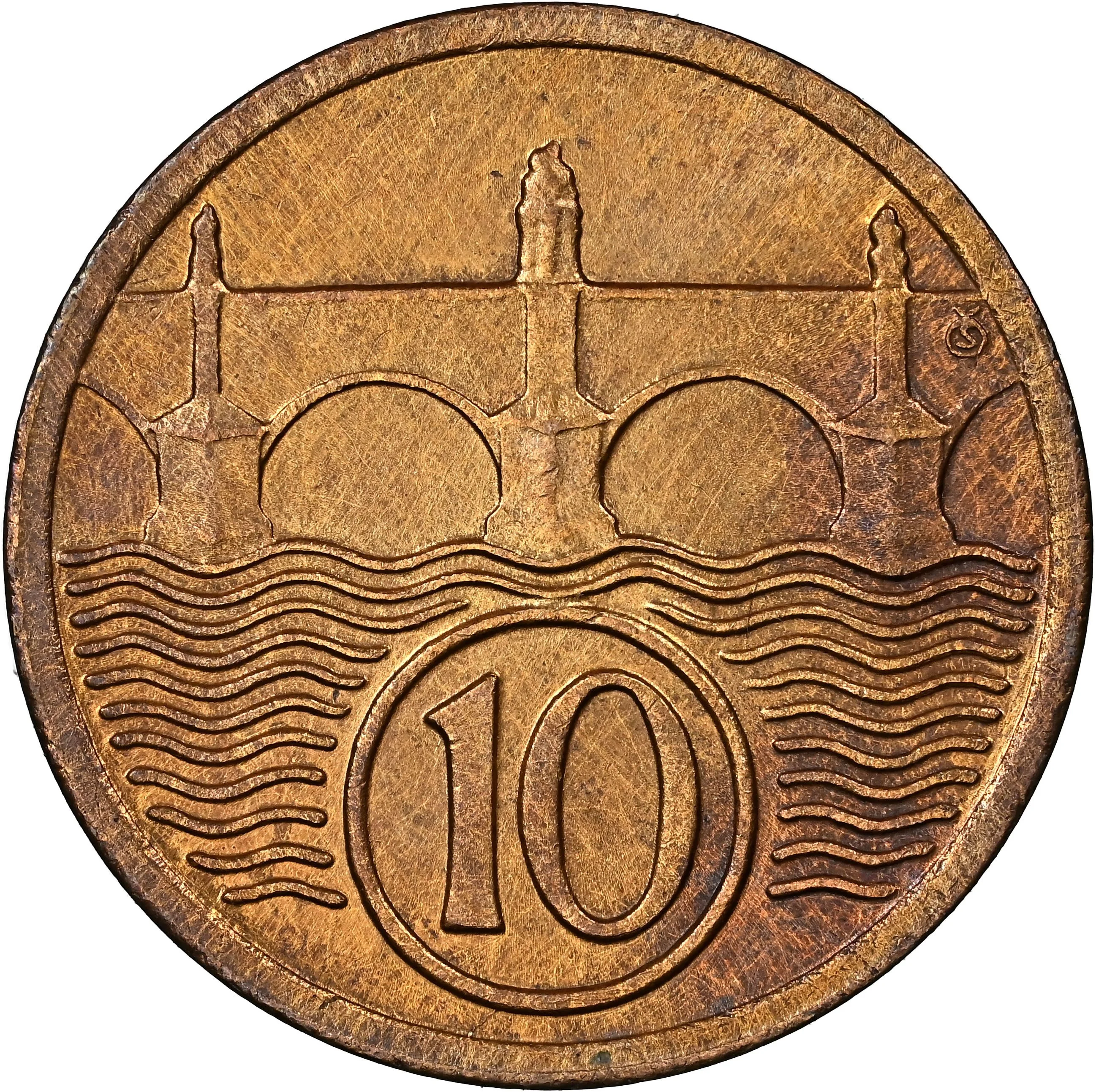
Reverse
Edge
Plain
Mints
| Name | Mark |
|---|---|
| Kremnica | — |
Mintings
| Year | Mint Mark | Mintage | Quality | Collection |
|---|---|---|---|---|
| 1922 | — | 6,000,000 | ||
| 1923 | — | 24,000,000 | ||
| 1924 | — | 5,320,000 | ||
| 1925 | — | 24,680,000 | ||
| 1926 | — | 10,000,000 | ||
| 1927 | — | 10,000,000 | ||
| 1928 | — | 14,290,000 | ||
| 1929 | — | 5,710,000 | ||
| 1930 | — | 6,980,000 | ||
| 1931 | — | 6,740,000 | ||
| 1932 | — | 11,280,000 | ||
| 1933 | — | 4,190,000 | ||
| 1934 | — | 13,200,000 | ||
| 1935 | — | 3,420,000 | ||
| 1936 | — | 8,560,000 | ||
| 1937 | — | 20,020,000 | ||
| 1938 | — | 21,400,000 |
Historical background
Following the collapse of the Austro-Hungarian Empire after World War I, the newly established Czechoslovakia inherited a chaotic monetary landscape in 1922. The country was flooded with rapidly depreciating Austro-Hungarian banknotes, which the government had initially stamped to legitimize but could not control. This period was marked by severe hyperinflation, a phenomenon gripping much of Central Europe, which eroded savings, disrupted trade, and caused significant social hardship. The young state's financial stability was precarious, as it lacked its own distinct currency and struggled to assert economic sovereignty amidst this inherited crisis.
Recognizing the urgent need for stabilization, the Czechoslovak government, under the skilled leadership of Minister of Finance Alois Rašín, embarked on a radical and ambitious policy of deflation. In 1919, the first critical step was taken with the physical stamping and partial confiscation of the old banknotes to reduce the money supply. By 1922, the cornerstone of Rašín's policy was fully in effect: maintaining a strict balanced budget, accumulating gold and foreign currency reserves, and deliberately driving up the value of the temporary Czechoslovak koruna. This "strong crown" policy made Czechoslovak exports more expensive but successfully halted inflation and established international confidence.
Consequently, by 1922, Czechoslovakia stood in stark contrast to its neighbors still suffering hyperinflation. The stringent measures had laid the essential groundwork for monetary stability, setting the stage for the successful introduction of a new, fully independent Czechoslovak koruna in 1926. This early fiscal discipline proved foundational, providing the economic stability that would underpin the country's reputation as the most prosperous and industrially advanced democracy in Central Europe during the interwar period.
Recognizing the urgent need for stabilization, the Czechoslovak government, under the skilled leadership of Minister of Finance Alois Rašín, embarked on a radical and ambitious policy of deflation. In 1919, the first critical step was taken with the physical stamping and partial confiscation of the old banknotes to reduce the money supply. By 1922, the cornerstone of Rašín's policy was fully in effect: maintaining a strict balanced budget, accumulating gold and foreign currency reserves, and deliberately driving up the value of the temporary Czechoslovak koruna. This "strong crown" policy made Czechoslovak exports more expensive but successfully halted inflation and established international confidence.
Consequently, by 1922, Czechoslovakia stood in stark contrast to its neighbors still suffering hyperinflation. The stringent measures had laid the essential groundwork for monetary stability, setting the stage for the successful introduction of a new, fully independent Czechoslovak koruna in 1926. This early fiscal discipline proved foundational, providing the economic stability that would underpin the country's reputation as the most prosperous and industrially advanced democracy in Central Europe during the interwar period.
🌱 Very Common