

50 Haléřů / Halierov – Czechoslovakia
Context
Years: 1921–1931
Issuer: Czechoslovakia 
Period:
(1918—1938)
Currency:
(1919—1939)
Demonetization: 30 September 1941
Total mintage: 61,000,000
Material
Diameter: 22 mm
Weight: 5 g
Thickness: 1.8 mm
Shape: Round
Composition: Copper-nickel
Technique: Milled
Alignment: Medal alignment
flip
References
KM: #Click to copy to clipboard2
Numista: #3970
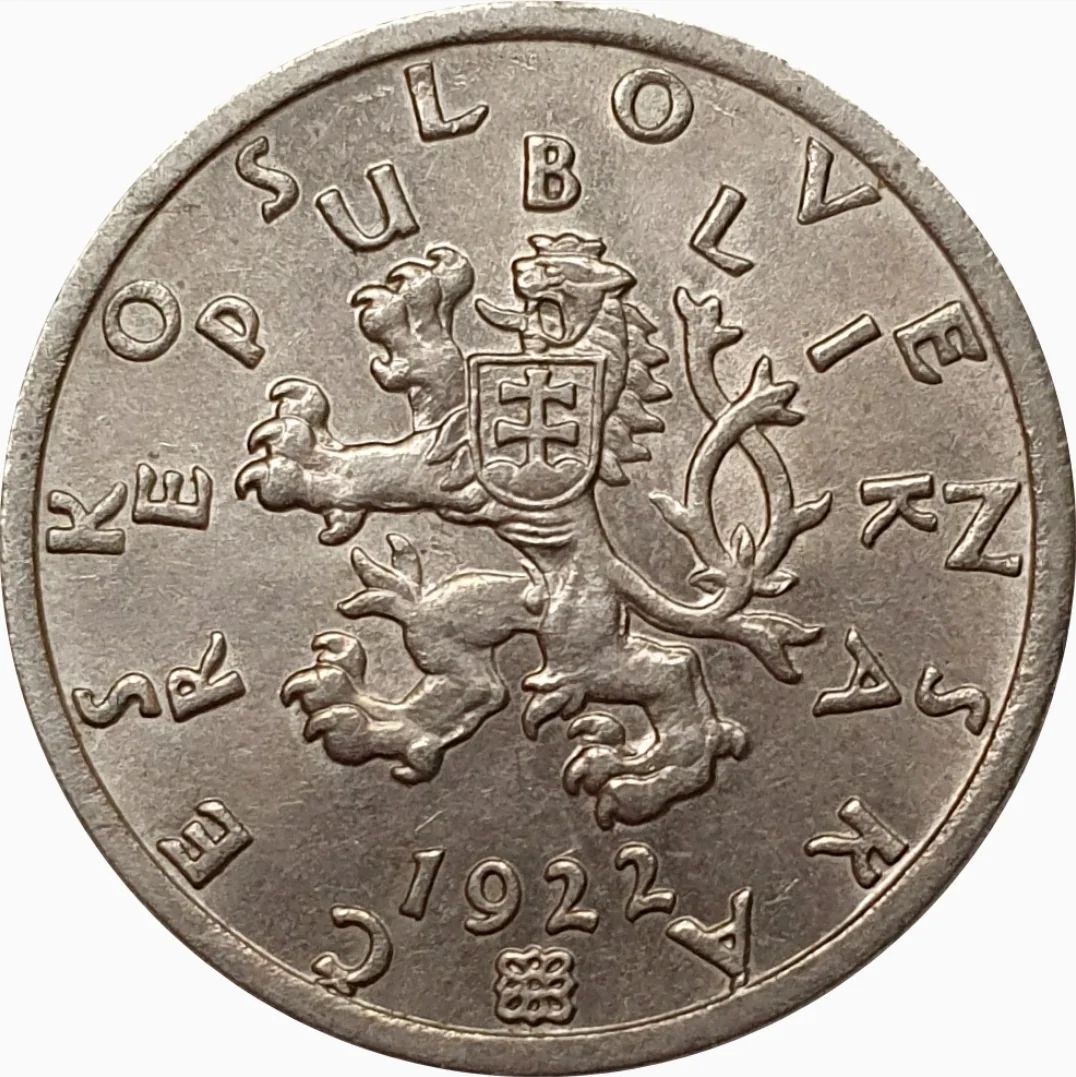
Obverse
Description:
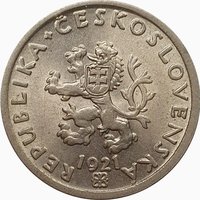
Czech lion, Slovak shield.
Inscription:
1922
ČESKOSLOVENSKÁ
REPUBLIKA
ČESKOSLOVENSKÁ
REPUBLIKA
Translation:
1922
CZECHOSLOVAK
REPUBLIC
CZECHOSLOVAK
REPUBLIC
Script: Latin
Engraver: Otakar Španiel
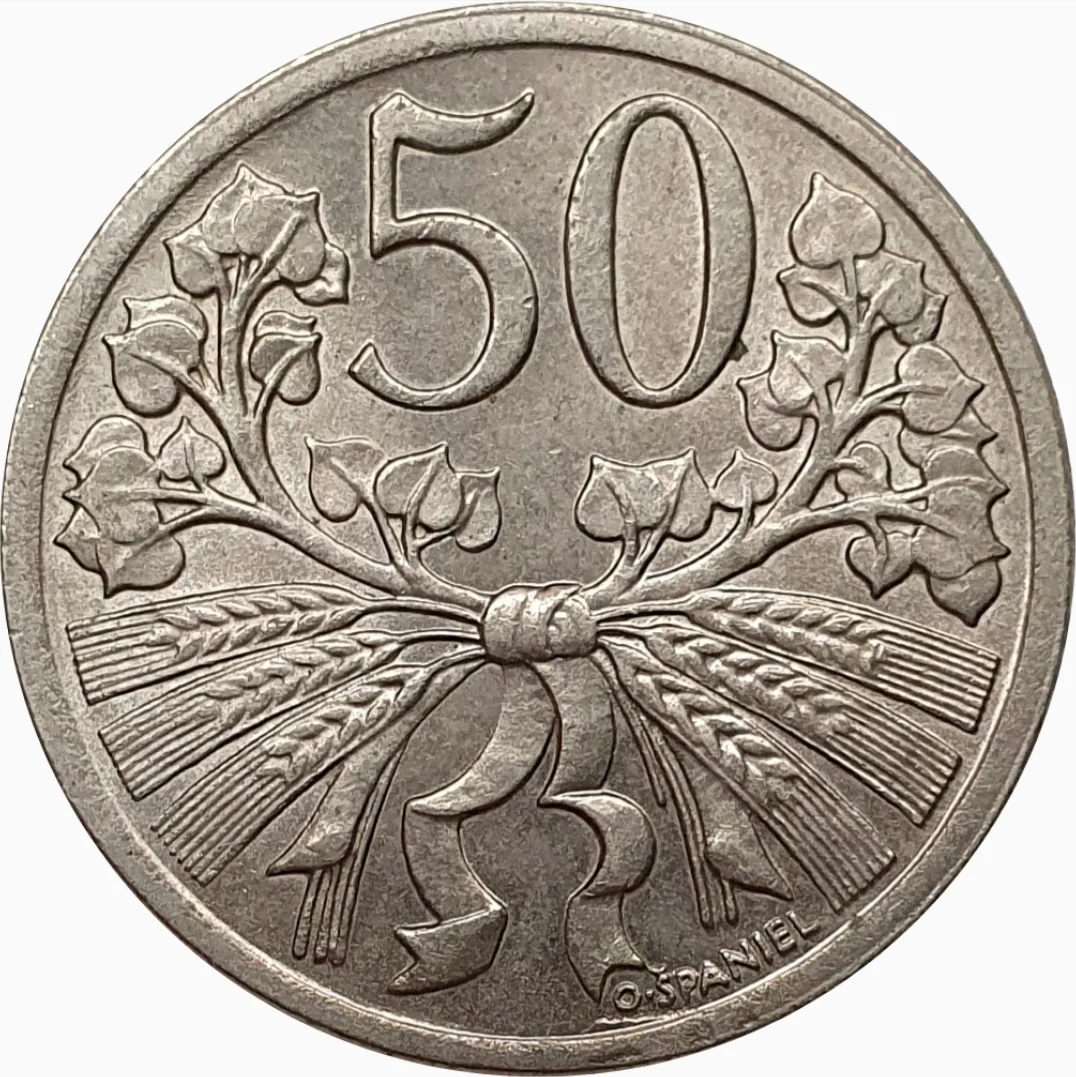
Reverse
Description:
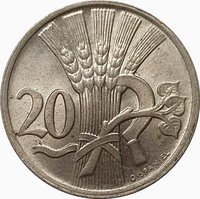
Value over linden and wheat bound by a ribbon.
Inscription:
50
O.ŠPANIEL
O.ŠPANIEL
Translation:
Fifty Ore. O. Španiel
Script: Latin
Language: Slovak
Engraver: Otakar Španiel
Edge
Milled
Categories
| Symbols> Coat of Arms |
Mints
| Name | Mark |
|---|---|
| Kremnica | — |
Mintings
| Year | Mint Mark | Mintage | Quality | Collection |
|---|---|---|---|---|
| 1921 | — | 3,000,000 | ||
| 1922 | — | 37,000,000 | ||
| 1924 | — | 10,000,000 | ||
| 1925 | — | 1,415,000 | ||
| 1926 | — | 1,585,000 | ||
| 1927 | — | 2,000,000 | ||
| 1931 | — | 6,000,000 |
Historical background
Following the collapse of the Austro-Hungarian Empire in 1918, the newly established Czechoslovakia inherited a severe monetary crisis. The country was flooded with rapidly depreciating Austro-Hungarian banknotes, which the government was forced to recognize as legal tender to prevent economic collapse. By 1921, hyperinflation was taking hold across Central Europe, severely undermining the value of this currency and threatening the republic's financial stability and political credibility. The urgent task for the state was to replace this unstable legacy with a strong, independent national currency.
In response, the Czechoslovak government, under the skilled leadership of Minister of Finance Alois Rašín, enacted a radical and successful stabilization policy. The cornerstone was the "Rašín Reform" of 1921, which involved the physical stamping and partial withdrawal of the old Austro-Hungarian banknotes circulating within its borders. This drastic measure effectively created a temporary, distinct currency and restricted the money supply. Simultaneously, the state implemented strict deflationary policies, including high taxes and tight control over credit, to build gold and foreign exchange reserves.
These harsh but necessary measures laid the groundwork for the introduction of the permanent Czechoslovak koruna in 1922. By the end of 1921, the country had successfully isolated itself from the hyperinflation raging in neighboring Austria and Hungary. The result was a remarkable achievement: Czechoslovakia emerged with one of the most stable currencies in Europe during the interwar period, which provided a solid foundation for its subsequent industrial growth and democratic development in the 1920s.
In response, the Czechoslovak government, under the skilled leadership of Minister of Finance Alois Rašín, enacted a radical and successful stabilization policy. The cornerstone was the "Rašín Reform" of 1921, which involved the physical stamping and partial withdrawal of the old Austro-Hungarian banknotes circulating within its borders. This drastic measure effectively created a temporary, distinct currency and restricted the money supply. Simultaneously, the state implemented strict deflationary policies, including high taxes and tight control over credit, to build gold and foreign exchange reserves.
These harsh but necessary measures laid the groundwork for the introduction of the permanent Czechoslovak koruna in 1922. By the end of 1921, the country had successfully isolated itself from the hyperinflation raging in neighboring Austria and Hungary. The result was a remarkable achievement: Czechoslovakia emerged with one of the most stable currencies in Europe during the interwar period, which provided a solid foundation for its subsequent industrial growth and democratic development in the 1920s.
🌱 Very Common