






Obverse
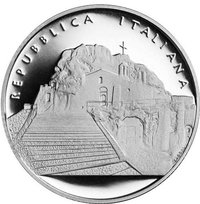
Description:
Trani Cathedral.
Inscription:
REPUBBLICA ITALIANA
U. PERNAZZA
U. PERNAZZA
Translation:
Italian Republic
U. Pernazza
U. Pernazza
Language: Italian
Engraver: Uliana Pernazza
Reverse
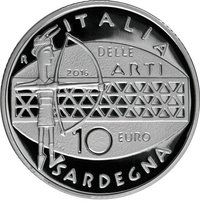
Inscription:
ITALIA DELLE ARTI
2018
10 EURO
TRANI
R
2018
10 EURO
TRANI
R
Engraver: Uliana Pernazza
Edge
Categories
| Building> Religious building |
Mintings
| Year | Mint Mark | Mintage | Quality | Collection |
|---|---|---|---|---|
| 2018 | R | 4,000 | Proof |
Historical background
In 2018, Italy's currency situation was defined by its membership in the Eurozone, using the euro (€) as its legal tender. This period was marked by significant political and economic turbulence, which fueled recurring debates about the sustainability of Italy's position within the single currency. The populist coalition government formed in June—comprising the Five Star Movement and the League—publicly clashed with European Union institutions over its expansionary budget, raising fears of a debt crisis and triggering market volatility. This tension kept the specter of "Italexit" (Italeave) and a potential return to a national currency like the lira in the background of political discourse, though it remained a fringe scenario.
Economically, the country grappled with persistent structural issues that strained its euro membership. Italy's public debt-to-GDP ratio, exceeding 130%, was the second highest in the Eurozone, while economic growth remained anemic and banking sectors were fragile. These vulnerabilities led to periodic spikes in the yield spread between Italian and German government bonds (the BTP-Bund spread), a key indicator of perceived risk. A widening spread signalled investor concern over Italy's creditworthiness and the potential for a crisis within the Eurozone itself, putting indirect pressure on the euro's stability as a whole.
Ultimately, the currency situation in 2018 was one of contained crisis. While the government's budget dispute with the European Commission was eventually settled with minor modifications, the underlying economic weaknesses and political euroscepticism were not resolved. The year demonstrated the deep tensions between domestic political demands and the fiscal constraints of the Eurozone, ensuring that questions over Italy's long-term relationship with the euro would persist. The euro remained firmly in place, but its future in Italy became a more openly contested political question.
Economically, the country grappled with persistent structural issues that strained its euro membership. Italy's public debt-to-GDP ratio, exceeding 130%, was the second highest in the Eurozone, while economic growth remained anemic and banking sectors were fragile. These vulnerabilities led to periodic spikes in the yield spread between Italian and German government bonds (the BTP-Bund spread), a key indicator of perceived risk. A widening spread signalled investor concern over Italy's creditworthiness and the potential for a crisis within the Eurozone itself, putting indirect pressure on the euro's stability as a whole.
Ultimately, the currency situation in 2018 was one of contained crisis. While the government's budget dispute with the European Commission was eventually settled with minor modifications, the underlying economic weaknesses and political euroscepticism were not resolved. The year demonstrated the deep tensions between domestic political demands and the fiscal constraints of the Eurozone, ensuring that questions over Italy's long-term relationship with the euro would persist. The euro remained firmly in place, but its future in Italy became a more openly contested political question.
Series: Italy of Arts














✨ Legendary