

50 sen – Brunei
Add to wishlist
Brunei
Context
Years: 1968–1977
Issuer: Brunei
Ruler: Hassanal Bolkiah
Currency:
(since 1967)
Total mintage: 1,700,000
Material
Diameter: 27.7 mm
Weight: 9.33 g
Thickness: 2.1 mm
Shape: Round
Composition: Copper-nickel
Technique: Milled
Alignment: Medal alignment
flip
References
KM: #
Numista: #3937
Value
Exchange value: 0.50 BND
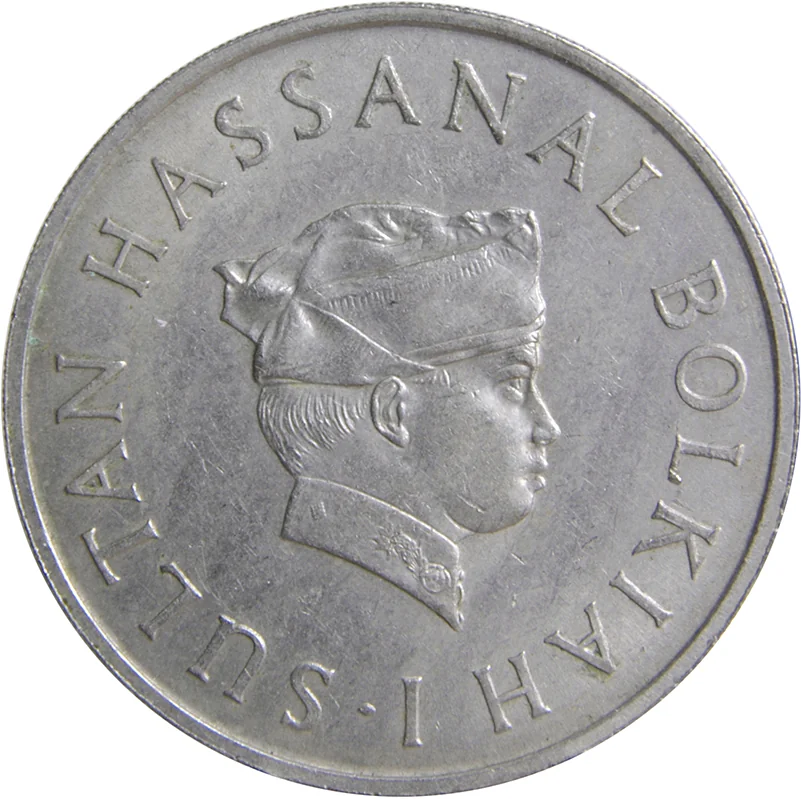
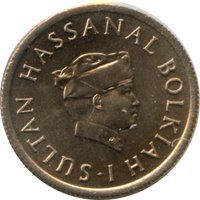
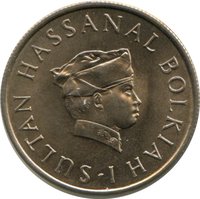
Obverse
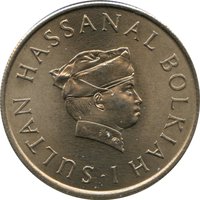
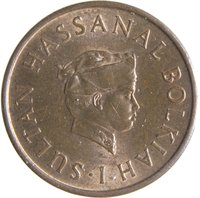
Inscription:
SULTAN HASSANAL BOLKIAH I·
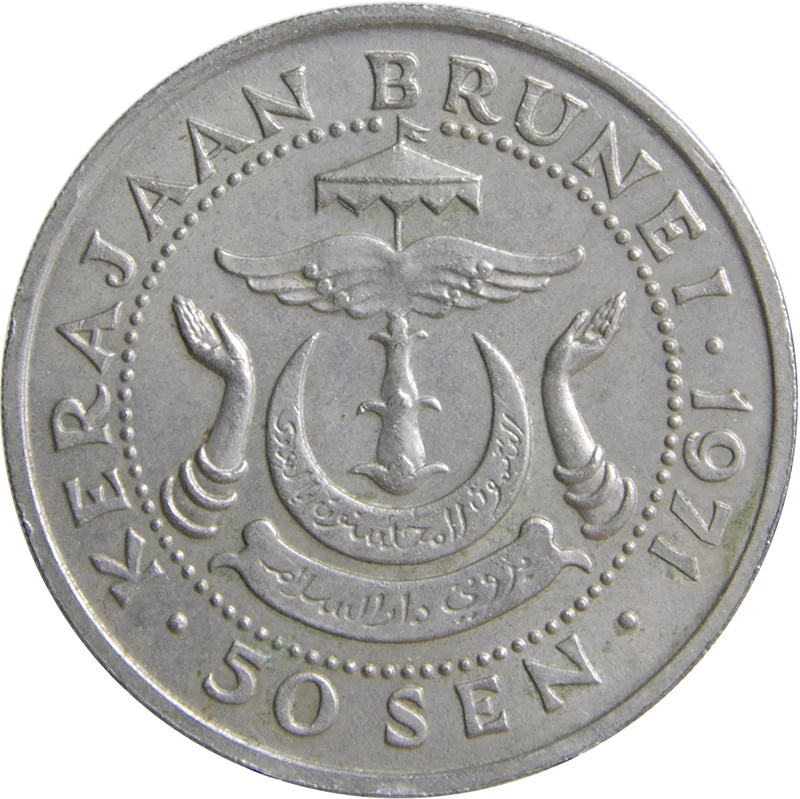
Reverse
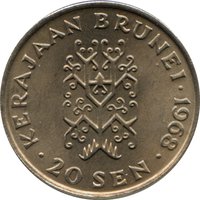
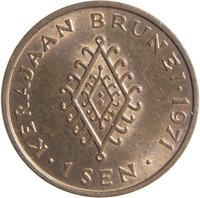
Inscription:
KERAJAAN BRUNEI·1971
الدائمون المحسنون بالهدى
بروني دارالسلام
· 50 SEN ·
الدائمون المحسنون بالهدى
بروني دارالسلام
· 50 SEN ·
Translation:
State of Brunei 1971
The eternally benevolent in guidance
Brunei, Abode of Peace
· 50 SEN ·
The eternally benevolent in guidance
Brunei, Abode of Peace
· 50 SEN ·
Engraver: Christopher Ironside
Edge
Security edge
Mints
| Name | Mark |
|---|---|
| Royal Mint | — |
Mintings
| Year | Mint Mark | Mintage | Quality | Collection |
|---|---|---|---|---|
| 1968 | — | 212,000 | ||
| 1970 | — | 300,000 | ||
| 1970 | — | 4,000 | Proof | |
| 1971 | — | 320,000 | ||
| 1973 | — | 140,000 | ||
| 1974 | — | 244,000 | ||
| 1976 | — | 240,000 | ||
| 1977 | — | 240,000 |
Historical background
In 1968, Brunei faced a pivotal currency transition as it moved to dissolve its monetary union with Malaysia and Singapore. Since 1952, the three territories had shared a common currency under the Board of Commissioners of Currency, Malaya and British Borneo, which issued the Malayan dollar (later the Malaya and British Borneo dollar). However, political shifts, particularly Singapore's separation from Malaysia in 1965 and Brunei's decision to maintain its protectorate status rather than join the Malaysian Federation, rendered the existing arrangement untenable. Brunei sought greater monetary sovereignty and control over its financial system, which was increasingly important given its burgeoning oil revenues.
Consequently, on June 12, 1967, Brunei introduced its own national currency, the Brunei dollar, which entered full circulation in 1968. The new currency was issued by the Brunei Currency Board, established the previous year. Critically, through the Interchangeability Agreement of 1967, the Brunei dollar was pegged at par and remained fully interchangeable with the Singapore dollar, a arrangement that persists to this day. This ensured monetary stability and seamless cross-border trade, avoiding disruption to Brunei's closely linked economy with Singapore.
Therefore, the currency situation in 1968 was one of successful and stable transformation. Brunei emerged with a sovereign currency that symbolized its independent economic identity, while pragmatically maintaining a key financial link to Singapore. This move laid the foundational monetary framework for the modern nation, allowing it to directly manage its currency while benefiting from regional stability as it leveraged its hydrocarbon wealth for future development.
Consequently, on June 12, 1967, Brunei introduced its own national currency, the Brunei dollar, which entered full circulation in 1968. The new currency was issued by the Brunei Currency Board, established the previous year. Critically, through the Interchangeability Agreement of 1967, the Brunei dollar was pegged at par and remained fully interchangeable with the Singapore dollar, a arrangement that persists to this day. This ensured monetary stability and seamless cross-border trade, avoiding disruption to Brunei's closely linked economy with Singapore.
Therefore, the currency situation in 1968 was one of successful and stable transformation. Brunei emerged with a sovereign currency that symbolized its independent economic identity, while pragmatically maintaining a key financial link to Singapore. This move laid the foundational monetary framework for the modern nation, allowing it to directly manage its currency while benefiting from regional stability as it leveraged its hydrocarbon wealth for future development.
Series: 1968 Brunei circulation coins
🌱 Common