

10 korún – Slovakia
Add to wishlist
Circulating commemorative coins
Commemoration: Prince Pribina
Slovakia
Obverse
Description:
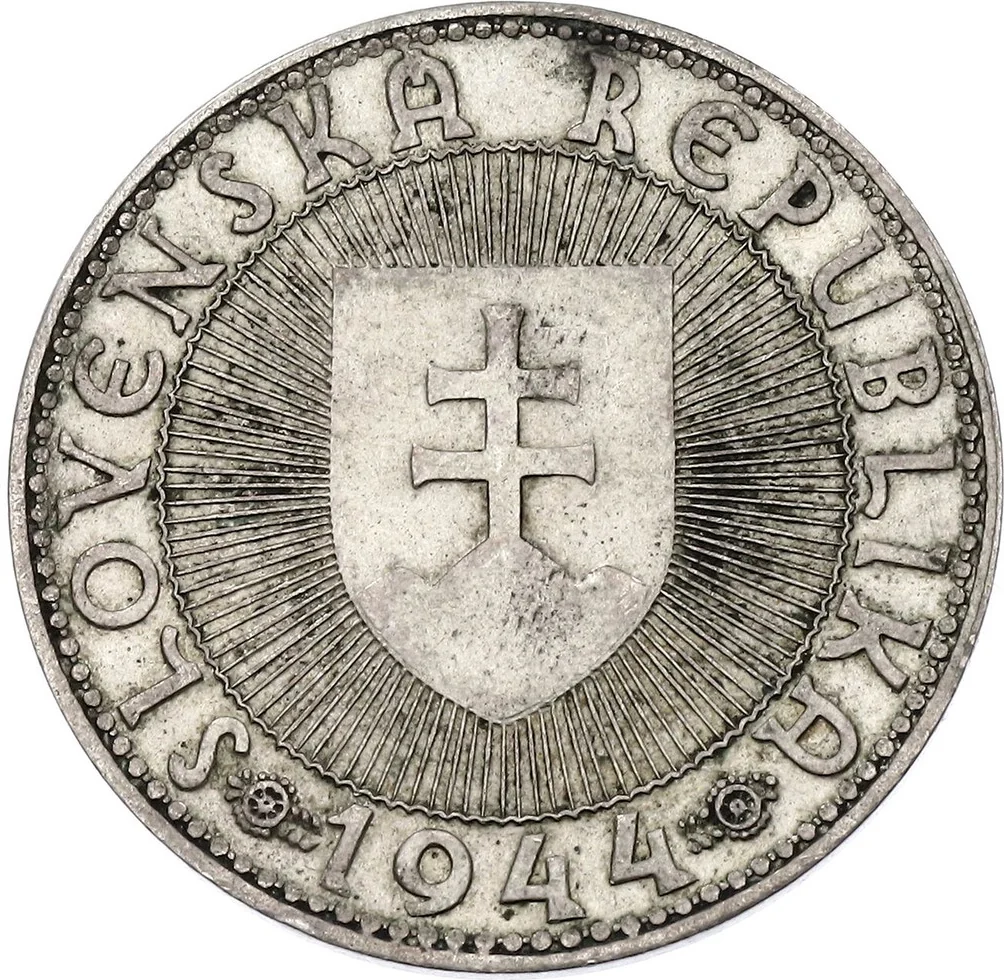
Slovakian crest
Inscription:
SLOVENSKÁ REPUBLIKA
1944
1944
Translation:
SLOVAK REPUBLIC
1944
1944
Script: Latin
Language: Slovak
Engraver: Ladislav Majerský
Reverse
Description:
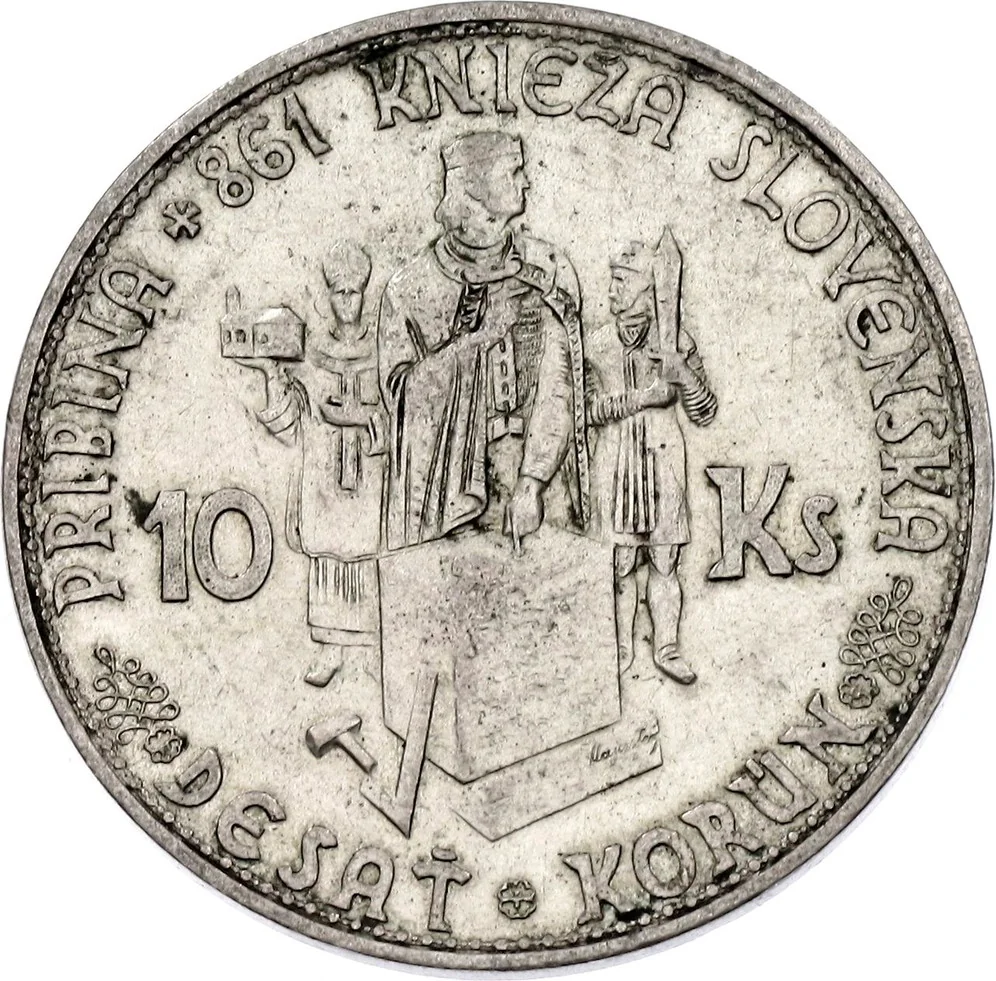
Knieza Pribina and two figures at the stone of the first Slovak church, a crossless building held by the left figure.
Inscription:
PRIBINA + 861 KNIEŽA SLOVENSKA
10 Ks
DESAŤ KORÚN
10 Ks
DESAŤ KORÚN
Translation:
PRIBINA + 861 PRINCE OF THE SLOVAKS
10 Ks
TEN CROWNS
10 Ks
TEN CROWNS
Script: Latin
Language: Slovak
Engraver: Ladislav Majerský
Edge
Plain
Categories
| Building> Religious building |
| Person> Monarch |
| Object> Cold weapons |
| Symbols> Coat of Arms |
| Symbol> Cross |
Mints
| Name | Mark |
|---|---|
| Kremnica | — |
Mintings
| Year | Mint Mark | Mintage | Quality | Collection |
|---|---|---|---|---|
| 1944 | — | — |
Historical background
In 1944, Slovakia existed as the nominally independent Slovak Republic, a client state of Nazi Germany. Its currency was the Slovak koruna (Sk), which had been established in 1939 following the dissolution of Czechoslovakia. While the Slovak National Bank held the right of issue, the currency's stability was entirely dependent on and managed within the German economic sphere, operating under strict foreign exchange controls and being pegged to the Reichsmark at a fixed rate. This linkage was a key instrument for funneling Slovak resources and production into the German war effort.
The year 1944 was one of severe economic strain and monetary instability. As the tide of war turned against Germany, the Slovak economy, geared toward supplying the German military, suffered from rampant inflation, shortages of consumer goods, and a growing black market. The government, led by Jozef Tiso, financed its expenditures increasingly through money printing, which further devalued the koruna. This inflationary pressure was dramatically exacerbated in the latter half of the year following the Slovak National Uprising in August, which saw fierce fighting between German/axis forces and Slovak partisans supported by the Allies, disrupting the economy and state control.
By the end of 1944, with the uprising brutally suppressed but German authority crumbling, the currency system was nearing collapse. The occupying German forces exercised de facto control over financial matters in much of the country, and the koruna's value was largely theoretical as barter became more common. The stage was set for a post-war currency reform, which would eventually occur in 1945, reintroducing the Czechoslovak koruna and nullifying the wartime Slovak currency as the Czechoslovak state was reestablished.
The year 1944 was one of severe economic strain and monetary instability. As the tide of war turned against Germany, the Slovak economy, geared toward supplying the German military, suffered from rampant inflation, shortages of consumer goods, and a growing black market. The government, led by Jozef Tiso, financed its expenditures increasingly through money printing, which further devalued the koruna. This inflationary pressure was dramatically exacerbated in the latter half of the year following the Slovak National Uprising in August, which saw fierce fighting between German/axis forces and Slovak partisans supported by the Allies, disrupting the economy and state control.
By the end of 1944, with the uprising brutally suppressed but German authority crumbling, the currency system was nearing collapse. The occupying German forces exercised de facto control over financial matters in much of the country, and the koruna's value was largely theoretical as barter became more common. The stage was set for a post-war currency reform, which would eventually occur in 1945, reintroducing the Czechoslovak koruna and nullifying the wartime Slovak currency as the Czechoslovak state was reestablished.
🌱 Common