

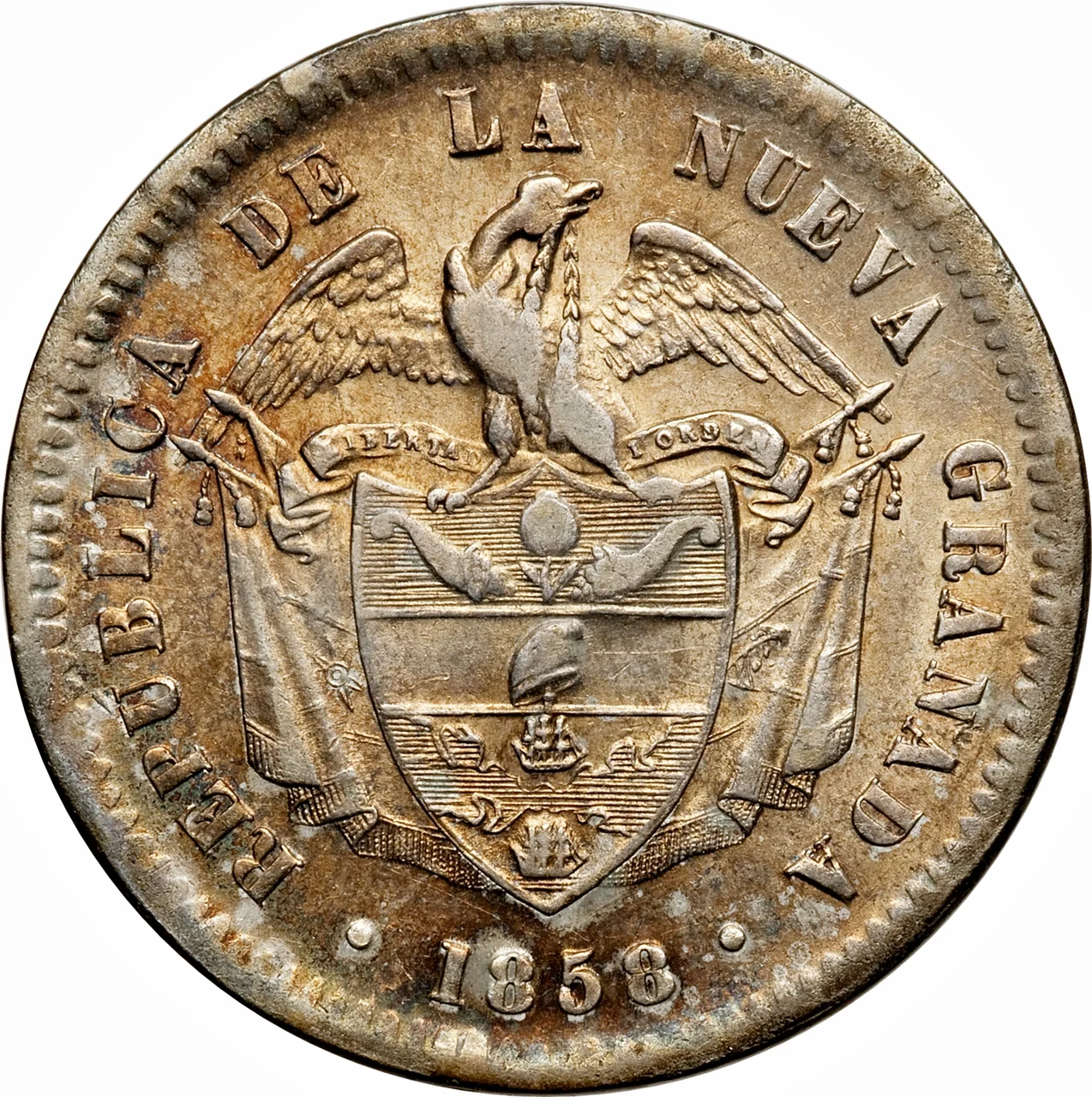
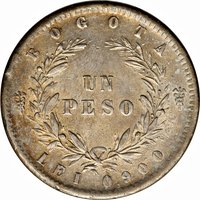
Obverse
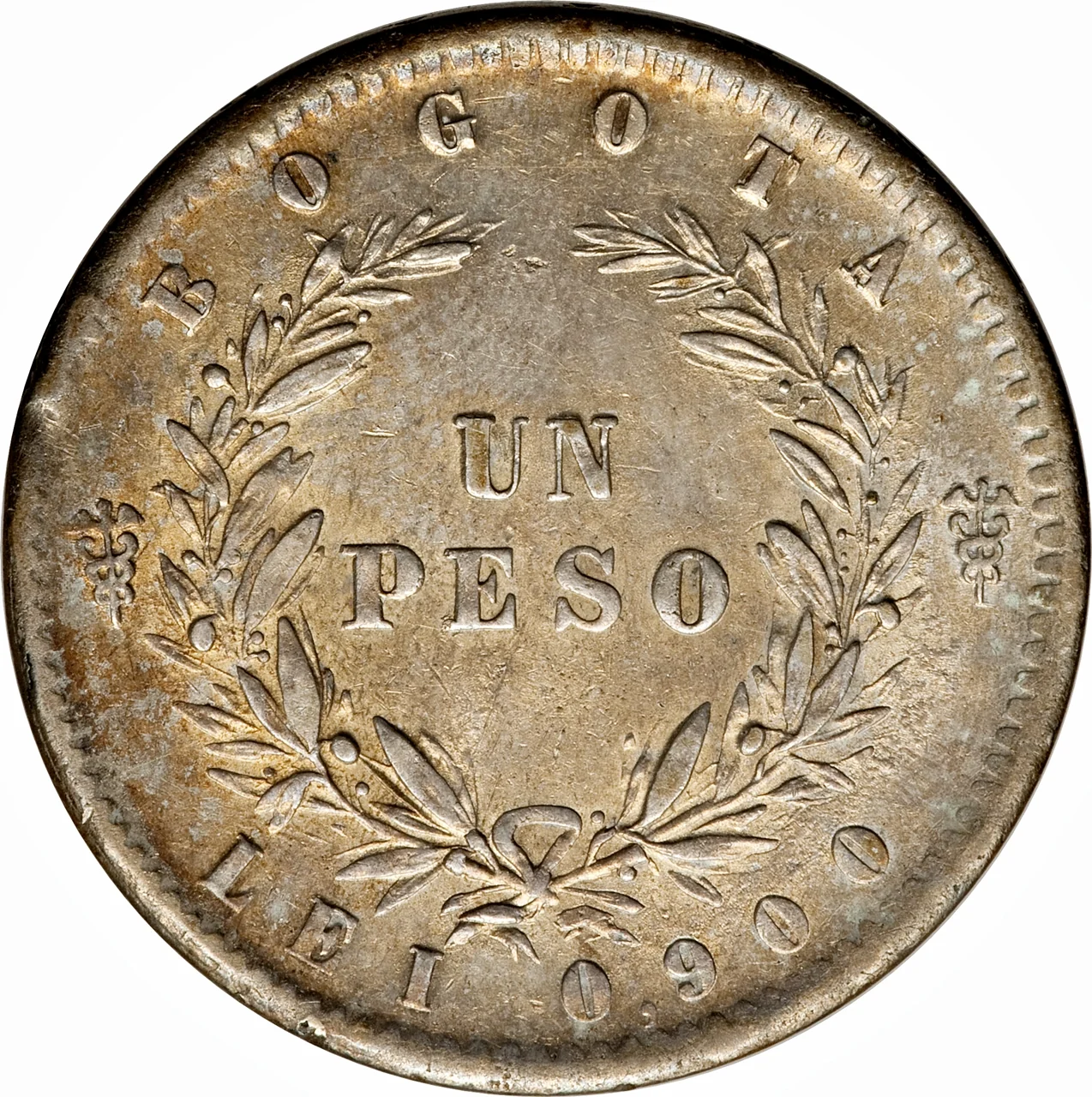
Reverse
Description:
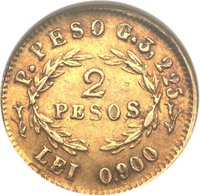
Wreath denomination. Mint above, fineness below.
Inscription:
BOGOTA
UN
PESO
LEI 0,900
UN
PESO
LEI 0,900
Script: Latin
Edge
Categories
| Symbols> Coat of Arms |
| Symbol> Wreath |
Mintings
| Year | Mint Mark | Mintage | Quality | Collection |
|---|---|---|---|---|
| 1855 | — | — | ||
| 1856 | — | — | ||
| 1857 | — | — | ||
| 1858 | — | — |
Historical background
In 1855, Colombia existed as the Republic of New Granada, a decentralized state grappling with the economic and political aftermath of its post-independence era. The period was defined by the implementation of the 1853 constitution, which granted significant autonomy to its provinces, including control over their own public finances and, critically, the power to issue paper money. This decentralization of monetary authority led to a fragmented and chaotic currency landscape, where the value and legitimacy of money varied dramatically from one province to the next.
The national government in Bogotá maintained the peso, theoretically pegged to the French franc, as the official currency, and gold and silver coins remained in circulation. However, the real story was the proliferation of low-denomination paper bills, known as billetes, issued by individual provincial banks and even some private entities. Without a central bank or uniform regulations, these notes were often poorly backed, leading to rapid depreciation, counterfeiting, and a severe loss of public confidence. In many regions, barter returned as a more reliable means of exchange than the unstable paper.
This monetary disarray was both a symptom and a cause of broader national instability. It hampered internal trade, complicated tax collection for the federal government, and fueled political tensions between liberal federalists and conservative centralists. The currency chaos of 1855 thus epitomized the challenges of building a unified national economy and would set the stage for future reforms, including attempts at centralization under the 1886 constitution and the eventual creation of the Banco de la República in 1923.
The national government in Bogotá maintained the peso, theoretically pegged to the French franc, as the official currency, and gold and silver coins remained in circulation. However, the real story was the proliferation of low-denomination paper bills, known as billetes, issued by individual provincial banks and even some private entities. Without a central bank or uniform regulations, these notes were often poorly backed, leading to rapid depreciation, counterfeiting, and a severe loss of public confidence. In many regions, barter returned as a more reliable means of exchange than the unstable paper.
This monetary disarray was both a symptom and a cause of broader national instability. It hampered internal trade, complicated tax collection for the federal government, and fueled political tensions between liberal federalists and conservative centralists. The currency chaos of 1855 thus epitomized the challenges of building a unified national economy and would set the stage for future reforms, including attempts at centralization under the 1886 constitution and the eventual creation of the Banco de la República in 1923.
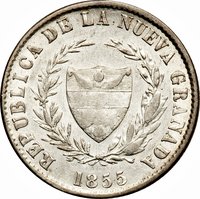
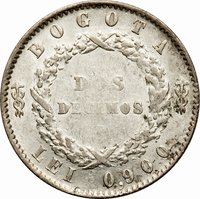
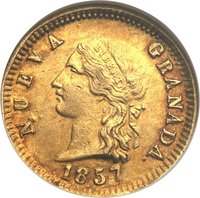
💎 Very Rare