

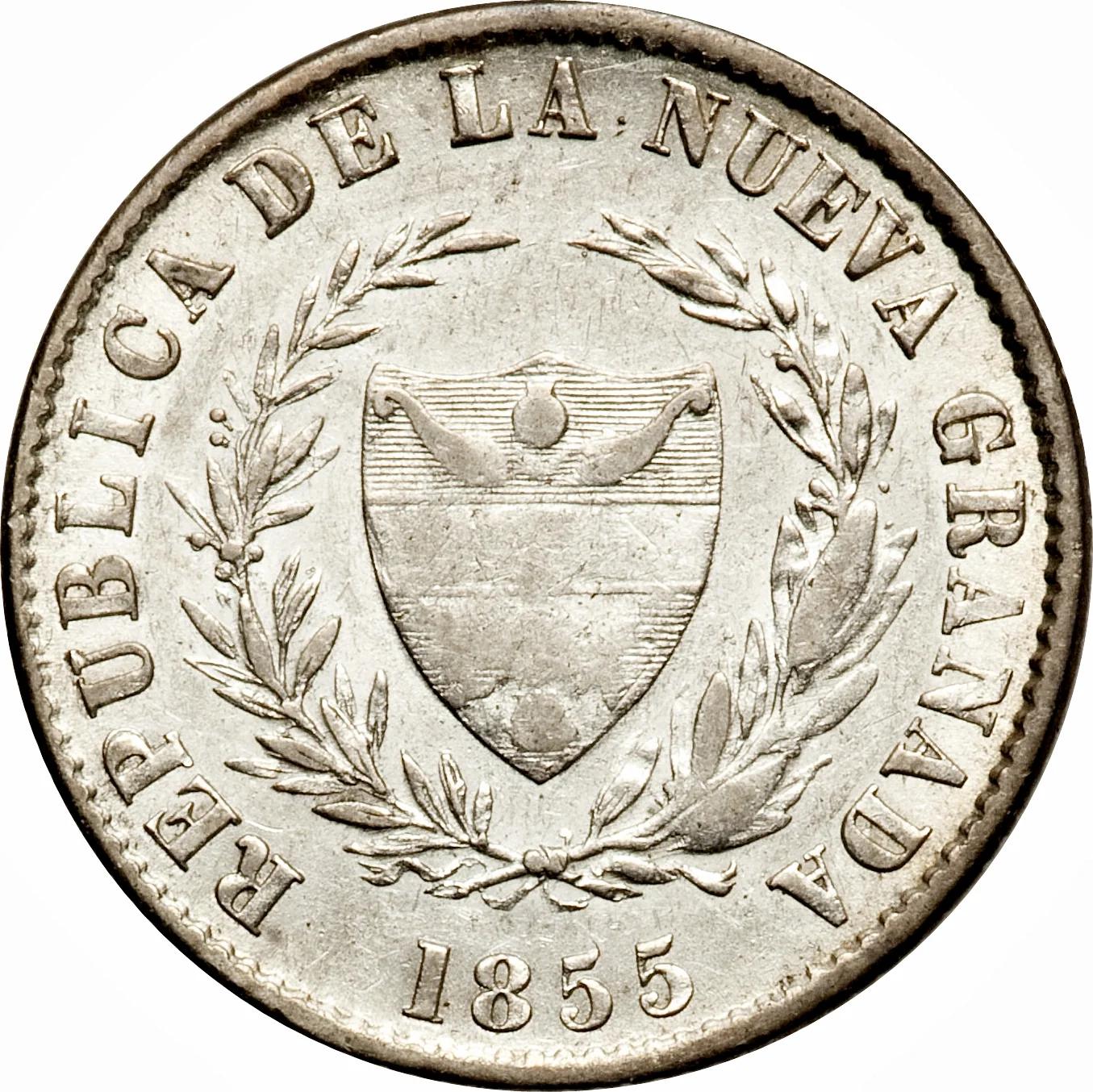
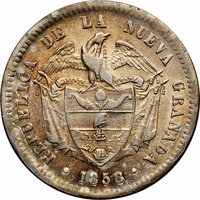
Obverse
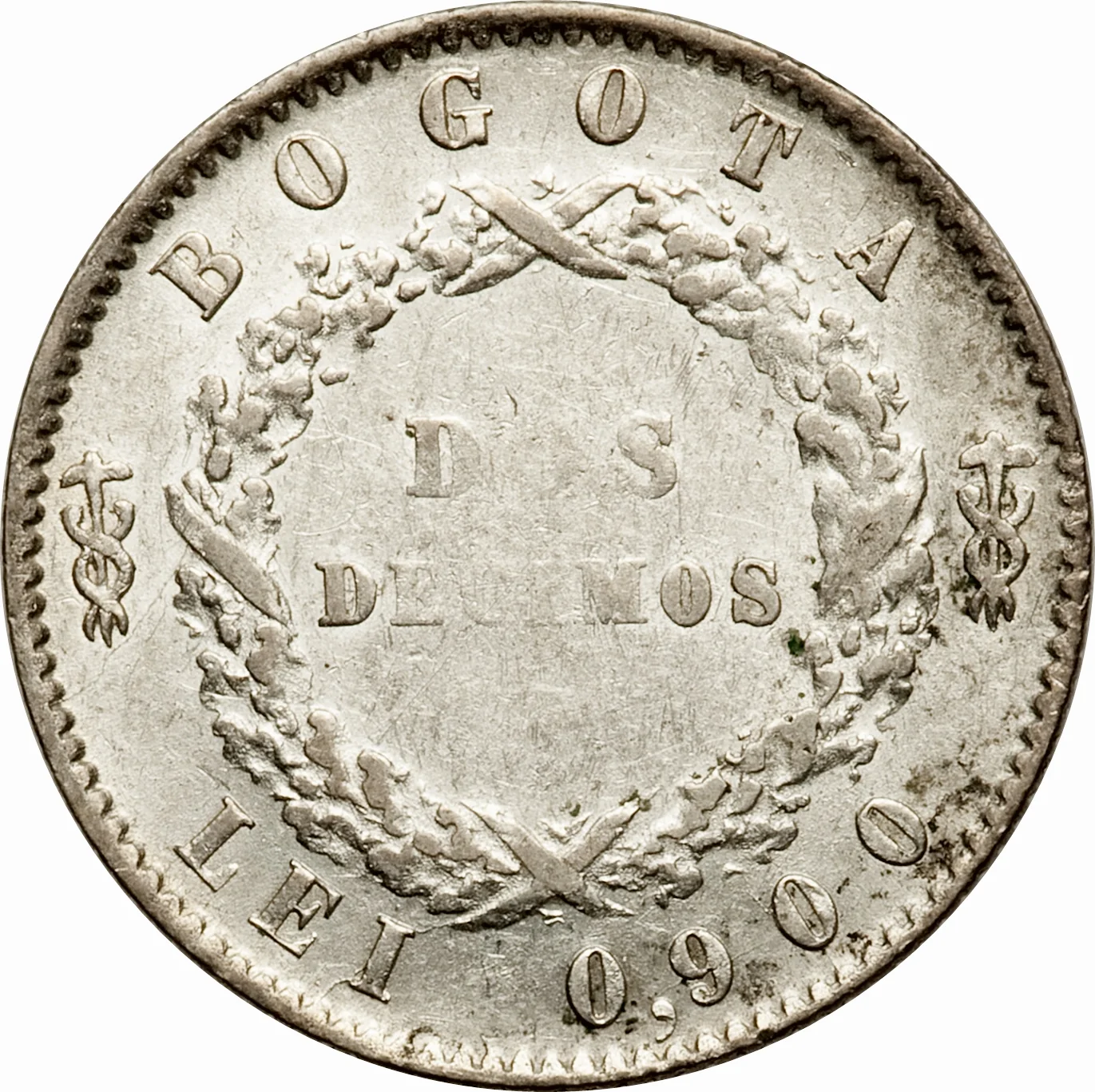
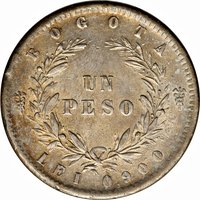
Reverse
Description:
Mint above, denomination in wreath, caduceus on sides, fineness below.
Inscription:
BOGOTA
DOS
DECIMOS
LEI 0.900
DOS
DECIMOS
LEI 0.900
Script: Latin
Edge
Milled
Mints
| Name | Mark |
|---|---|
| Bogota Mint | BOGOTA |
Mintings
| Year | Mint Mark | Mintage | Quality | Collection |
|---|---|---|---|---|
| 1854 | — | — | ||
| 1855 | — | — | ||
| 1856 | — | — | ||
| 1857 | — | — | ||
| 1858 | — | — |
Historical background
In 1854, Colombia, then known as the Republic of New Granada, was embroiled in a profound monetary crisis rooted in political fragmentation and economic instability. Following the dissolution of Gran Colombia in 1831, the nation lacked a unified and trusted national currency. The monetary landscape was a chaotic patchwork of coins from the colonial era, foreign currencies (particularly British sovereigns and French francs), and a multitude of privately issued paper notes from regional banks and commercial houses. This absence of a strong central monetary authority led to widespread confusion, counterfeiting, and wildly fluctuating values, severely hampering domestic trade and economic development.
The situation was exacerbated by the political turmoil of the mid-19th century, culminating in the 1854 civil war, known as the Golpe de Estado de 1854 or the Melo Revolution. This armed conflict, sparked by political and artisanal discontent, further destabilized the economy and shattered any remaining confidence in the fragile financial system. The government's desperate need for funds to finance military operations led to increased issuance of low-value token coinage and debt, inflating the money supply without backing and deepening the currency devaluation. Commerce often reverted to barter or relied on trusted foreign coinage, as the value of locally circulating mediums was unpredictable.
This crisis of 1854 served as a powerful catalyst for monetary reform. It highlighted the urgent need for a strong, centralized state capable of imposing fiscal and monetary order. The experience directly paved the way for the ambitious reforms of the 1850s and 1860s, most notably the establishment of the Banco de Bogotá in 1870 and, eventually, the creation of the Banco Nacional in 1880. Thus, the chaotic currency situation of 1854 stands as a critical juncture, demonstrating how monetary disunity weakened the nation and propelled the eventual creation of a centralized banking system and a uniform national currency.
The situation was exacerbated by the political turmoil of the mid-19th century, culminating in the 1854 civil war, known as the Golpe de Estado de 1854 or the Melo Revolution. This armed conflict, sparked by political and artisanal discontent, further destabilized the economy and shattered any remaining confidence in the fragile financial system. The government's desperate need for funds to finance military operations led to increased issuance of low-value token coinage and debt, inflating the money supply without backing and deepening the currency devaluation. Commerce often reverted to barter or relied on trusted foreign coinage, as the value of locally circulating mediums was unpredictable.
This crisis of 1854 served as a powerful catalyst for monetary reform. It highlighted the urgent need for a strong, centralized state capable of imposing fiscal and monetary order. The experience directly paved the way for the ambitious reforms of the 1850s and 1860s, most notably the establishment of the Banco de Bogotá in 1870 and, eventually, the creation of the Banco Nacional in 1880. Thus, the chaotic currency situation of 1854 stands as a critical juncture, demonstrating how monetary disunity weakened the nation and propelled the eventual creation of a centralized banking system and a uniform national currency.
💎 Extremely Rare