

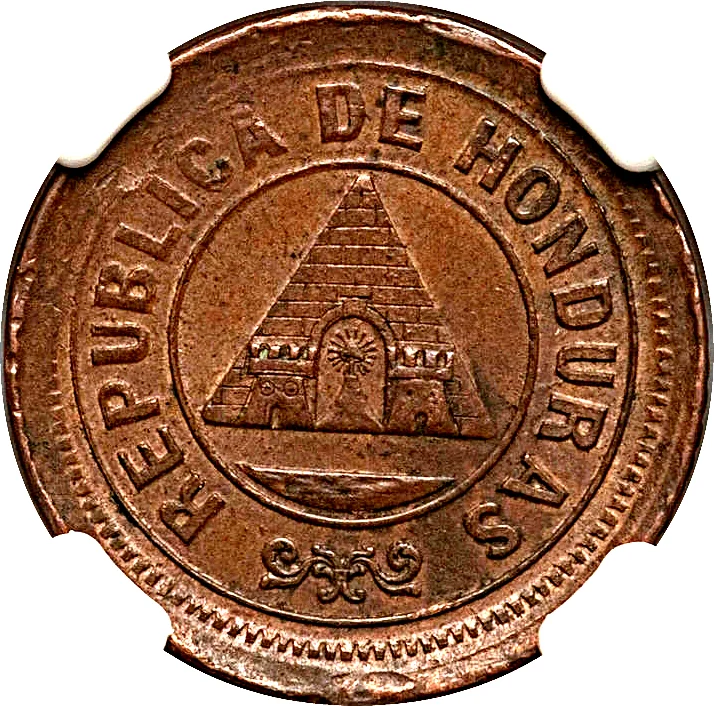
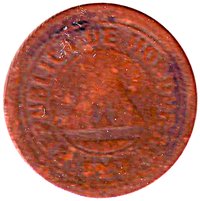
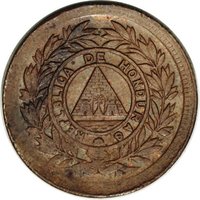
Obverse
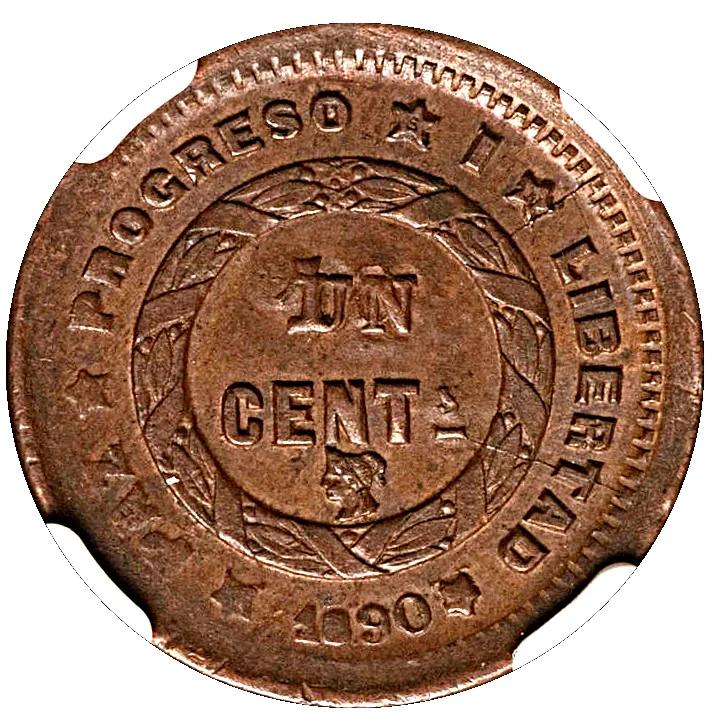
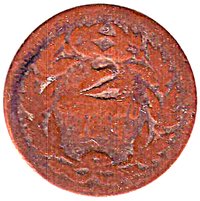
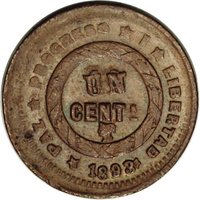
Reverse
Edge
Plain
Categories
| Symbols> Coat of Arms |
| Symbol> Wreath |
Mints
| Name | Mark |
|---|---|
| Casa Nacional de la Moneda | — |
Mintings
| Year | Mint Mark | Mintage | Quality | Collection |
|---|---|---|---|---|
| 1890 | — | — | ||
| 1893 | — | — | ||
| 1895 | — | 44,558 | ||
| 1907 | — | — | ||
| 1908 | — | 263,410 |
Historical background
In 1890, Honduras operated under a complex and unstable monetary system, a direct legacy of its colonial past and the economic turbulence of the 19th century. The official currency was the Honduran Peso, theoretically on a silver standard, but its value and circulation were inconsistent. More significantly, the country experienced a severe shortage of physical coinage, particularly of low denominations needed for daily transactions. This scarcity crippled local commerce and forced the widespread use of foreign coins, primarily the Mexican Peso and British sovereigns, which circulated freely alongside the domestic currency, creating a de facto multi-currency environment without formal fixed exchange rates.
This monetary chaos was exacerbated by the dominant role of foreign capital, especially from British and American interests, which controlled the burgeoning banana industry and mining sectors. These companies often paid workers and conducted large-scale transactions in their own preferred currencies or scripts, further fragmenting the money supply. The Honduran government, chronically weak and burdened by significant foreign debt (much of it to British bankers), lacked the fiscal strength and institutional capacity to issue a trusted, unified national currency. Consequently, the monetary system was not truly sovereign but rather a passive arena where stronger foreign currencies competed.
The situation in 1890 was a clear symptom of Honduras's position within the global economic order as a primary goods exporter with a fragile state. The lack of a reliable and exclusive national currency hindered domestic economic integration and made the government vulnerable to fluctuations in the value of the foreign coins circulating within its borders. This unstable foundation would persist until the early 20th century, when American influence became paramount and led to the creation of the Honduran Lempira in 1931, finally establishing a unified national currency.
This monetary chaos was exacerbated by the dominant role of foreign capital, especially from British and American interests, which controlled the burgeoning banana industry and mining sectors. These companies often paid workers and conducted large-scale transactions in their own preferred currencies or scripts, further fragmenting the money supply. The Honduran government, chronically weak and burdened by significant foreign debt (much of it to British bankers), lacked the fiscal strength and institutional capacity to issue a trusted, unified national currency. Consequently, the monetary system was not truly sovereign but rather a passive arena where stronger foreign currencies competed.
The situation in 1890 was a clear symptom of Honduras's position within the global economic order as a primary goods exporter with a fragile state. The lack of a reliable and exclusive national currency hindered domestic economic integration and made the government vulnerable to fluctuations in the value of the foreign coins circulating within its borders. This unstable foundation would persist until the early 20th century, when American influence became paramount and led to the creation of the Honduran Lempira in 1931, finally establishing a unified national currency.
💎 Very Rare