

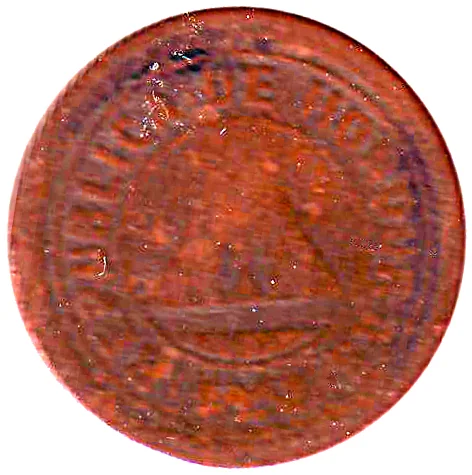
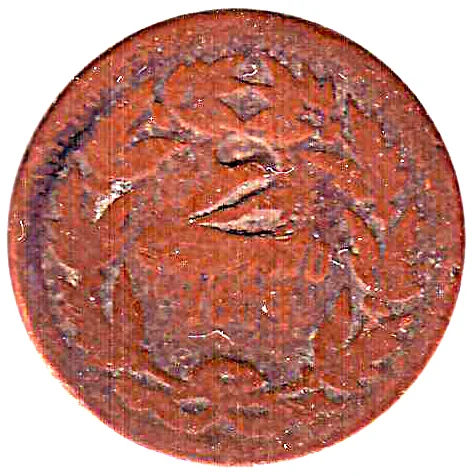
2 centavos – Honduras
Add to wishlist
Honduras
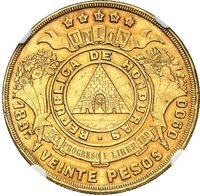
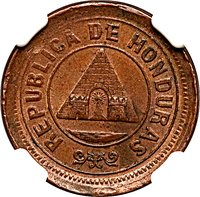
Obverse
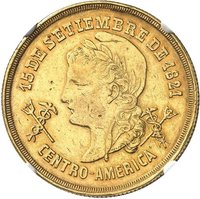
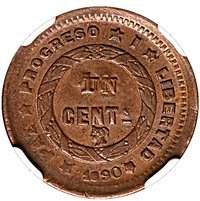
Reverse
Edge
Categories
| Symbols> Coat of Arms |
Mintings
| Year | Mint Mark | Mintage | Quality | Collection |
|---|---|---|---|---|
| 1889 | — | — |
Historical background
In 1889, Honduras operated under a complex and unstable monetary system, a legacy of its colonial past and 19th-century economic turmoil. The official currency was the silver Peso, theoretically adhering to a bimetallic standard alongside gold. However, the reality was one of severe currency scarcity and chaotic circulation. A multitude of foreign coins, primarily Peruvian, Bolivian, Chilean, and Mexican silver pesos, circulated alongside limited domestic issues, all valued by weight and fineness rather than face value. This proliferation of foreign specie, often worn or debased, created constant challenges for commerce and state finances, fostering confusion and hindering economic development.
The Honduran government's repeated attempts to establish monetary order had largely failed. Efforts to introduce a national coinage were sporadic and insufficient to meet the economy's needs. More critically, the country lacked a national banking institution to regulate currency supply and credit; the first major bank, the Banco de Honduras, would not be established until just a few years later, in 1892. Consequently, the economy relied heavily on imported coin and was vulnerable to external monetary shocks. The lack of a uniform, trusted currency exacerbated the nation's fiscal weaknesses, as the government struggled to collect taxes and fund its operations in a reliable monetary unit.
This monetary disarray reflected and amplified Honduras's broader economic condition in the late 19th century. The economy was predominantly agrarian, with a growing dependence on banana exports controlled by foreign corporations, notably the nascent United Fruit Company. The unstable currency situation discouraged foreign investment outside the enclave sectors and complicated both domestic trade and international financial transactions. Thus, in 1889, Honduras found itself in a transitional period, grappling with the monetary chaos of a post-colonial state while standing on the precipice of the export-led boom that would define its modern economy, all without a sound and sovereign currency system to support it.
The Honduran government's repeated attempts to establish monetary order had largely failed. Efforts to introduce a national coinage were sporadic and insufficient to meet the economy's needs. More critically, the country lacked a national banking institution to regulate currency supply and credit; the first major bank, the Banco de Honduras, would not be established until just a few years later, in 1892. Consequently, the economy relied heavily on imported coin and was vulnerable to external monetary shocks. The lack of a uniform, trusted currency exacerbated the nation's fiscal weaknesses, as the government struggled to collect taxes and fund its operations in a reliable monetary unit.
This monetary disarray reflected and amplified Honduras's broader economic condition in the late 19th century. The economy was predominantly agrarian, with a growing dependence on banana exports controlled by foreign corporations, notably the nascent United Fruit Company. The unstable currency situation discouraged foreign investment outside the enclave sectors and complicated both domestic trade and international financial transactions. Thus, in 1889, Honduras found itself in a transitional period, grappling with the monetary chaos of a post-colonial state while standing on the precipice of the export-led boom that would define its modern economy, all without a sound and sovereign currency system to support it.
✨ Legendary