

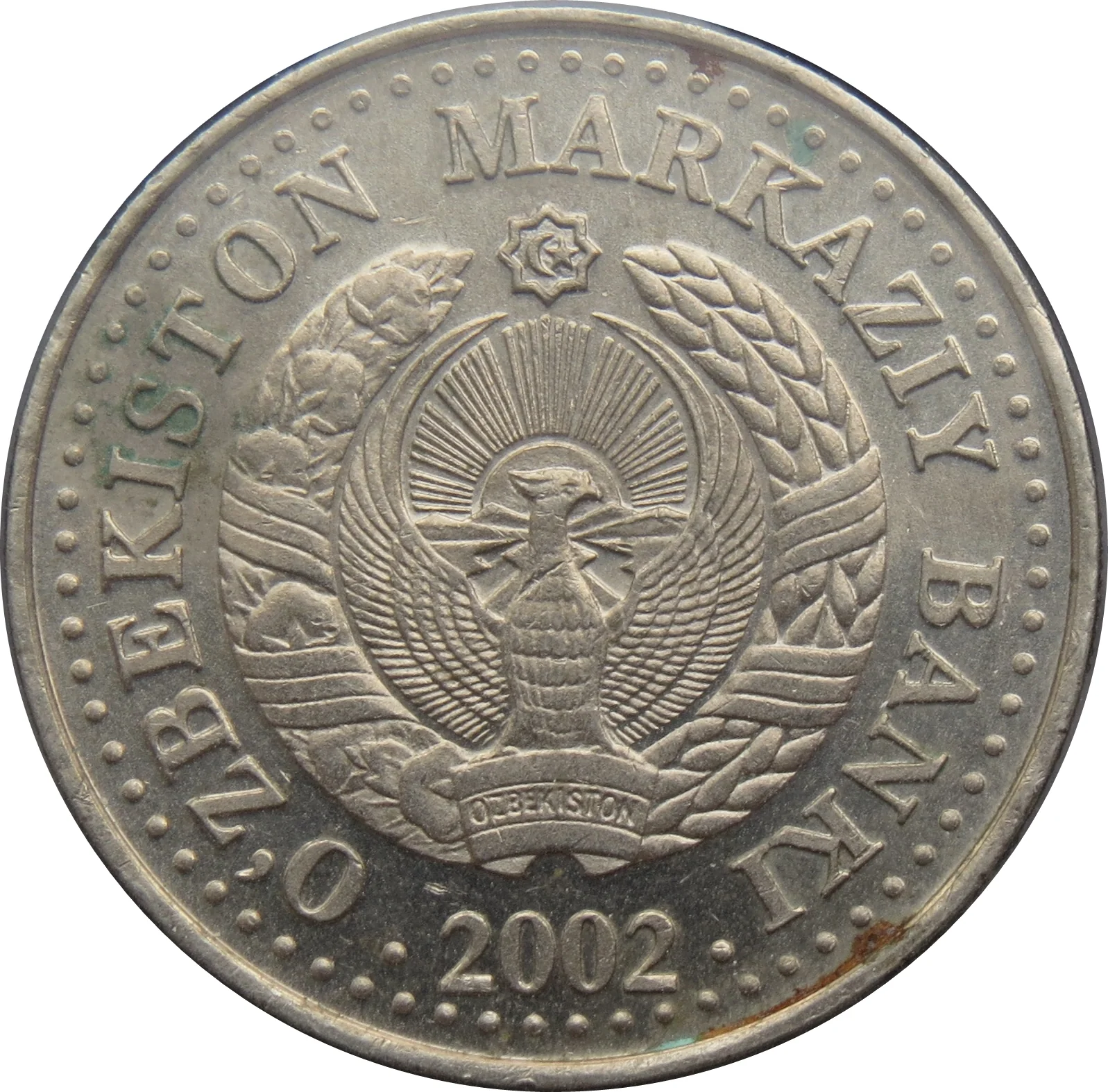
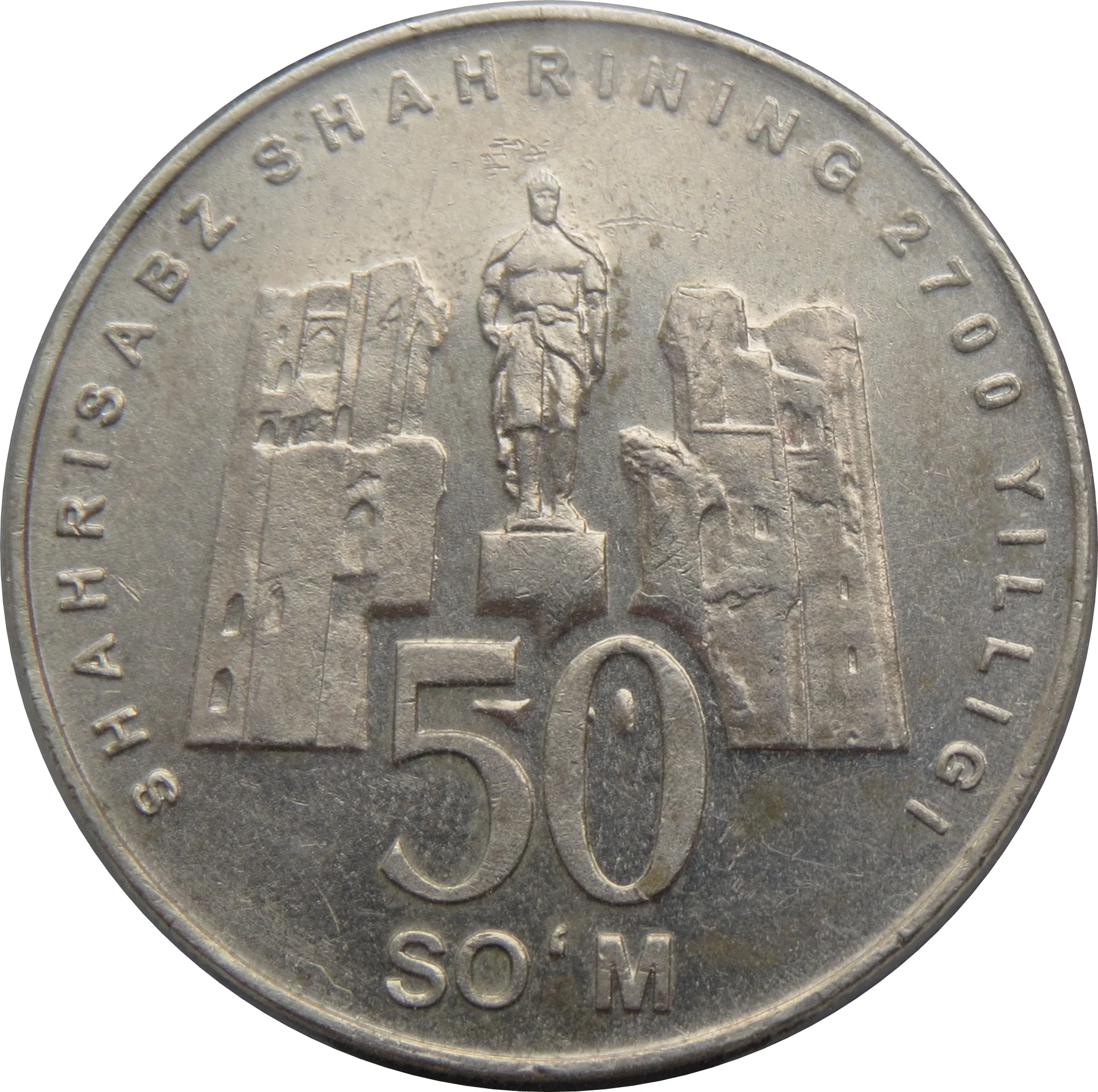
50 Soʻm (Shahrisabz Town) – Uzbekistan
Circulating commemorative coins
Commemoration: 2700th Anniversary of Shahrisabz Town
Uzbekistan
Context
Year: 2002
Issuer: Uzbekistan 
Period:
(since 1991)
Currency:
(since 1994)
Demonetization: 1 July 2019
Material
References
KM: #Click to copy to clipboard16
Numista: #3901
Value
Exchange value: 50 UZS
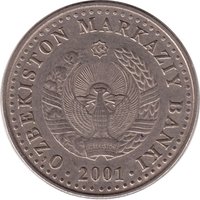
Obverse
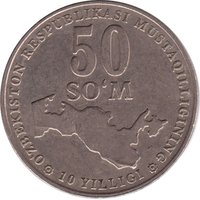
Reverse
Edge
Segmented reeding
Categories
| Animal> Bird |
| Mythology> Fantastic animal |
| Art> Sculpture |
| Building> Memorial |
| Person> Military leader |
| Person> Monarch |
| Symbols> Coat of Arms |
| Symbol> Sun |
Mintings
| Year | Mint Mark | Mintage | Quality | Collection |
|---|---|---|---|---|
| 2002 | — | — |
Historical background
In 2002, Uzbekistan's currency situation was defined by the stark contrast between the official exchange rate and a thriving black market, a legacy of the Soviet-era monetary system and cautious post-independence reforms. The national currency, the sum, was not freely convertible and was pegged at an artificially high official rate by the Central Bank of Uzbekistan, around 970 sum to the US dollar. This overvalued official rate did not reflect economic realities, creating a severe shortage of hard currency for businesses and individuals who needed it for foreign trade and travel. Consequently, a pervasive parallel market emerged where the sum traded at a significantly weaker rate, often between 1,200 to 1,300 per dollar, effectively creating a two-tier economy.
This dual system created significant economic distortions. Legitimate enterprises faced immense difficulties obtaining dollars at the official rate, hindering imports of vital machinery and materials, while fueling corruption as access to the preferential rate became a prized privilege. The black market, though illegal, became an essential but inefficient lubricant for the economy, allowing some level of international transaction to occur. The government's strict currency controls, including mandatory surrender of foreign exchange earnings and restrictions on access, were intended to conserve hard currency reserves but ultimately stifled foreign investment and economic growth.
The situation in 2002 represented a critical pressure point, highlighting the limitations of Uzbekistan's gradualist transition from a command economy. While providing short-term stability, the rigid currency regime was increasingly seen as a major obstacle to integration into the global economy. The growing disparity between the official and market rates built up significant pressure for reform, setting the stage for the difficult but necessary step of moving towards a unified and more realistic exchange rate, a process that would begin in earnest later in the decade.
This dual system created significant economic distortions. Legitimate enterprises faced immense difficulties obtaining dollars at the official rate, hindering imports of vital machinery and materials, while fueling corruption as access to the preferential rate became a prized privilege. The black market, though illegal, became an essential but inefficient lubricant for the economy, allowing some level of international transaction to occur. The government's strict currency controls, including mandatory surrender of foreign exchange earnings and restrictions on access, were intended to conserve hard currency reserves but ultimately stifled foreign investment and economic growth.
The situation in 2002 represented a critical pressure point, highlighting the limitations of Uzbekistan's gradualist transition from a command economy. While providing short-term stability, the rigid currency regime was increasingly seen as a major obstacle to integration into the global economy. The growing disparity between the official and market rates built up significant pressure for reform, setting the stage for the difficult but necessary step of moving towards a unified and more realistic exchange rate, a process that would begin in earnest later in the decade.
🌱 Common