

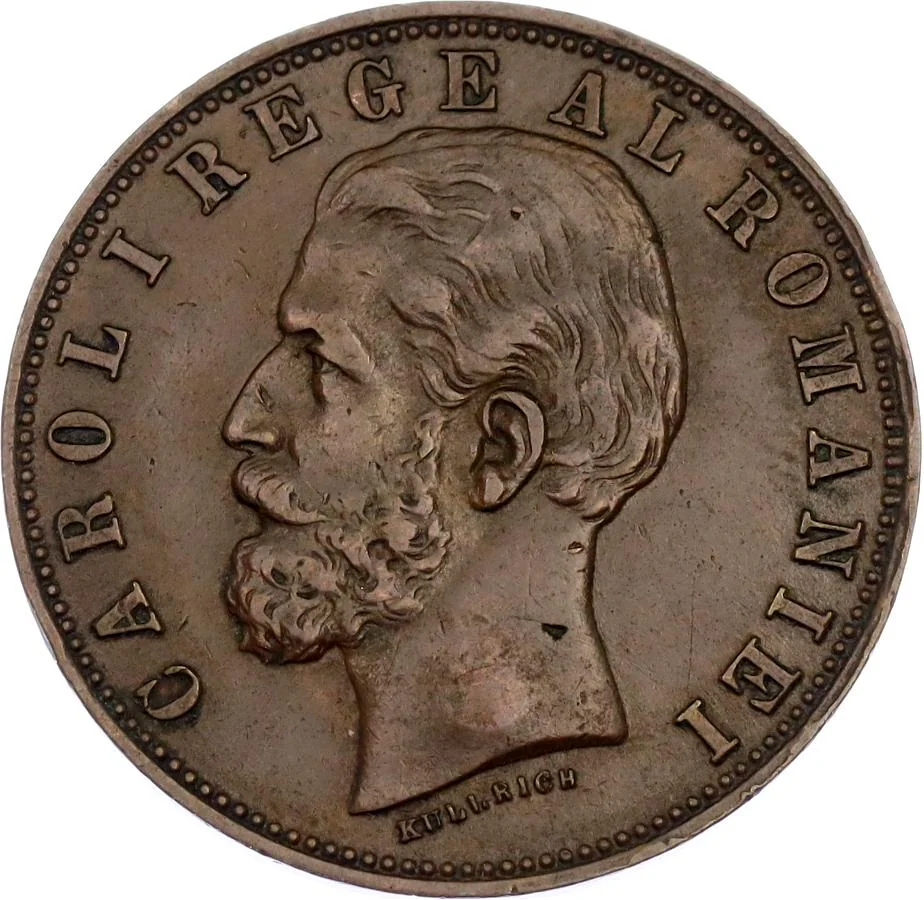
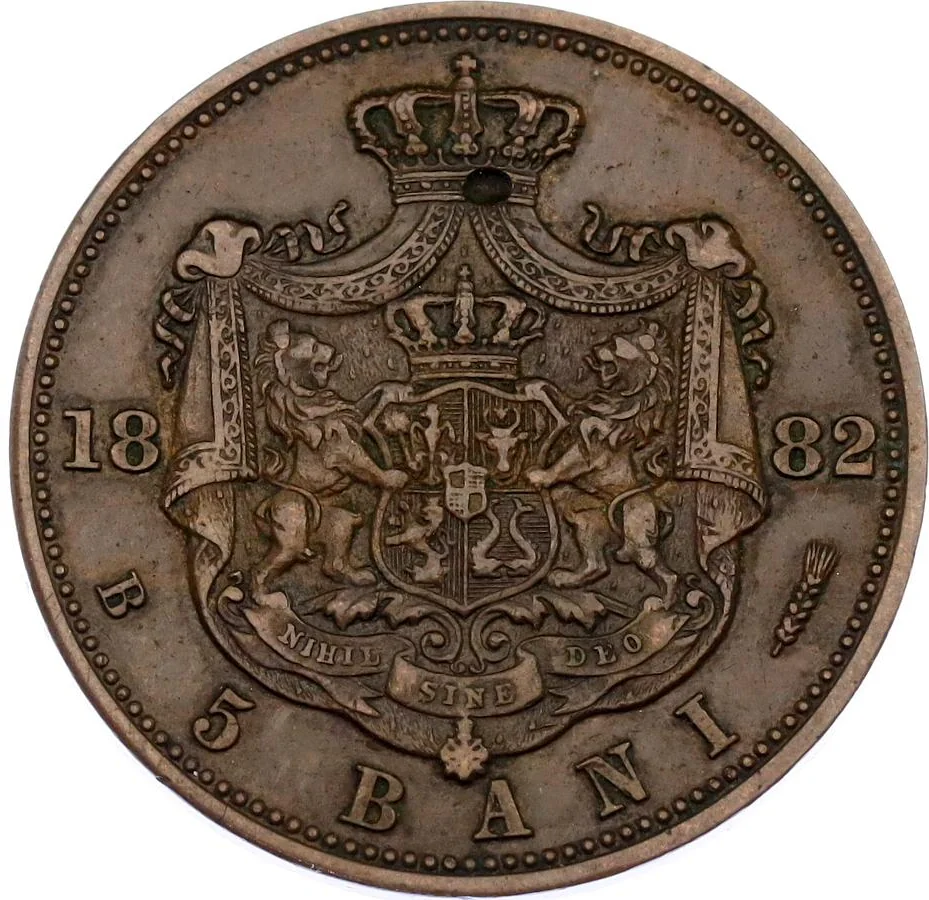

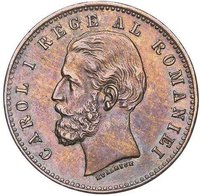
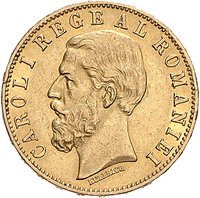
Obverse
Description:
King Carol I facing left, encircled by legend.
Inscription:
CAROL I REGE AL ROMANIEI
KULLRICH
KULLRICH
Translation:
CAROL I KING OF ROMANIA
KULLRICH
KULLRICH
Script: Latin
Engraver: Friedrich Wilhelm Kullrich
Reverse
Edge
Plain
Mints
| Name | Mark |
|---|---|
| State Mint | B |
Mintings
Historical background
In 1882, Romania was navigating a complex monetary landscape as a newly independent principality seeking economic stability and international recognition. The country operated on a bimetallic system theoretically tied to both gold and silver, but in practice, the currency in widespread daily use was the silver leu. However, the value of silver was declining sharply on the global market due to large discoveries and demonetization in other nations, causing the Romanian leu to depreciate against the gold-backed currencies of major European powers. This instability created significant challenges for foreign trade, government borrowing, and long-term economic planning, highlighting the vulnerability of a silver-based currency in a world increasingly moving to the gold standard.
The situation was further complicated by the circulation of a multitude of foreign coins, particularly Austrian florins, Russian rubles, and Turkish gold liras, alongside domestic issues. This monetary pluralism reflected Romania's historical ties and geographic position but undermined state sovereignty and fiscal control. The National Bank of Romania, established in 1880, held the exclusive right to issue banknotes, yet establishing confidence in a unified national currency remained an ongoing struggle. The government's ambition to join the Latin Monetary Union—a 19th-century attempt to standardize European currencies—was a key driver of policy, but membership required a firm commitment to gold convertibility, which Romania's finances could not yet securely support.
Consequently, 1882 was a year of transition and preparation. Policymakers were actively laying the groundwork for a decisive shift to a gold standard, a move seen as essential for securing international loans, attracting foreign investment, and solidifying national prestige. This culminated just a few years later with the Currency Law of 1890, which formally adopted a gold monometallism, pegging the leu to the French franc. Therefore, the currency situation in 1882 is best understood as a precarious interim period, defined by the pressures of global economic forces and setting the stage for Romania's definitive monetary reform at the decade's end.
The situation was further complicated by the circulation of a multitude of foreign coins, particularly Austrian florins, Russian rubles, and Turkish gold liras, alongside domestic issues. This monetary pluralism reflected Romania's historical ties and geographic position but undermined state sovereignty and fiscal control. The National Bank of Romania, established in 1880, held the exclusive right to issue banknotes, yet establishing confidence in a unified national currency remained an ongoing struggle. The government's ambition to join the Latin Monetary Union—a 19th-century attempt to standardize European currencies—was a key driver of policy, but membership required a firm commitment to gold convertibility, which Romania's finances could not yet securely support.
Consequently, 1882 was a year of transition and preparation. Policymakers were actively laying the groundwork for a decisive shift to a gold standard, a move seen as essential for securing international loans, attracting foreign investment, and solidifying national prestige. This culminated just a few years later with the Currency Law of 1890, which formally adopted a gold monometallism, pegging the leu to the French franc. Therefore, the currency situation in 1882 is best understood as a precarious interim period, defined by the pressures of global economic forces and setting the stage for Romania's definitive monetary reform at the decade's end.
🌱 Common