


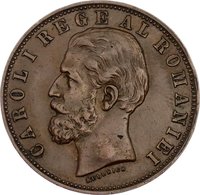
Obverse
Description:
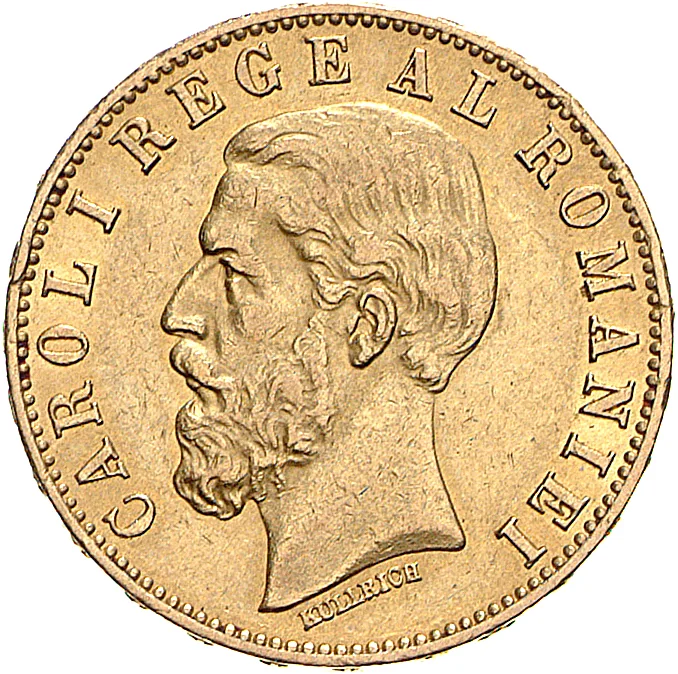
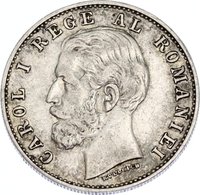
Charles I's head, left; signed "KULLRICH" below.
Inscription:
CAROL I REGE AL ROMANIEI
KULLRICH
KULLRICH
Translation:
CAROL I KING OF ROMANIA
KULLRICH
KULLRICH
Script: Latin
Engraver: Friedrich Wilhelm Kullrich
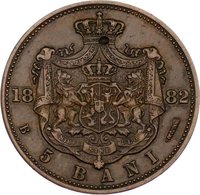
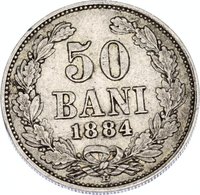
Reverse
Description:
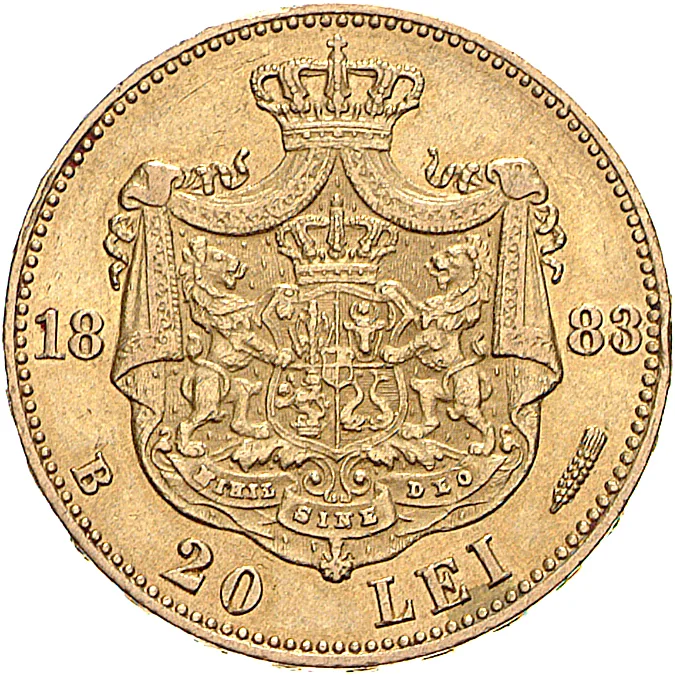
Crowned shield on a mantling, supported by lions.
Inscription:
18 90
B
20 LEI
B
20 LEI
Script: Latin
Edge
Categories
| Symbols> Coat of Arms |
| Person> Monarch |
Mints
| Name | Mark |
|---|---|
| State Mint | B |
Historical background
In 1883, Romania was navigating a complex monetary landscape as a newly independent kingdom seeking economic stability and international recognition. The country operated on a bimetallic system, but in practice, the currency in circulation was a chaotic mix of Ottoman, Russian, Austro-Hungarian, and domestic coins, alongside paper money of varying reliability. This multiplicity of currencies created significant challenges for trade, state finance, and public trust, hindering the nation's modernisation efforts and complicating its ambition to attract foreign investment.
The pivotal development of this period was the preparation for a profound monetary reform, which would culminate in 1890 with the creation of the Romanian leu on the gold standard. The 1883 law, building upon earlier statutes, was a critical step in this process. It formally adopted the Latin Monetary Union standards, pegging the future Romanian currency to the French franc and defining the leu as equal to 1 gram of gold at 90% purity. This move was both economic and deeply political, aligning Romania with Western European financial systems and signalling its orientation away from the Ottoman and Russian spheres of influence.
Consequently, the currency situation in 1883 was one of transition and anticipation. While the old, fragmented system still physically dominated everyday transactions, the legal and institutional framework for a modern, unified, and gold-backed national currency was being actively put in place. This period of preparation, involving the accumulation of gold reserves and the establishment of the National Bank of Romania in 1880, set the stage for the eventual stabilization of the leu, which was crucial for Romania's integration into the European economic order.
The pivotal development of this period was the preparation for a profound monetary reform, which would culminate in 1890 with the creation of the Romanian leu on the gold standard. The 1883 law, building upon earlier statutes, was a critical step in this process. It formally adopted the Latin Monetary Union standards, pegging the future Romanian currency to the French franc and defining the leu as equal to 1 gram of gold at 90% purity. This move was both economic and deeply political, aligning Romania with Western European financial systems and signalling its orientation away from the Ottoman and Russian spheres of influence.
Consequently, the currency situation in 1883 was one of transition and anticipation. While the old, fragmented system still physically dominated everyday transactions, the legal and institutional framework for a modern, unified, and gold-backed national currency was being actively put in place. This period of preparation, involving the accumulation of gold reserves and the establishment of the National Bank of Romania in 1880, set the stage for the eventual stabilization of the leu, which was crucial for Romania's integration into the European economic order.
⭐ Somewhat Rare