

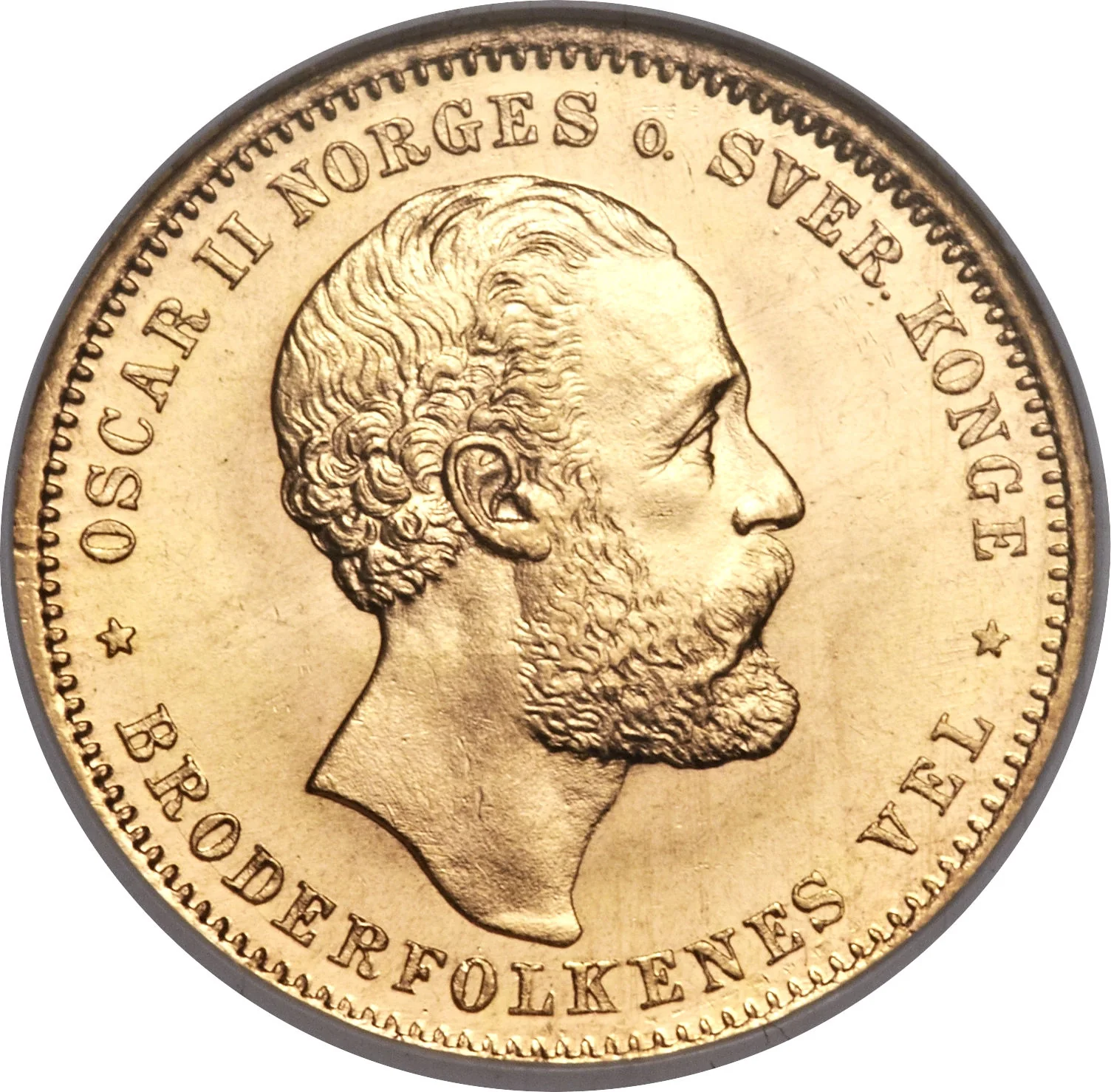
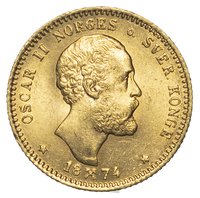
Obverse
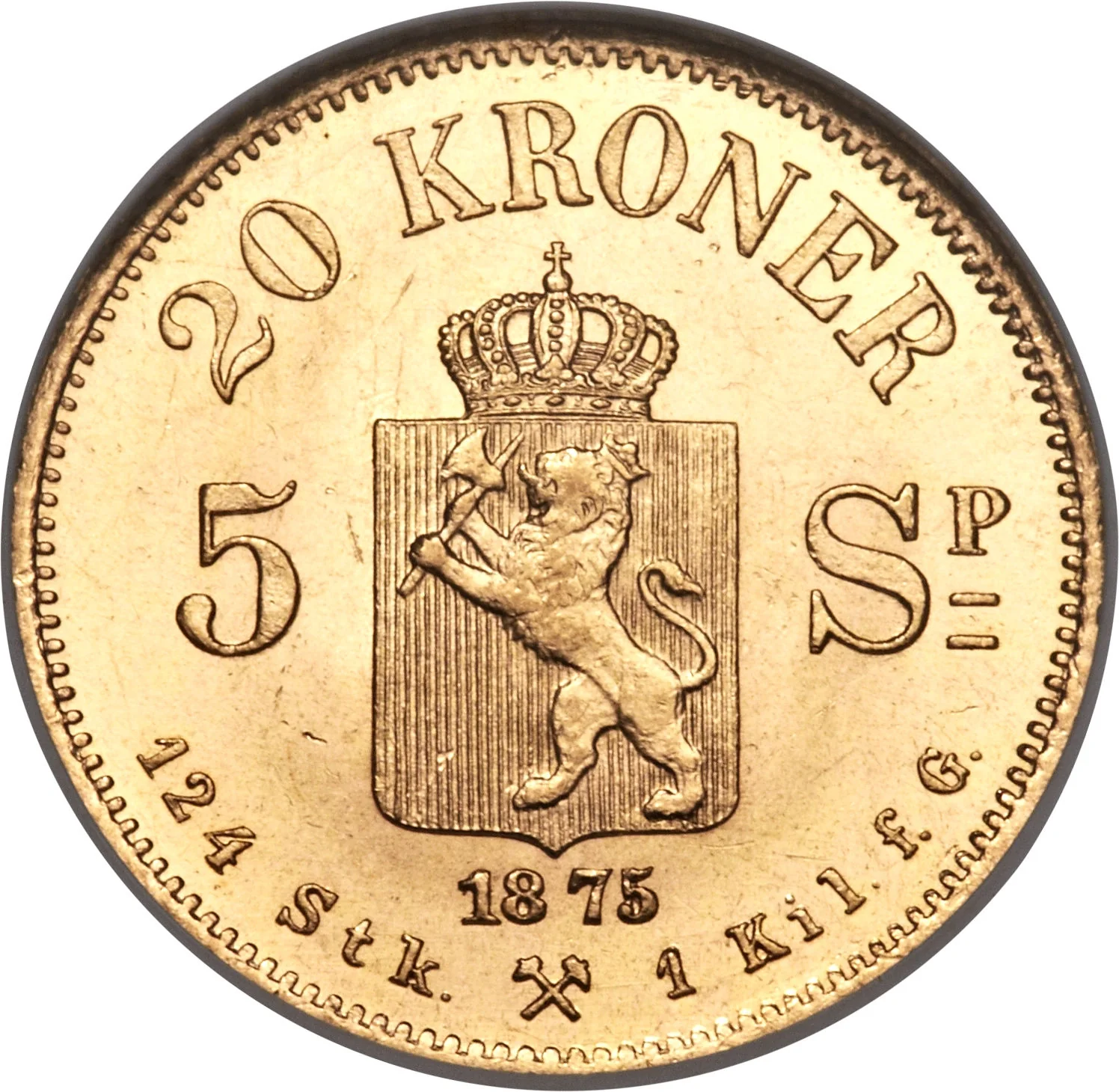
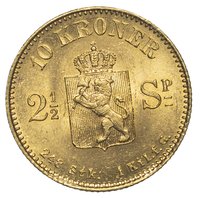
Reverse
Description:
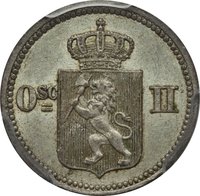
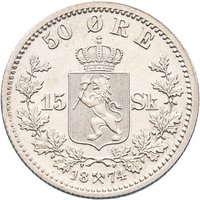
Crowned shield with Norwegian lion holding a halberd. Old value inside shield, new value above crown. Date below shield, value and mintmark below date. Beaded rim.
Inscription:
20 KRONER
5 | SP=
18 75
124 Stk. ⚒ 1 Kil. f. G.
5 | SP=
18 75
124 Stk. ⚒ 1 Kil. f. G.
Script: Latin
Edge
Reeded
Mints
| Name | Mark |
|---|---|
| Norwegian Mint | — |
Mintings
| Year | Mint Mark | Mintage | Quality | Collection |
|---|---|---|---|---|
| 1874 | — | 197,500 | ||
| 1875 | — | 105,000 |
Historical background
In 1874, Norway stood at a monetary crossroads, transitioning from a complex system to a modern, unified currency. Prior to this, the country's economy operated on the speciedaler, a silver-based currency divided into 120 skilling. This system, a legacy of the union with Denmark, was cumbersome for calculation and trade. Furthermore, the circulation was cluttered with a mix of domestic notes, foreign coins (particularly Swedish), and private bank issues, creating inefficiency and uncertainty in commercial transactions.
The decisive shift was driven by both practical economic needs and political symbolism. The Scandinavian Monetary Union (SMU), established in 1873 with Denmark and Sweden, provided the framework. Norway joined in 1874, replacing the speciedaler with the krone (crown), subdivided into 100 øre. This decimal system aligned Norway with its neighbors and international best practice, facilitating trade and investment. Crucially, the new krone was placed on the gold standard, pegging its value to a fixed quantity of gold, which promised monetary stability and greater confidence in international finance.
Thus, 1874 marked the culmination of a major financial reform. The introduction of the Norwegian krone was more than a simple redenomination; it was a strategic move to integrate Norway into the Scandinavian and global economies, assert its economic identity within the Swedish union, and embrace the orthodox monetary principles of the late 19th century. The changes laid a stable foundation for the country's industrial growth in the decades that followed.
The decisive shift was driven by both practical economic needs and political symbolism. The Scandinavian Monetary Union (SMU), established in 1873 with Denmark and Sweden, provided the framework. Norway joined in 1874, replacing the speciedaler with the krone (crown), subdivided into 100 øre. This decimal system aligned Norway with its neighbors and international best practice, facilitating trade and investment. Crucially, the new krone was placed on the gold standard, pegging its value to a fixed quantity of gold, which promised monetary stability and greater confidence in international finance.
Thus, 1874 marked the culmination of a major financial reform. The introduction of the Norwegian krone was more than a simple redenomination; it was a strategic move to integrate Norway into the Scandinavian and global economies, assert its economic identity within the Swedish union, and embrace the orthodox monetary principles of the late 19th century. The changes laid a stable foundation for the country's industrial growth in the decades that followed.
Series: 1874 Norway circulation coins
💎 Very Rare