

Spain
Context
Years: 1880–1885
Issuer: Spain 
Ruler: Alfonso XII
Currency:
(1868—2001)
Demonetization: 20 February 1939
Total mintage: 8,434,000
Material
References
KM: #Click to copy to clipboard685
Numista: #14295
Value
Exchange value: 0.50 ESP
Bullion value: $5.93
Obverse
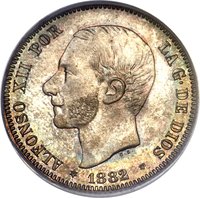
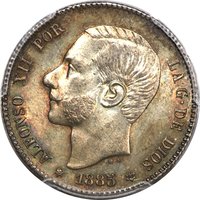
Description:
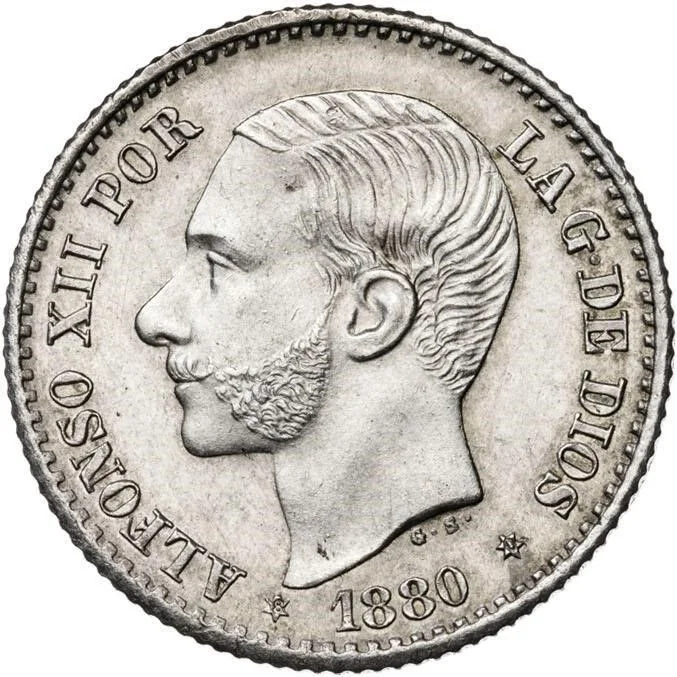
King Alfonso XII facing left.
Inscription:
ALFONSO XII POR LA G· DE DIOS
G· S·
🟌 1880 🟌
G· S·
🟌 1880 🟌
Translation:
By the grace of God, Alfonso XII
Sovereign of Spain
🟌 1880 🟌
Sovereign of Spain
🟌 1880 🟌
Script: Latin
Language: Spanish
Engraver: Gregorio Sellán y González
Reverse
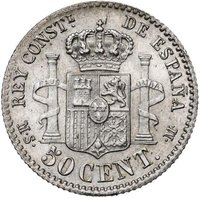
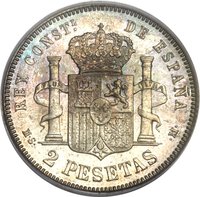
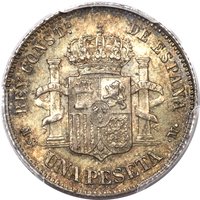
Description:
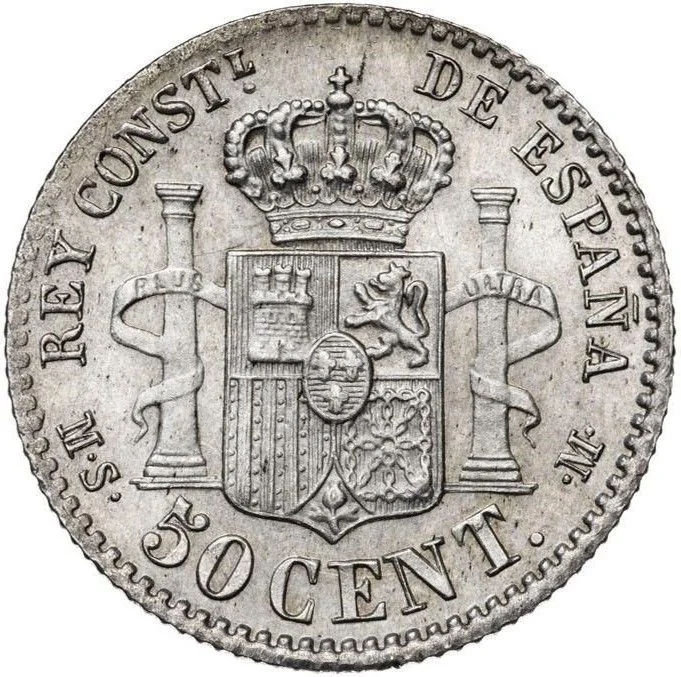
Spanish coat of arms with the Pillars of Hercules.
Inscription:
REY CONSTL. DE ESPAÑA
PLUS ULTRA
M · S · 50 CENT. · M ·
PLUS ULTRA
M · S · 50 CENT. · M ·
Translation:
KING CONSTITUTIONAL OF SPAIN
MORE BEYOND
M · S · 50 CENT · M ·
MORE BEYOND
M · S · 50 CENT · M ·
Script: Latin
Engraver: Gregorio Sellán y González
Edge
Reeded
Categories
| Person> Monarch |
| Symbols> Coat of Arms |
Mints
| Name | Mark |
|---|---|
| Royal Mint of Madrid | (🟌) |
Mintings
| Year | Mint Mark | Mintage | Quality | Collection |
|---|---|---|---|---|
| 1880 | 🟌 | 2,787,000 | ||
| 1881 | 🟌 | 5,647,000 | ||
| 1885 | 🟌 | — |
Historical background
In 1880, Spain's currency system was in a state of transition and complexity, caught between its colonial past and the demands of a modernizing European economy. The foundational unit was the peseta, introduced in 1868 to replace the old real and to unify the nation under a decimal, bimetallic standard (gold and silver) aligned with the Latin Monetary Union. However, the theoretical bimetallism was unstable in practice. A global glut of silver following major discoveries had driven down its market value, causing gold coins to be hoarded or exported. This effectively pushed Spain toward a de facto silver standard, where the peseta's value was tied to a metal of declining international worth.
This monetary fragility was exacerbated by profound political instability, including the recent end of the First Spanish Republic (1873-1874) and the restoration of the Bourbon monarchy. Chronic budget deficits, foreign debt, and the costs of ongoing conflicts like the Third Carlist War (ended 1876) eroded confidence. The government frequently resorted to printing paper money—banknotes issued by the Bank of Spain—which were not fully convertible to specie (gold or silver) on demand. This created a dual circulation: a trusted but scarce metallic currency for large transactions and international trade, and a less-trusted, inflationary paper currency for everyday use.
Consequently, Spain struggled with exchange rate volatility and a premium on gold, hindering foreign investment and trade. While major European powers like Britain operated on a stable gold standard, Spain's weaker, silver-based economy found itself at a commercial disadvantage. The period around 1880 thus represents a pivotal moment of monetary vulnerability, setting the stage for future debates and crises that would culminate in the suspension of silver convertibility in 1883 and a long, difficult path toward financial stabilization.
This monetary fragility was exacerbated by profound political instability, including the recent end of the First Spanish Republic (1873-1874) and the restoration of the Bourbon monarchy. Chronic budget deficits, foreign debt, and the costs of ongoing conflicts like the Third Carlist War (ended 1876) eroded confidence. The government frequently resorted to printing paper money—banknotes issued by the Bank of Spain—which were not fully convertible to specie (gold or silver) on demand. This created a dual circulation: a trusted but scarce metallic currency for large transactions and international trade, and a less-trusted, inflationary paper currency for everyday use.
Consequently, Spain struggled with exchange rate volatility and a premium on gold, hindering foreign investment and trade. While major European powers like Britain operated on a stable gold standard, Spain's weaker, silver-based economy found itself at a commercial disadvantage. The period around 1880 thus represents a pivotal moment of monetary vulnerability, setting the stage for future debates and crises that would culminate in the suspension of silver convertibility in 1883 and a long, difficult path toward financial stabilization.
🌱 Common