

100 won (Liberation) – South Korea
Add to wishlist
Circulating commemorative coins
Commemoration: 30th Anniversary of Liberation
South Korea
Context
Material
References
KM: #
Numista: #14288
Value
Exchange value: 100 KRW
Inflation-adjusted value: 1531.83 KRW
Obverse
Description:
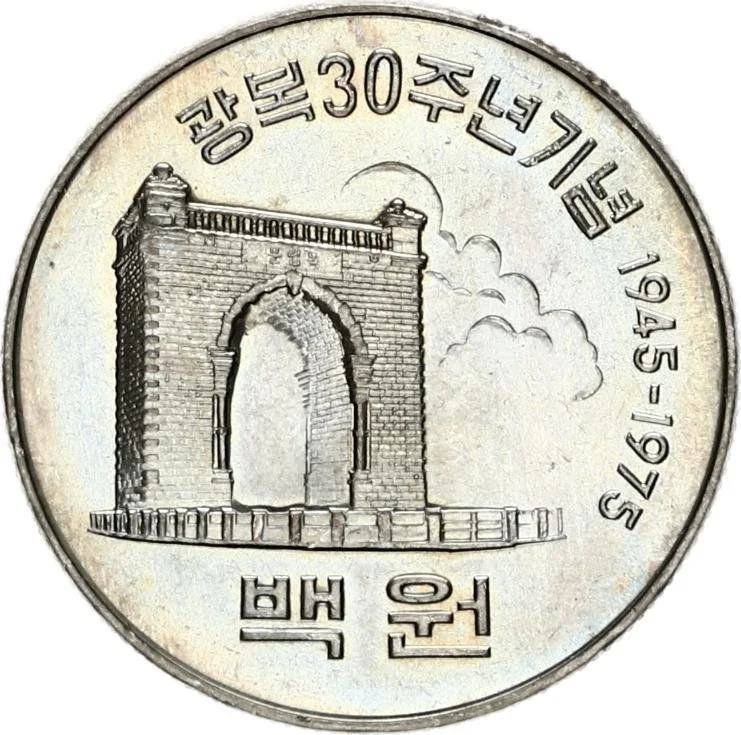
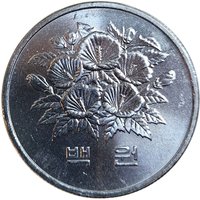
Liberty Gate, Denomination below
Inscription:
광복30주년기념 1945-1975
백원
백원
Translation:
Commemorating the 30th Anniversary of Liberation 1945-1975
One Hundred Won
One Hundred Won
Script: Hangul
Language: Korean
Engraver: Jo Byung-soo
Reverse
Description:
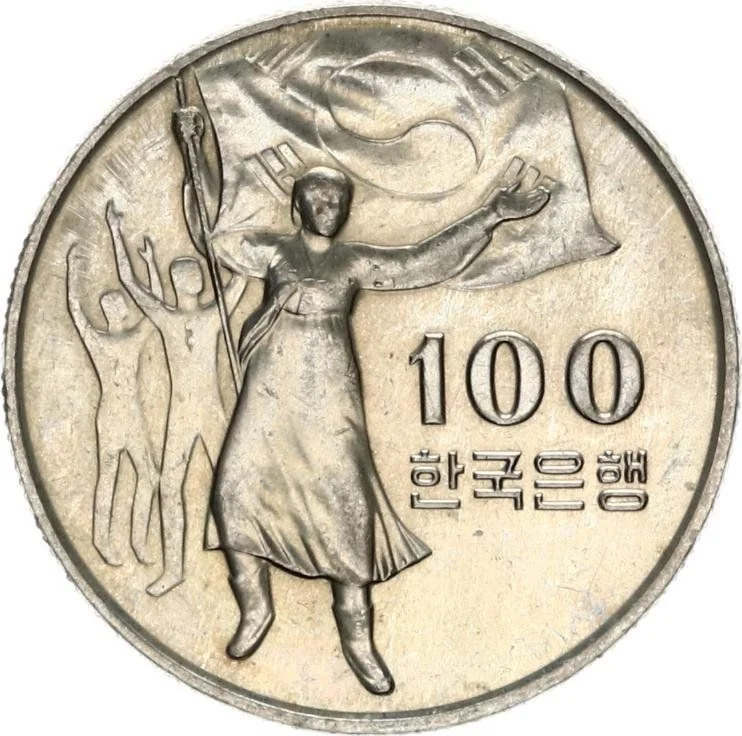
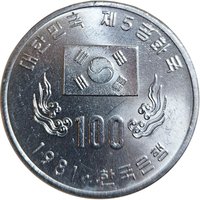
Figures stand before a South Korean flag, denomination at right.
Inscription:
100
한국은행
한국은행
Translation:
Bank of Korea
Script: Hangul
Language: Korean
Engraver: Jo Byung-soo
Edge
Reeded
Mints
| Name | Mark |
|---|---|
| Korea Minting and Security Printing Corporation | — |
Mintings
| Year | Mint Mark | Mintage | Quality | Collection |
|---|---|---|---|---|
| 1975 | — | 4,998,000 | ||
| 1975 | — | 2,000 | Proof |
Historical background
In 1975, South Korea's currency situation was fundamentally shaped by the authoritarian Park Chung-hee regime's state-led development model. The won was a tightly controlled, non-convertible currency, with its value fixed by government decree rather than market forces. This system was a critical tool for the government's export-oriented industrialization drive, as an artificially low exchange rate made Korean goods cheap on the global market. All foreign exchange transactions were strictly regulated by the government, which centralized hard currency earnings from exports to finance the import of essential raw materials, machinery, and technology needed for heavy and chemical industries.
The financial landscape was one of severe repression, with interest rates kept artificially low to provide cheap capital to government-favored conglomerates, the chaebol. This led to chronic excess demand for loans, necessitating a system of directed credit where the state allocated financing according to its Five-Year Plans. Consequently, a large, unofficial curb market existed where businesses paid much higher interest rates for needed funds. Inflation was a persistent challenge, partly fueled by monetary expansion to finance development, but it was managed—though not eliminated—through price controls and the stabilizing effect of fixed exchange rates.
Internationally, South Korea's currency policy drew scrutiny and pressure, particularly from the United States. As the economy grew through export surges, trade tensions increased, with critics arguing the won was significantly undervalued, granting Korea an unfair trade advantage. While these external pressures would later build toward gradual liberalization, in 1975 the system remained rigidly in place. The primary goal was not monetary stability for its own sake, but rather the mobilization of all financial resources to sustain the "Miracle on the Han River" and ensure national survival in a still-tense Cold War environment on the Korean peninsula.
The financial landscape was one of severe repression, with interest rates kept artificially low to provide cheap capital to government-favored conglomerates, the chaebol. This led to chronic excess demand for loans, necessitating a system of directed credit where the state allocated financing according to its Five-Year Plans. Consequently, a large, unofficial curb market existed where businesses paid much higher interest rates for needed funds. Inflation was a persistent challenge, partly fueled by monetary expansion to finance development, but it was managed—though not eliminated—through price controls and the stabilizing effect of fixed exchange rates.
Internationally, South Korea's currency policy drew scrutiny and pressure, particularly from the United States. As the economy grew through export surges, trade tensions increased, with critics arguing the won was significantly undervalued, granting Korea an unfair trade advantage. While these external pressures would later build toward gradual liberalization, in 1975 the system remained rigidly in place. The primary goal was not monetary stability for its own sake, but rather the mobilization of all financial resources to sustain the "Miracle on the Han River" and ensure national survival in a still-tense Cold War environment on the Korean peninsula.
🌱 Fairly Common