

50 Réis – Brazil
Brazil
Context

Material
Diameter: 22 mm
Weight: 7 g
Thickness: 2.22 mm
Shape: Round
Composition: Copper-nickel
Technique: Milled
Alignment: Coin alignment
flip
References
KM: #Click to copy to clipboard482
Numista: #3877
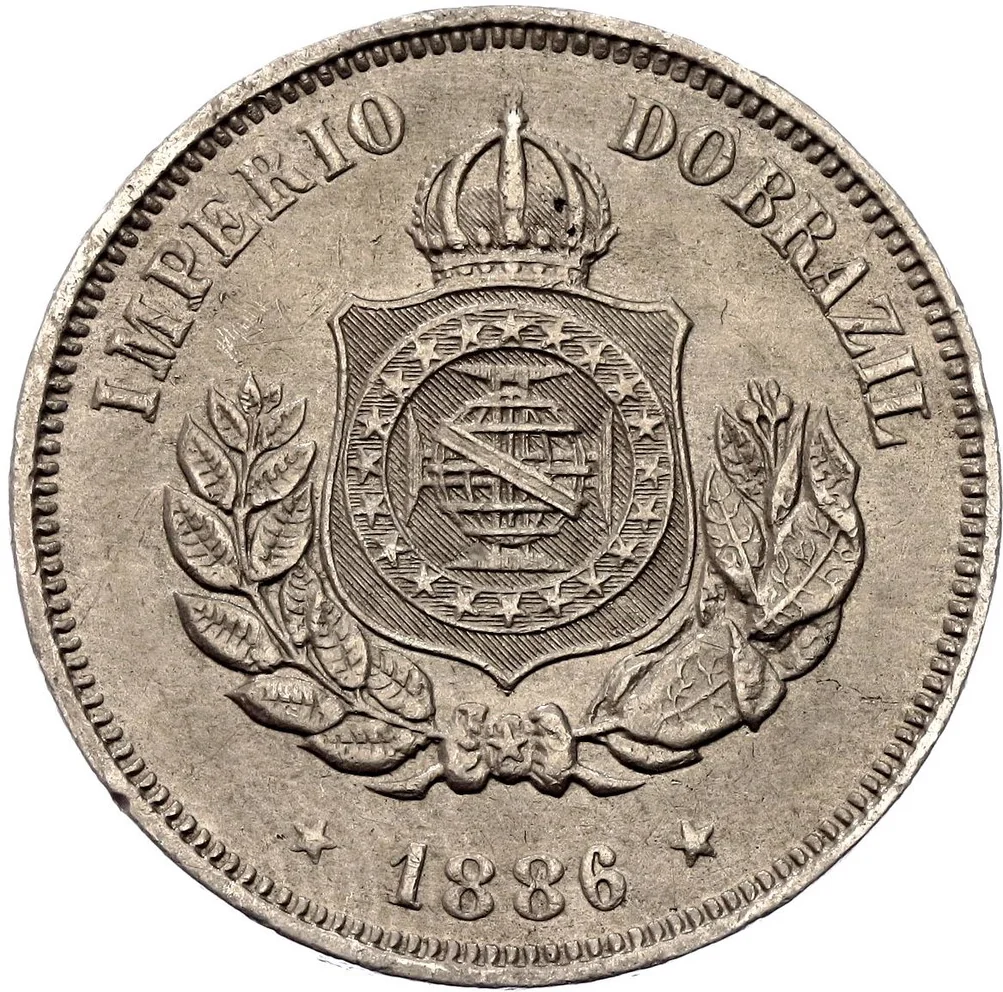
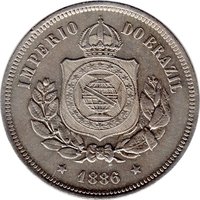
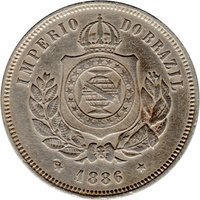
Obverse
Description:
Shield crowned in wreath, date beneath.
Inscription:
IMPERIO DO BRAZIL
1886
1886
Translation:
Empire of Brazil
1886
1886
Script: Latin
Language: Portuguese
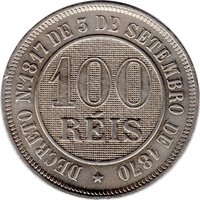
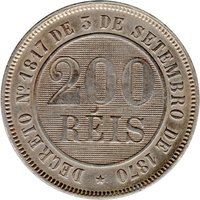
Reverse
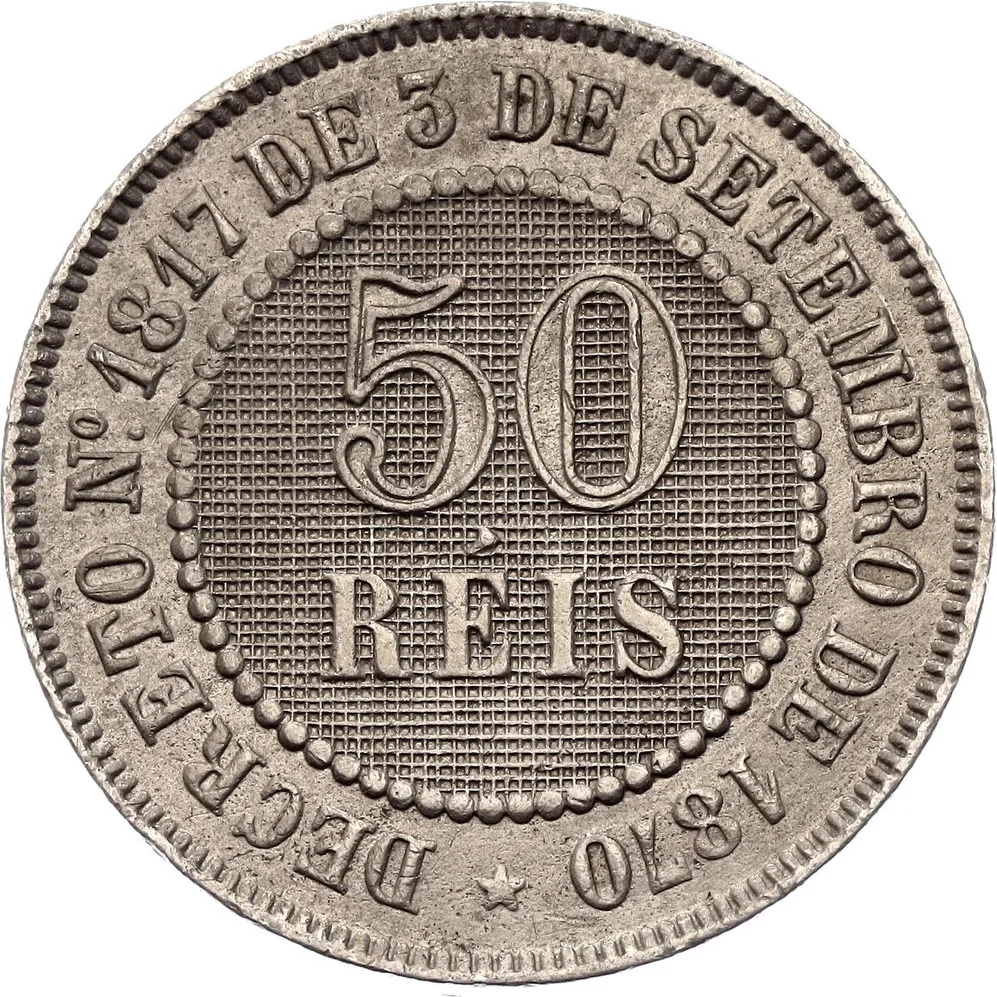
Description:
Beaded circle's value
Inscription:
DECRETO N°1817 DE 3 DE SETEMBRO DE 1870
50
RÉIS
50
RÉIS
Translation:
By Decree No. 1817 of September 3, 1870
50
Réis
50
Réis
Script: Latin
Languages: Latin, Portuguese
Edge
Plain
Mints
| Name | Mark |
|---|---|
| Casa da Moeda do Brasil | — |
Mintings
| Year | Mint Mark | Mintage | Quality | Collection |
|---|---|---|---|---|
| 1886 | — | 590,000 | ||
| 1887 | — | 768,461 | ||
| 1888 | — | 152,976 |
Historical background
In 1886, Brazil's currency situation was characterized by profound instability and inflationary pressures, a legacy of the Paraguayan War (1864-1870) and the policies of the Brazilian Empire. To finance the massive war effort, the government had extensively issued inconvertible paper money, known as papel-moeda, severing its link to gold. By 1886, the paper milréis had depreciated significantly against sterling, and the economy operated on a de facto fiduciary standard with a floating exchange rate. This environment created a sharp divide between two economic sectors: internal transactions conducted with depreciating paper currency, and the export economy (dominated by coffee) which dealt in gold-backed foreign exchange, leading to frequent disputes over exchange rate policies.
The financial debate of the era was polarized between the metalistas (backers of a return to the gold standard) and the papelistas (who advocated for a flexible, managed paper currency). The metalistas, often linked to import merchants and foreign creditors, argued that sound money was essential for long-term investment and international credibility. Conversely, the papelistas, supported by powerful coffee planters seeking cheap credit and a weak currency to boost export profits, resisted a swift return to convertibility, fearing it would trigger a painful deflation and credit contraction. The government, under the Conservative Cabinet of the Baron of Cotegipe, was caught in the middle, attempting gradual deflation but lacking the political will or fiscal surplus for a decisive monetary reform.
Consequently, 1886 found Brazil in a holding pattern of monetary uncertainty. The Treasury engaged in occasional interventions to support the milréis and slowly reduce the paper money in circulation, but these measures were inconsistent. The unresolved currency question exacerbated broader economic tensions and was symptomatic of the Empire's weakening grip on a changing society. This financial fragility would persist until the aftermath of the Republic's proclamation in 1889, which eventually led to the Encilhamento, a period of wild monetary expansion and speculation.
The financial debate of the era was polarized between the metalistas (backers of a return to the gold standard) and the papelistas (who advocated for a flexible, managed paper currency). The metalistas, often linked to import merchants and foreign creditors, argued that sound money was essential for long-term investment and international credibility. Conversely, the papelistas, supported by powerful coffee planters seeking cheap credit and a weak currency to boost export profits, resisted a swift return to convertibility, fearing it would trigger a painful deflation and credit contraction. The government, under the Conservative Cabinet of the Baron of Cotegipe, was caught in the middle, attempting gradual deflation but lacking the political will or fiscal surplus for a decisive monetary reform.
Consequently, 1886 found Brazil in a holding pattern of monetary uncertainty. The Treasury engaged in occasional interventions to support the milréis and slowly reduce the paper money in circulation, but these measures were inconsistent. The unresolved currency question exacerbated broader economic tensions and was symptomatic of the Empire's weakening grip on a changing society. This financial fragility would persist until the aftermath of the Republic's proclamation in 1889, which eventually led to the Encilhamento, a period of wild monetary expansion and speculation.
Series: 1886 Brazil circulation coins
🌱 Common