

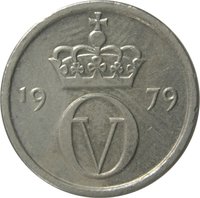
Obverse
Description:
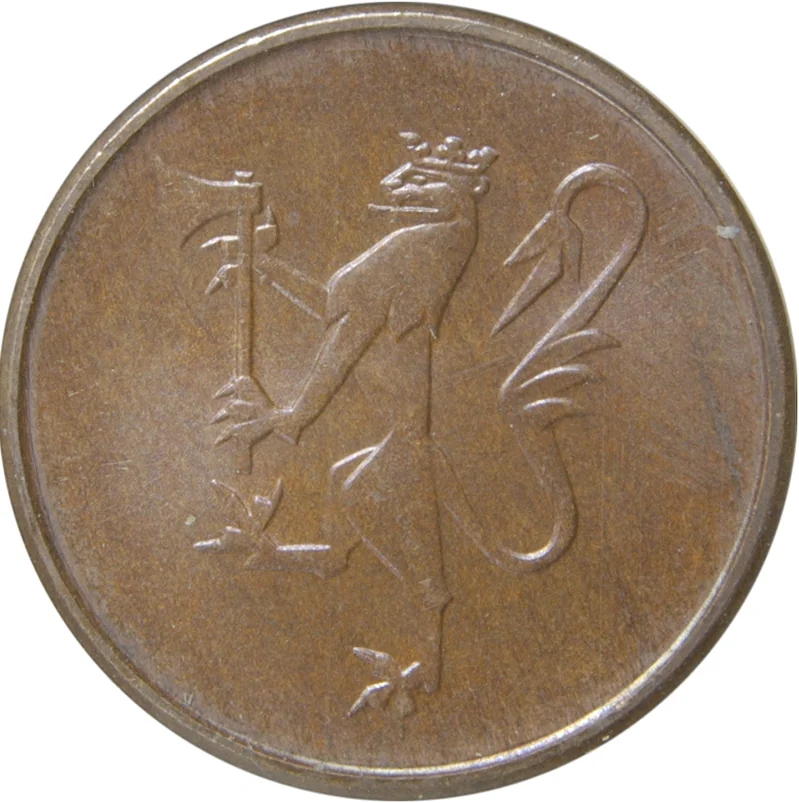
Norwegian lion crowned, facing left with a halberd. Solid ring on rim.
Engraver: Øivind Hansen
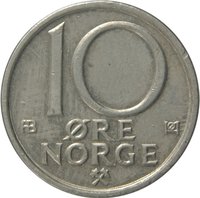
Reverse
Description:
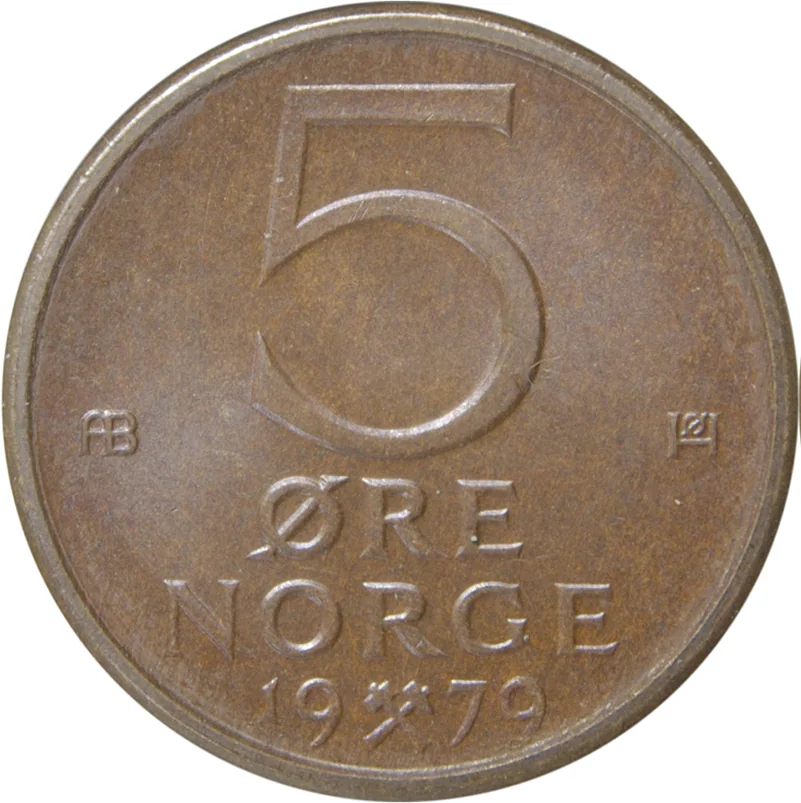
Three-line inscription. Mintmaster initial left, engraver initial right, between lines. Date split by mintmark below. Solid rim ring.
Inscription:
5
AB | ØH
ØRE
NORGE
19 ⚒ 79
AB | ØH
ØRE
NORGE
19 ⚒ 79
Translation:
Five Øre
Norway
19 79
Norway
19 79
Script: Latin
Engraver: Øivind Hansen
Edge
Plain
Mints
| Name | Mark |
|---|---|
| Norwegian Mint | — |
Mintings
| Year | Mint Mark | Mintage | Quality | Collection |
|---|---|---|---|---|
| 1973 | — | 52,866,000 | ||
| 1974 | — | 37,110,253 | ||
| 1975 | — | 32,443,250 | ||
| 1976 | — | 24,202,824 | ||
| 1977 | — | 29,616,000 | ||
| 1978 | — | 13,803,000 | ||
| 1979 | — | 24,997,000 | ||
| 1980 | — | 15,120,000 | ||
| 1981 | — | 24,429,000 | ||
| 1982 | — | 21,798,000 |
Historical background
In 1973, Norway’s currency situation was fundamentally shaped by its participation in the European "snake in the tunnel" arrangement, a collective effort to limit exchange rate fluctuations following the collapse of the Bretton Woods system. Norway, along with several other European nations, had joined this mechanism in 1972, pegging the Norwegian krone to a narrow band against the Deutsche Mark and other member currencies. This commitment was driven by a desire for monetary stability and closer economic integration with major trading partners, particularly within Europe, as Norway prepared for a referendum on EEC membership.
However, maintaining this peg proved challenging due to powerful domestic economic pressures. The discovery of vast oil reserves in the North Sea in the late 1960s was beginning to transform the economy, leading to rising inflation and a growing current account surplus. Speculative capital inflows, anticipating a krone revaluation, created destabilizing pressures. Despite efforts to defend the parity, including interest rate hikes and central bank interventions, the economic fundamentals made the fixed rate increasingly difficult to sustain, especially as other "snake" currencies experienced their own strains.
The situation culminated in a pivotal decision on November 19, 1973. After a period of intense pressure, Norway withdrew the krone from the "snake" and allowed it to float. This move was a direct response to the failure of the fixed regime to accommodate Norway’s unique, oil-driven economic divergence from its European partners. The float marked a significant shift toward a more independent monetary policy, setting the stage for the management of the krone in the coming era of petroleum wealth and laying the groundwork for the flexible exchange rate regime that characterizes Norway’s approach to this day.
However, maintaining this peg proved challenging due to powerful domestic economic pressures. The discovery of vast oil reserves in the North Sea in the late 1960s was beginning to transform the economy, leading to rising inflation and a growing current account surplus. Speculative capital inflows, anticipating a krone revaluation, created destabilizing pressures. Despite efforts to defend the parity, including interest rate hikes and central bank interventions, the economic fundamentals made the fixed rate increasingly difficult to sustain, especially as other "snake" currencies experienced their own strains.
The situation culminated in a pivotal decision on November 19, 1973. After a period of intense pressure, Norway withdrew the krone from the "snake" and allowed it to float. This move was a direct response to the failure of the fixed regime to accommodate Norway’s unique, oil-driven economic divergence from its European partners. The float marked a significant shift toward a more independent monetary policy, setting the stage for the management of the krone in the coming era of petroleum wealth and laying the groundwork for the flexible exchange rate regime that characterizes Norway’s approach to this day.
🌱 Very Common