

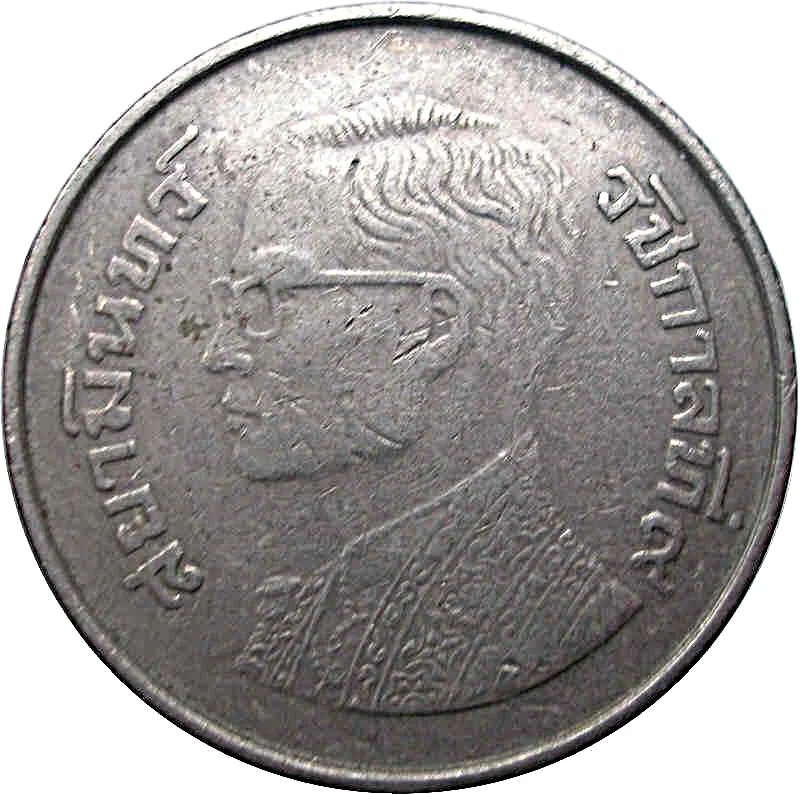
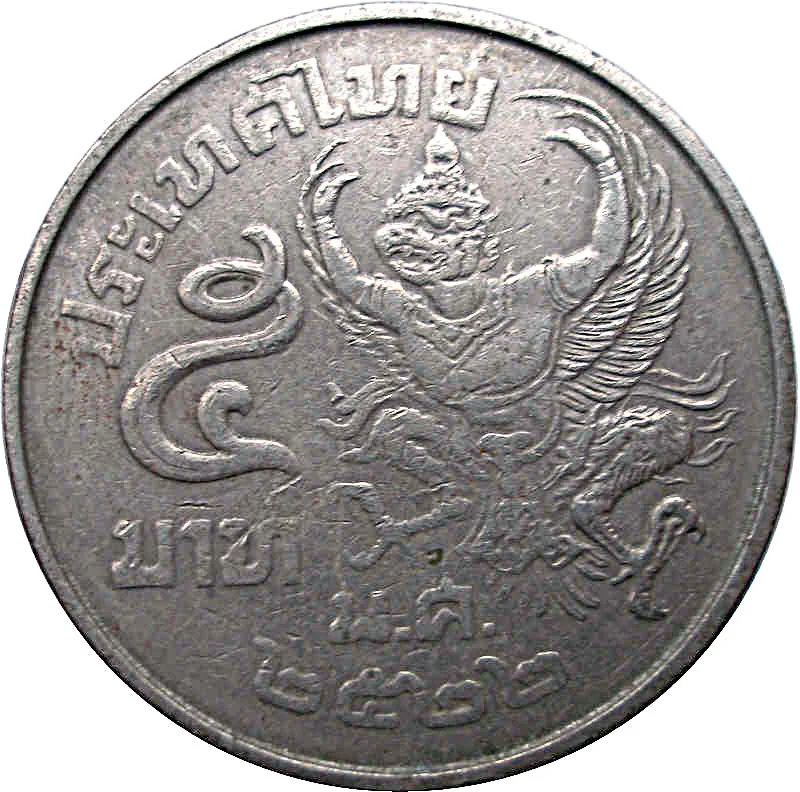
5 bahts – Thailand
Add to wishlist
Thailand
Context
Years: 1977–1979
Issuer: Thailand
Ruler: Bhumibol Adulyadej
Currency:
(since 1897)
Demonetized: Yes
Total mintage: 99,997,000
Material
References
Y: #
Numista: #3839
Value
Exchange value: 5 THB
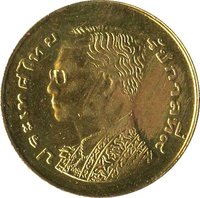
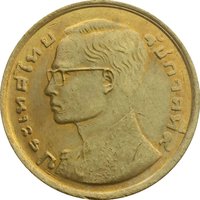
Obverse
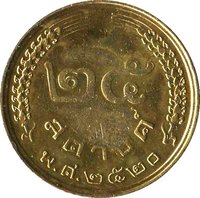
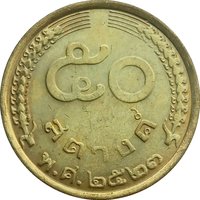
Reverse
Edge
Incuse lettering
Legend:
กระทรวงการคลัง ๛ กองกษาปณ์ กรมธนารักษ์
Translation:
Ministry of Finance, Treasury Department, Coin Making Division.
Language: Thai
Mintings
| Year | Mint Mark | Mintage | Quality | Collection |
|---|---|---|---|---|
| 1977 | — | 27,257,000 | ||
| 1979 | — | 72,740,000 |
Historical background
In 1977, Thailand's currency situation was characterized by relative stability under a managed float system, but it operated within a context of significant regional volatility and domestic economic pressures. The Thai baht (THB) was pegged to a basket of currencies, heavily weighted toward the U.S. dollar, which provided a nominal anchor. This period followed the collapse of the Bretton Woods system in the early 1970s, and Thailand, like many nations, had moved away from a strict dollar peg to this basket method in 1973 to better absorb external shocks. The managed float allowed the Bank of Thailand to intervene to control excessive fluctuations, maintaining a stable exchange rate that supported trade and investment confidence during a crucial decade of industrialization.
Economically, the country was navigating the aftermath of the 1973 oil crisis and a period of political transition following the 1976 military coup. While growth remained robust, driven by agricultural exports, light manufacturing, and burgeoning tourism, the fixed-but-adjustable exchange rate regime required careful foreign reserve management. Inflation was a persistent concern, partly imported through the dollar-linked system during a global inflationary period. The stability of the baht was thus a key policy objective, intended to provide a predictable environment for the export-oriented growth strategy that would later define Thailand's "economic miracle."
Regionally, the situation was fraught with uncertainty. Neighboring Southeast Asian nations faced currency instability and economic challenges, making Thailand's relative stability an exception. However, this very stability would later contribute to vulnerabilities, as the commitment to a stable exchange rate, continued in subsequent decades, eventually led to overvaluation and speculative pressures. These culminated in the 1997 Asian Financial Crisis, which had its epicenter in Bangkok. Therefore, the currency regime of 1977, while successful in providing short-term stability, sowed the seeds for a much larger systemic crisis two decades later.
Economically, the country was navigating the aftermath of the 1973 oil crisis and a period of political transition following the 1976 military coup. While growth remained robust, driven by agricultural exports, light manufacturing, and burgeoning tourism, the fixed-but-adjustable exchange rate regime required careful foreign reserve management. Inflation was a persistent concern, partly imported through the dollar-linked system during a global inflationary period. The stability of the baht was thus a key policy objective, intended to provide a predictable environment for the export-oriented growth strategy that would later define Thailand's "economic miracle."
Regionally, the situation was fraught with uncertainty. Neighboring Southeast Asian nations faced currency instability and economic challenges, making Thailand's relative stability an exception. However, this very stability would later contribute to vulnerabilities, as the commitment to a stable exchange rate, continued in subsequent decades, eventually led to overvaluation and speculative pressures. These culminated in the 1997 Asian Financial Crisis, which had its epicenter in Bangkok. Therefore, the currency regime of 1977, while successful in providing short-term stability, sowed the seeds for a much larger systemic crisis two decades later.
🌱 Very Common