

Obverse
Description:
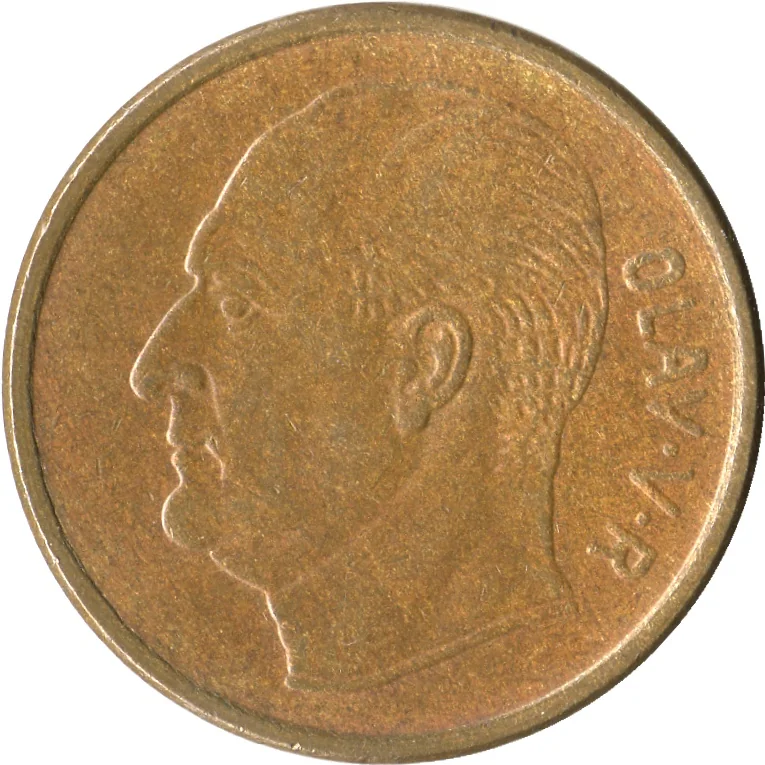
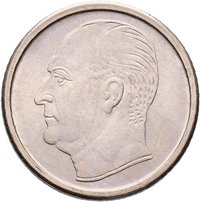
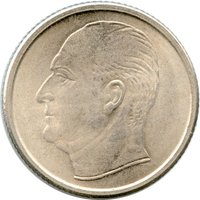
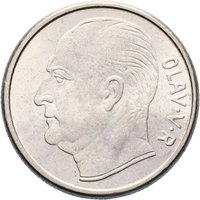
King Olav V bust left, inscription right, solid rim ring.
Inscription:
OLAV·V·R
Translation:
Olav, by the grace of God, King
Script: Latin
Language: Latin
Engraver: Per Palle Storm
Reverse
Description:
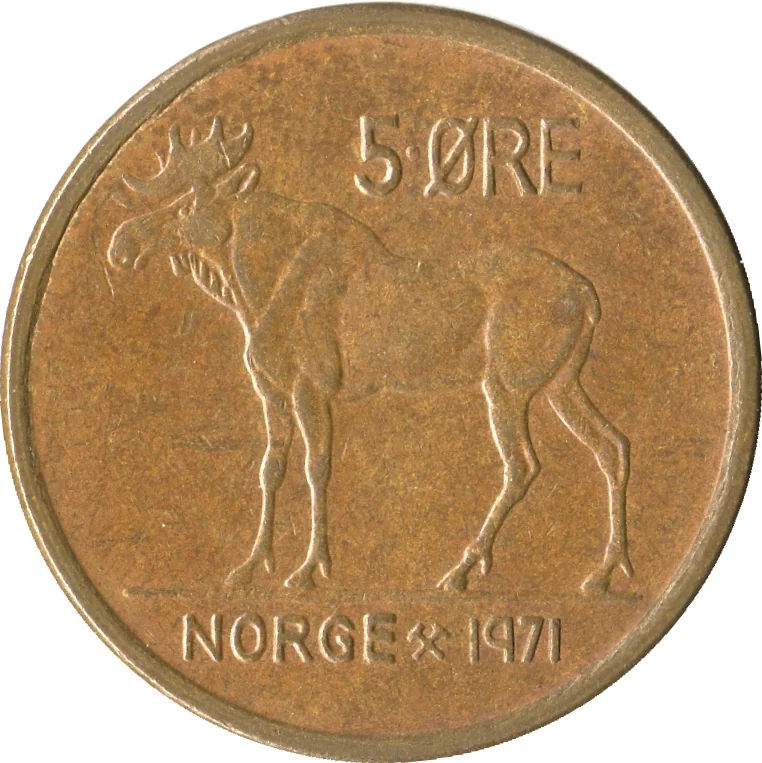
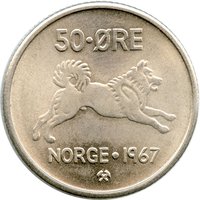
Eurasian Elk facing left on flat ground, value above, inscription, mintmark, and date below, within a solid ring.
Inscription:
5·ØRE
NORGE ⚒ 1971
NORGE ⚒ 1971
Translation:
5 ORE
NORWAY 1971
NORWAY 1971
Script: Latin
Engraver: Per Palle Storm
Edge
Plain
Mints
| Name | Mark |
|---|---|
| Norwegian Mint | — |
Mintings
| Year | Mint Mark | Mintage | Quality | Collection |
|---|---|---|---|---|
| 1958 | — | 2,205,000 | ||
| 1959 | — | 3,208,000 | ||
| 1960 | — | 5,519,000 | ||
| 1961 | — | 4,554,000 | ||
| 1962 | — | 7,764,000 | ||
| 1963 | — | 3,204,000 | ||
| 1964 | — | 6,108,000 | ||
| 1965 | — | 6,839,200 | ||
| 1966 | — | 8,413,600 | ||
| 1967 | — | 9,068,600 | ||
| 1968 | — | 4,284,600 | ||
| 1969 | — | 4,317,500 | ||
| 1970 | — | 7,341,300 | ||
| 1970 | — | — | Proof | |
| 1971 | — | 13,444,100 | ||
| 1972 | — | 18,988,800 | ||
| 1973 | — | 9,564,000 |
Historical background
In 1958, Norway was operating under a fixed exchange rate system, anchored to the US dollar as part of the Bretton Woods international monetary framework. The Norwegian krone (NOK) had been devalued significantly in 1949, following the UK's sterling devaluation, and its value was pegged at 7.142 NOK per US dollar. This peg was managed by Norges Bank, the central bank, which was obligated to buy and sell dollars at the fixed rate to maintain stability, requiring careful control of the country's foreign currency reserves.
The domestic economic context was one of robust post-war reconstruction and development, but also of recurring external deficits. Norway's extensive investment in its industrial and welfare infrastructure led to strong demand for imported capital goods, often outpacing export revenues. By the late 1950s, this resulted in persistent balance of payments deficits, putting downward pressure on the krone and straining the foreign exchange reserves needed to defend the fixed parity. The government employed a system of strict capital controls and import regulations to manage this pressure and shield the currency.
Consequently, 1958 fell within a period of cautious economic management, preceding a decade of change. The fixed but vulnerable krone, combined with a regulated credit market, was a defining feature. This stability was soon tested; within a few years, mounting inflationary pressures and continued external imbalances would lead Norway to revalue the krone briefly in 1961, before a more decisive devaluation in 1967, marking the beginning of the end for the strict Bretton Woods regime in the country.
The domestic economic context was one of robust post-war reconstruction and development, but also of recurring external deficits. Norway's extensive investment in its industrial and welfare infrastructure led to strong demand for imported capital goods, often outpacing export revenues. By the late 1950s, this resulted in persistent balance of payments deficits, putting downward pressure on the krone and straining the foreign exchange reserves needed to defend the fixed parity. The government employed a system of strict capital controls and import regulations to manage this pressure and shield the currency.
Consequently, 1958 fell within a period of cautious economic management, preceding a decade of change. The fixed but vulnerable krone, combined with a regulated credit market, was a defining feature. This stability was soon tested; within a few years, mounting inflationary pressures and continued external imbalances would lead Norway to revalue the krone briefly in 1961, before a more decisive devaluation in 1967, marking the beginning of the end for the strict Bretton Woods regime in the country.
Series: 1958 Norway circulation coins
🌱 Very Common