

1 dollar – Australia
Add to wishlist
Australia
Context
Material
Diameter: 40 mm
Weight: 31.1 g
Silver Weight:: 31.07 g
Shape: Round
Composition: 99.9% Silver
Standard: Silver ounce
Magnetic: No
Technique: Milled
Alignment: Medal alignment
flip
References
KM: #
Numista: #383243
Value
Exchange value: 1 AUD
Bullion value: $76.91
Inflation-adjusted value: 1.34 AUD
Obverse
Description:
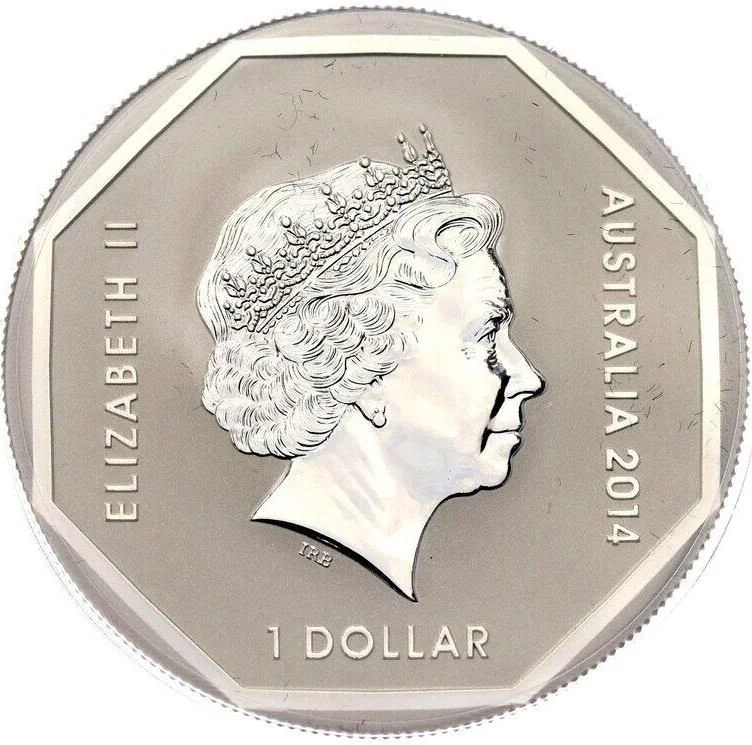
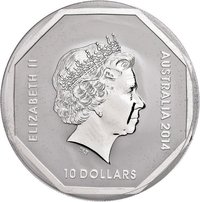
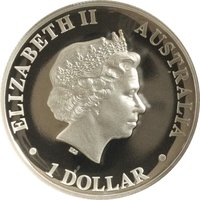
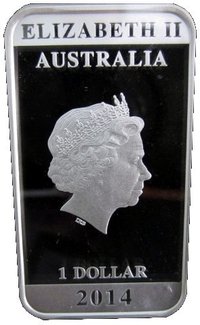
Queen Elizabeth II facing right in the Girls of Great Britain and Ireland Tiara.
Inscription:
ELIZABETH II
AUSTRALIA 2014
1 DOLLAR
IRB
AUSTRALIA 2014
1 DOLLAR
IRB
Script: Latin
Designer: Ian Rank-Broadley
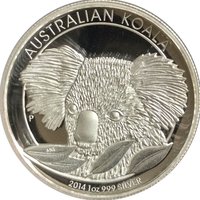
Reverse
Edge
Reeded
Mints
| Name | Mark |
|---|---|
| Royal Australian Mint | — |
Mintings
| Year | Mint Mark | Mintage | Quality | Collection |
|---|---|---|---|---|
| 2014 | — | 3,393 | Proof |
Historical background
In 2014, the Australian dollar (AUD) was in a period of significant transition, moving from a historically high valuation towards a more moderate level. The preceding years of the mining investment boom had driven the currency to multi-decade highs, peaking above parity with the US dollar in 2011-2013. This strength was fuelled by strong demand for Australia's key commodity exports, particularly iron ore and coal, and by relatively high domestic interest rates which attracted foreign capital. However, by 2014, the peak of the mining investment boom had passed, and global commodity prices, especially iron ore, began a sharp and sustained decline, removing a key pillar of support for the currency.
Domestically, the Reserve Bank of Australia (RBA) maintained a clear easing bias, having cut the official cash rate to a record-low 2.5% in August 2013, where it would remain for the entirety of 2014. Governor Glenn Stevens and the RBA board frequently described the AUD as "uncomfortably high," publicly advocating for a lower exchange rate to help rebalance the economy away from mining and towards the non-mining sectors like tourism, education, and manufacturing. This "jawboning" was a deliberate policy tool aimed at talking down the currency to stimulate trade-exposed industries.
Consequently, the AUD experienced a steady depreciation throughout the year, falling from around US$0.89 in January to approximately US$0.81 by December, a decline of roughly 9%. This downward trend was seen as broadly desirable by policymakers and many economists, as it provided a necessary adjustment to the post-boom economy. The currency's decline in 4 set the stage for further falls in 2015, when it would eventually drop below US$0.70, completing its correction from the commodity-boom highs.
Domestically, the Reserve Bank of Australia (RBA) maintained a clear easing bias, having cut the official cash rate to a record-low 2.5% in August 2013, where it would remain for the entirety of 2014. Governor Glenn Stevens and the RBA board frequently described the AUD as "uncomfortably high," publicly advocating for a lower exchange rate to help rebalance the economy away from mining and towards the non-mining sectors like tourism, education, and manufacturing. This "jawboning" was a deliberate policy tool aimed at talking down the currency to stimulate trade-exposed industries.
Consequently, the AUD experienced a steady depreciation throughout the year, falling from around US$0.89 in January to approximately US$0.81 by December, a decline of roughly 9%. This downward trend was seen as broadly desirable by policymakers and many economists, as it provided a necessary adjustment to the post-boom economy. The currency's decline in 4 set the stage for further falls in 2015, when it would eventually drop below US$0.70, completing its correction from the commodity-boom highs.
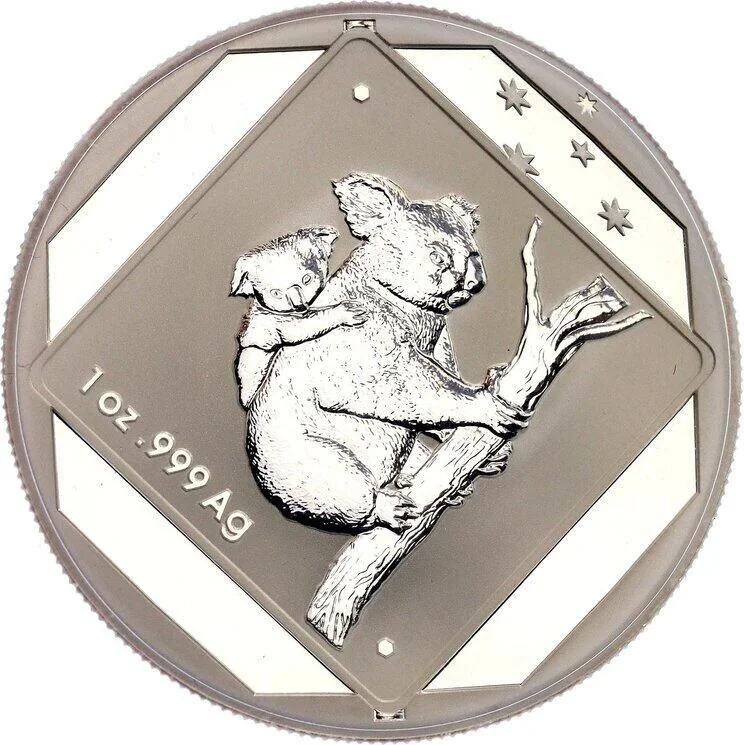
Series: Australian Road Signs

✨ Legendary