

½ Franc – Monaco
Monaco
Context
Years: 1965–1995
Issuer: Monaco 
Ruler: Rainier III
Currency:
(1960—2001)
Demonetized: Yes
Total mintage: 1,700,000
Material
References
KM: #Click to copy to clipboard145
Numista: #3821
Value
Exchange value: ½ MCF
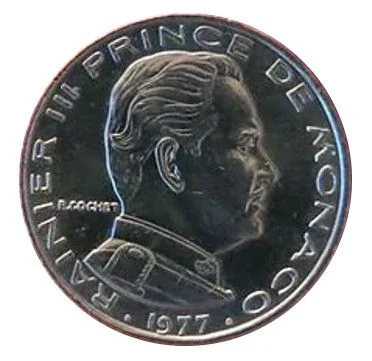
Obverse
Description:
Rainier III in right profile.
Inscription:
RAINIER III PRINCE DE MONACO
R.COCHET
· 1977 ·
R.COCHET
· 1977 ·
Translation:
Rainier III Prince of Monaco
R.Cochet
· 1977 ·
R.Cochet
· 1977 ·
Script: Latin
Engraver: Robert Cochet
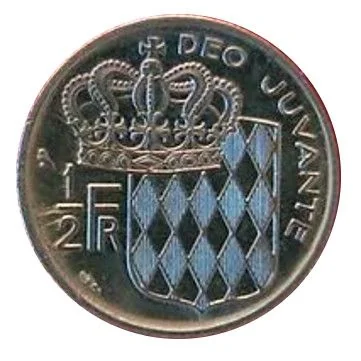
Reverse
Description:
Crown atop shield, value lower left.
Inscription:
DEO JUVANTE
½ FR
½ FR
Translation:
With God's help
½ Frank
½ Frank
Script: Latin
Language: Latin
Engraver: Robert Cochet
Edge
Reeded
Mints
| Name | Mark |
|---|---|
| Monnaie de Paris | — |
Mintings
| Year | Mint Mark | Mintage | Quality | Collection |
|---|---|---|---|---|
| 1965 | — | 375,000 | ||
| 1968 | — | 125,000 | ||
| 1974 | — | 62,500 | ||
| 1975 | — | 62,500 | ||
| 1976 | — | 62,500 | ||
| 1977 | — | 62,500 | ||
| 1978 | — | 226,500 | ||
| 1979 | — | 226,500 | ||
| 1982 | — | 457,000 | ||
| 1989 | — | 10,000 | ||
| 1995 | — | 30,000 | In sets |
Historical background
In 1965, Monaco’s currency situation was intrinsically linked to that of France, governed by the bilateral Franco-Monegasque Treaty of 1865. This treaty granted Monaco the right to mint its own coinage, the Monegasque franc, which was legally pegged at a strict 1:1 parity with the French franc and enjoyed equal status as legal tender within the Principality. Consequently, Monaco operated within the French Franc Zone, meaning its monetary policy, exchange controls, and economic stability were entirely dependent on decisions made in Paris. The Bank of France effectively managed the money supply, and Monegasque coins, while bearing national symbols, were a nominal expression of sovereignty rather than an independent currency.
The period was one of relative monetary stability for Monaco under this arrangement, but it unfolded against a backdrop of broader European economic change. The early 1960s saw France, under President Charles de Gaulle, pursuing a policy of strengthening the franc and maintaining the Bretton Woods system of fixed exchange rates tied to the US dollar. For Monaco, this meant benefiting from the franc's stability while having no autonomous tools to manage its own economy. The Principality’s burgeoning banking and tourism sectors operated seamlessly with French currency, facilitating its growth as a financial center.
Looking ahead, the stability of 1965 was a prelude to significant change. The treaty framework remained unchallenged at the time, but the eventual economic turbulence of the late 1960s and the eventual collapse of the Bretton Woods system would later test the fixed parity. The fundamental dependency on French monetary policy highlighted in 1965 would persist until the adoption of the Euro by both France and Monaco decades later, which simply replaced one fixed, dependent relationship with another under a new supranational currency.
The period was one of relative monetary stability for Monaco under this arrangement, but it unfolded against a backdrop of broader European economic change. The early 1960s saw France, under President Charles de Gaulle, pursuing a policy of strengthening the franc and maintaining the Bretton Woods system of fixed exchange rates tied to the US dollar. For Monaco, this meant benefiting from the franc's stability while having no autonomous tools to manage its own economy. The Principality’s burgeoning banking and tourism sectors operated seamlessly with French currency, facilitating its growth as a financial center.
Looking ahead, the stability of 1965 was a prelude to significant change. The treaty framework remained unchallenged at the time, but the eventual economic turbulence of the late 1960s and the eventual collapse of the Bretton Woods system would later test the fixed parity. The fundamental dependency on French monetary policy highlighted in 1965 would persist until the adoption of the Euro by both France and Monaco decades later, which simply replaced one fixed, dependent relationship with another under a new supranational currency.
🌱 Very Common