

50 francs – Monaco
Add to wishlist
Monaco
Context
Year: 1950
Issuer: Monaco
Ruler: Rainier III
Currency:
(1837—1960)
Demonetized: Yes
Total mintage: 500,000
Material
Diameter: 27 mm
Weight: 8 g
Thickness: 2.2 mm
Shape: Round
Composition: Copper-aluminium
Technique: Milled
Alignment: Coin alignment
flip
References
KM: #
Numista: #3810
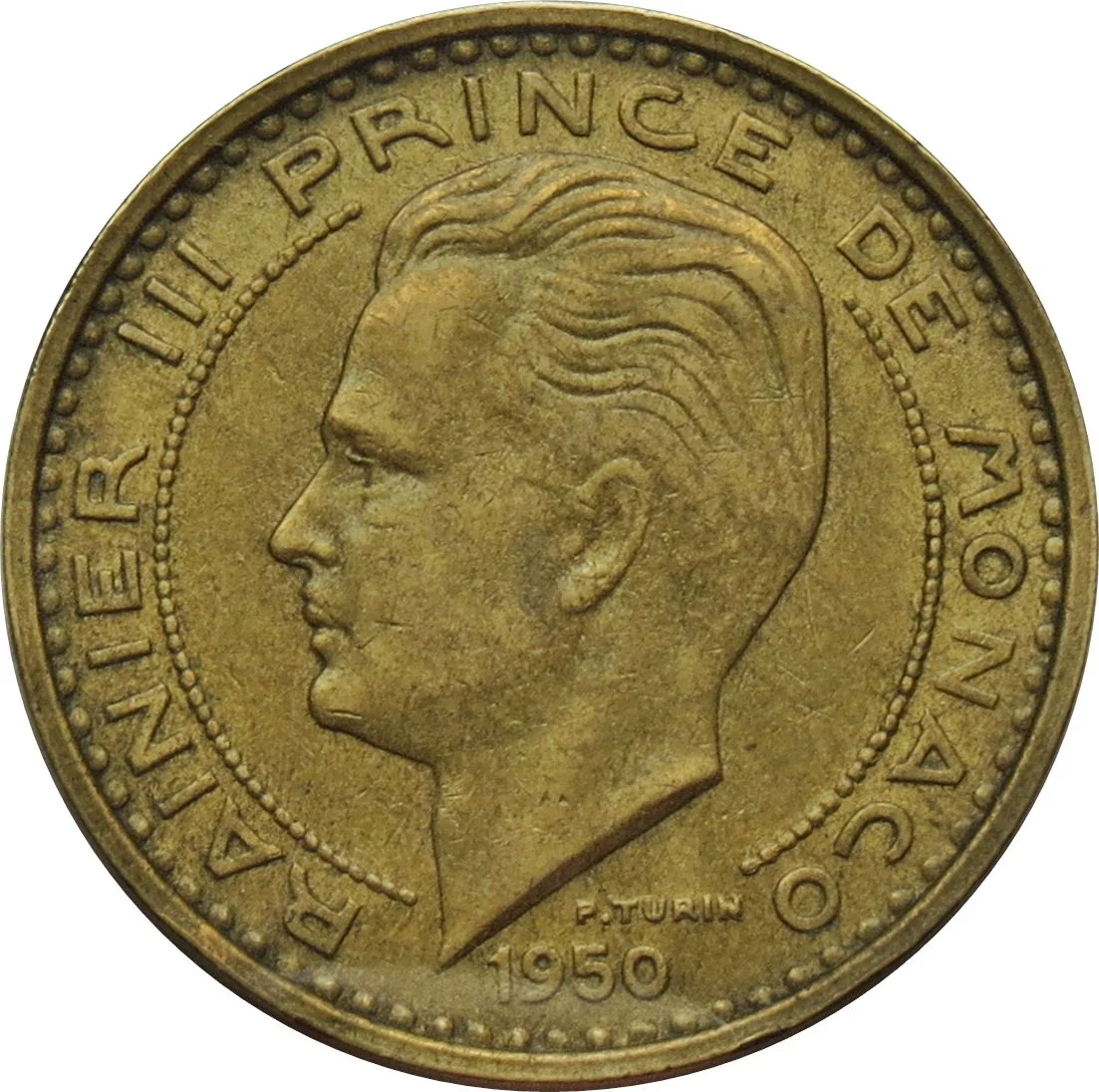
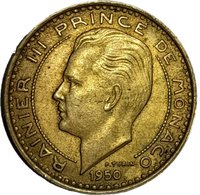
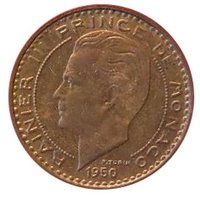
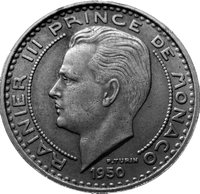
Obverse
Description:
Left half of circle.
Inscription:
RAINIER III PRINCE DE MONACO
P. TURIN
1950
P. TURIN
1950
Translation:
Rainier III Prince of Monaco
P. Turin
1950
P. Turin
1950
Script: Latin
Language: French
Engraver: Pierre Turin
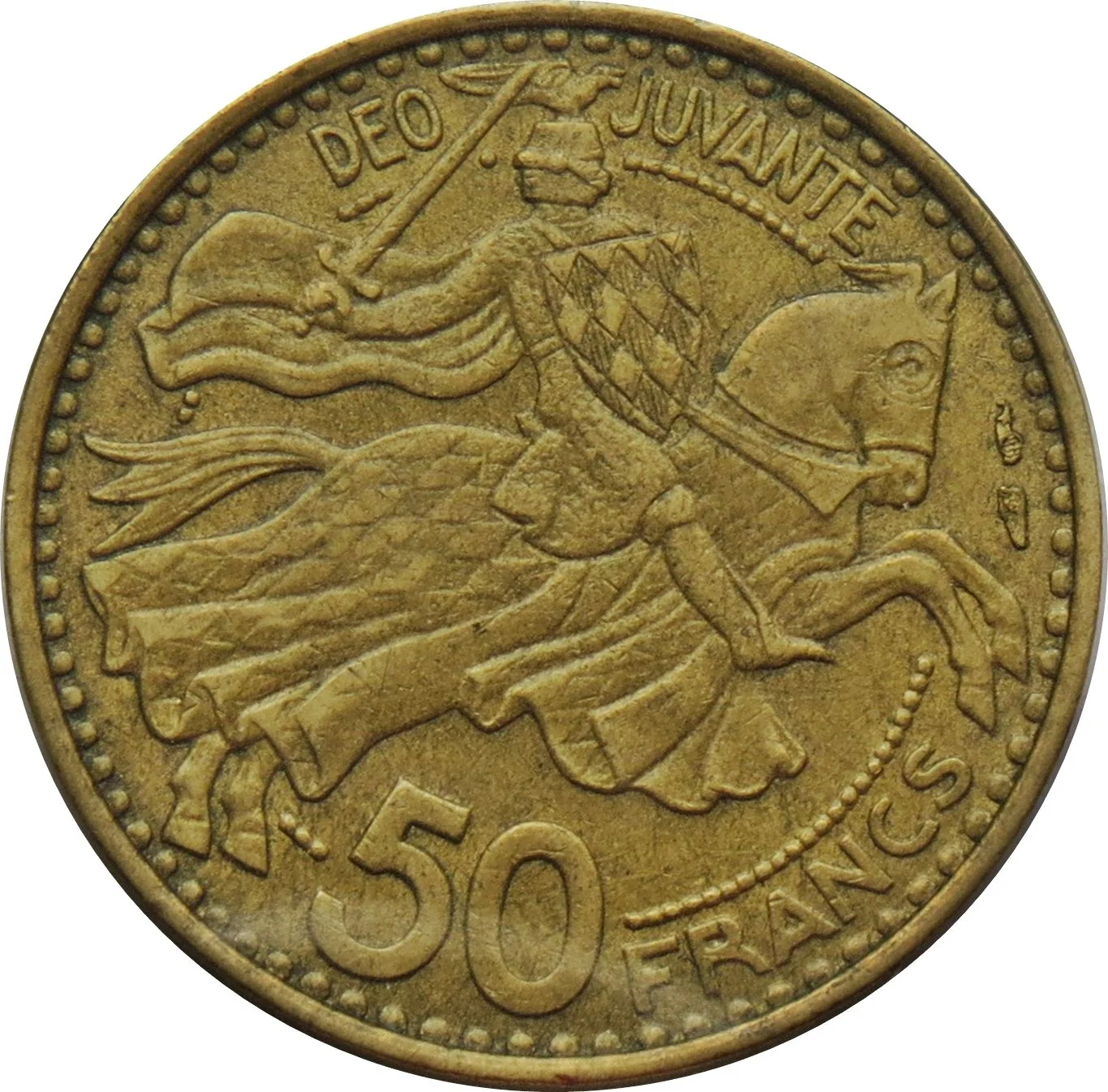
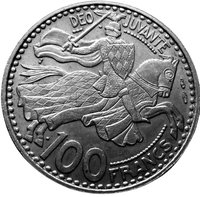
Reverse
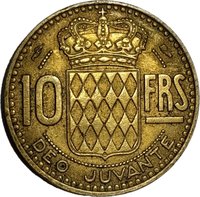
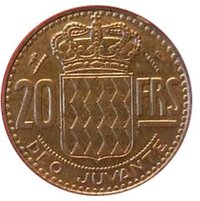
Description:
Armored rider circles value.
Inscription:
DEO JUVANTE
50 FRANCS
50 FRANCS
Translation:
With God's help
50 Francs
50 Francs
Script: Latin
Language: Latin
Engraver: Pierre Turin
Edge
Plain
Mints
| Name | Mark |
|---|---|
| Monnaie de Paris | — |
Mintings
| Year | Mint Mark | Mintage | Quality | Collection |
|---|---|---|---|---|
| 1950 | — | 500,000 |
Historical background
In 1950, Monaco's currency situation was intrinsically tied to that of France, governed by the monetary conventions established in the Franco-Monégasque Treaty of 1865. This treaty granted Monaco the right to issue its own coinage, the Monégasque franc, which was legally equivalent to the French franc and circulated interchangeably within the principality. However, the actual production of banknotes and the control of monetary policy remained firmly under the authority of the French central bank, the Banque de France. Consequently, Monaco did not possess an independent monetary policy and its economy operated fully within the French franc zone.
The post-World War II period leading up to 1950 was a time of significant monetary instability and reconstruction across Europe. France itself was grappling with inflation and a series of devaluations, most notably the major devaluation of the franc in September 1949, which was part of a wider European realignment following the devaluation of the British pound. As a satellite of the French franc zone, Monaco automatically absorbed these economic shocks and policy decisions. The value and purchasing power of the Monégasque franc directly mirrored the turbulent trajectory of its French counterpart, with no mechanism for the principality to deviate.
Therefore, the background of Monaco's currency in 1950 is one of complete dependency and alignment. The principality benefited from the stability and international recognition provided by the French franc system, which facilitated trade and tourism—the cornerstones of its economy. Yet, this came at the cost of monetary sovereignty, leaving Monaco vulnerable to France's economic conditions and policy choices as Europe navigated the early years of post-war recovery and the dawn of the European Payments Union.
The post-World War II period leading up to 1950 was a time of significant monetary instability and reconstruction across Europe. France itself was grappling with inflation and a series of devaluations, most notably the major devaluation of the franc in September 1949, which was part of a wider European realignment following the devaluation of the British pound. As a satellite of the French franc zone, Monaco automatically absorbed these economic shocks and policy decisions. The value and purchasing power of the Monégasque franc directly mirrored the turbulent trajectory of its French counterpart, with no mechanism for the principality to deviate.
Therefore, the background of Monaco's currency in 1950 is one of complete dependency and alignment. The principality benefited from the stability and international recognition provided by the French franc system, which facilitated trade and tourism—the cornerstones of its economy. Yet, this came at the cost of monetary sovereignty, leaving Monaco vulnerable to France's economic conditions and policy choices as Europe navigated the early years of post-war recovery and the dawn of the European Payments Union.
Series: 1950 Monaco circulation coins
🌱 Very Common