

100 Euro (Starter Kit) – France
Non-circulating coins
Commemoration: 20th anniversary of the Starter Kit (2001-2021).
Series: The Sower
France
Context
Material
Diameter: 31 mm
Weight: 15.55 g
Gold weight: 15.53 g
Shape: Round
Composition: 99.9% Gold
Standard: Silver half ounce
Magnetic: No
Technique: Milled
Alignment: Medal alignment
flip
References
Numista: #380089
Value
Exchange value: 100 EUR = $118.14
Bullion value: $2585.92
Inflation-adjusted value: 117.56 EUR
Obverse
Description:
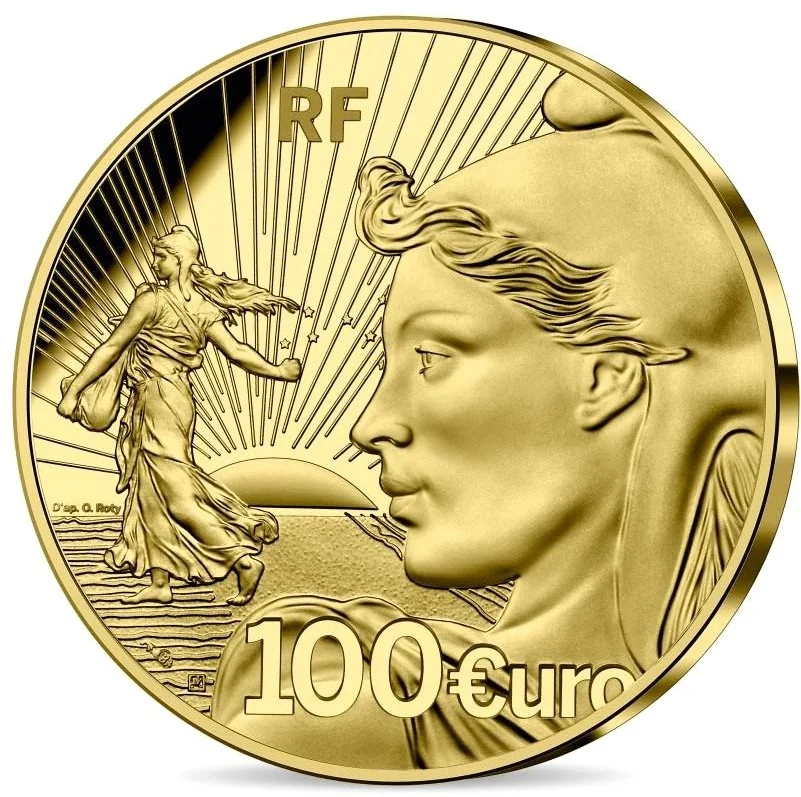
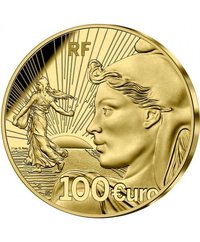
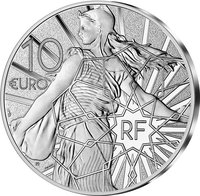
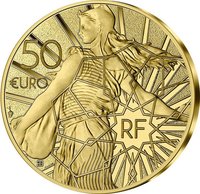
The foreground features Rosalinda Pesce, the model for Oscar Roty's engraving, appearing on a coin for the first time. Behind her is the original Sower from the 1898 1 franc coin. Twenty stars represent years, while the sun nods to the former Franc currency. The heraldic ground symbolizes the French flag: blue with horizontal lines, white with the flat band, and red with vertical lines.
Inscription:
RF
100 €uro
d'ap. O. Roty
100 €uro
d'ap. O. Roty
Script: Latin
Designer: Joaquin Jimenez
Reverse
Description:
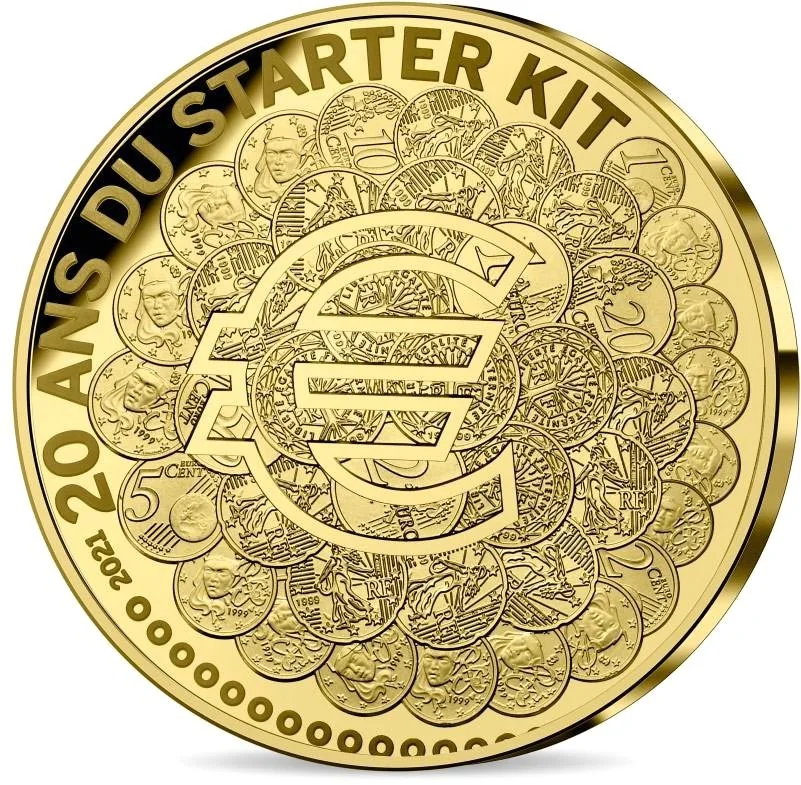
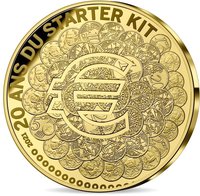
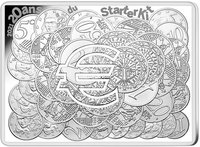
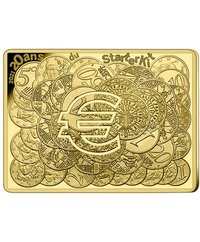
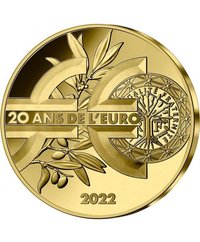
The 40 coins of the Starter Kit, featuring the original euro symbol at the center.
Inscription:
2021
20 ANS DU STARTER KIT
20 ANS DU STARTER KIT
Translation:
2021
20 Years of the Starter Kit
20 Years of the Starter Kit
Script: Latin
Language: French
Designer: Joaquin Jimenez
Edge
Plain
Categories
| Currency> Coin depiction |
| Symbol> Phrygian cap |
Mints
| Name | Mark |
|---|---|
| Monnaie de Paris | — |
Mintings
| Year | Mint Mark | Mintage | Quality | Collection |
|---|---|---|---|---|
| 2021 | — | 250 | Proof |
Historical background
In 2021, France's currency situation was firmly anchored within the Eurozone framework, using the euro (€) as its sole legal tender. The macroeconomic landscape was dominated by the ongoing recovery from the COVID-19 pandemic, with the European Central Bank (ECB) maintaining an ultra-accommodative monetary policy. Key interest rates were held at historic lows, and the ECB continued its massive Pandemic Emergency Purchase Programme (PEPP) to ensure favorable financing conditions, support economic activity, and guard against deflationary pressures. This policy, shared across the Eurozone, meant France had no independent control over its monetary policy, relying on the ECB's decisions aimed at the currency bloc's aggregate economic health.
Domestically, the focus was on fiscal stimulus rather than currency manipulation. The French government, under President Emmanuel Macron, implemented substantial support packages, including furlough schemes and state-guaranteed loans, leading to a significant increase in public debt, which exceeded 115% of GDP. Inflation emerged as a growing concern towards the latter half of the year, initially driven by rising energy prices and supply chain bottlenecks, though the annual rate remained moderate by later standards, averaging around 1.6% for the year. The strong euro exchange rate against the dollar and other currencies was a point of attention for exporters, but it also helped mitigate the cost of imported energy.
Politically, the euro remained largely unchallenged in mainstream discourse, with debates centered on the level of EU fiscal integration rather than a return to the franc. Key discussions at the European level involved the final implementation of the €750 billion NextGenerationEU recovery fund, from which France was set to be a major beneficiary. This fund, financed by common EU borrowing, represented a significant step toward fiscal union and was seen as crucial for financing France's national recovery plan, France Relance, which aimed to modernize the economy through green and digital transitions without direct recourse to devaluation or independent currency tools.
Domestically, the focus was on fiscal stimulus rather than currency manipulation. The French government, under President Emmanuel Macron, implemented substantial support packages, including furlough schemes and state-guaranteed loans, leading to a significant increase in public debt, which exceeded 115% of GDP. Inflation emerged as a growing concern towards the latter half of the year, initially driven by rising energy prices and supply chain bottlenecks, though the annual rate remained moderate by later standards, averaging around 1.6% for the year. The strong euro exchange rate against the dollar and other currencies was a point of attention for exporters, but it also helped mitigate the cost of imported energy.
Politically, the euro remained largely unchallenged in mainstream discourse, with debates centered on the level of EU fiscal integration rather than a return to the franc. Key discussions at the European level involved the final implementation of the €750 billion NextGenerationEU recovery fund, from which France was set to be a major beneficiary. This fund, financed by common EU borrowing, represented a significant step toward fiscal union and was seen as crucial for financing France's national recovery plan, France Relance, which aimed to modernize the economy through green and digital transitions without direct recourse to devaluation or independent currency tools.
Series: The Sower






✨ Legendary