

1 Falus – Uncertain Afghan city
Afghanistan
Context
Year: 1894
Islamic (Hijri) Year: 1312
Country: Afghanistan 
Issuer: Uncertain Afghan city
Currency:
(1747—1891)
Demonetized: Yes
Material
Diameter: 15 mm
Weight: 5.73 g
Shape: Irregular round
Composition: Copper
Magnetic: No
Technique: Hammered
References
Numista: #379823
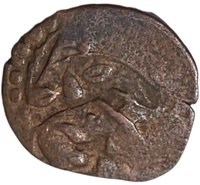
Obverse
Description:
Legend in circle.
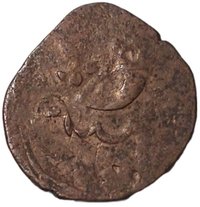
Reverse
Description:
Three-leaf clusters.
Edge
Plain.
Mintings
| Year | Mint Mark | Mintage | Quality | Collection |
|---|---|---|---|---|
| 1894 | — | — |
Historical background
In the bustling, sun-baked crossroads of Uncertain, Afghanistan, in 1894, the currency situation was a complex tapestry of imperial ambition and local pragmatism. The city, a vital trading hub, saw coins from the Kabuli rupee of Emir Abdur Rahman Khan’s consolidating Afghan state circulate alongside older, worn Herati and Kandahari rupees, their values shifting with political winds and merchant consensus. More significantly, the Russian Imperial ruble and the British Indian rupee flowed freely, their relative values hotly debated in the bazaars. This was a direct monetary reflection of the "Great Game," as both empires used commercial and financial influence to secure loyalty in a region not yet under their direct control.
The practical reality for merchants and residents was one of constant calculation and inherent risk. Transactions often required scales, as coins were valued by their weight and silver content rather than their face value, leading to disputes. For larger deals, the hundi (a traditional bill of exchange) was essential, relying on networks of trust among money-changers (sarraf) who acted as primitive bankers. Counterfeiting was rampant, and the volatility caused by political rumors or the arrival of a new caravan could alter exchange rates overnight, making commerce a speculative venture.
Ultimately, this monetary chaos was a symptom of Afghanistan's precarious sovereignty. While Emir Abdur Rahman Khan, with British support, was aggressively centralizing power, his reach into a cosmopolitan frontier city like Uncertain remained incomplete in 1894. The simultaneous circulation of multiple currencies, each representing a different sphere of influence—Kabul, St. Petersburg, and Calcutta—meant that the city’s economy, and by extension its political leanings, remained fiercely contested and profoundly uncertain.
The practical reality for merchants and residents was one of constant calculation and inherent risk. Transactions often required scales, as coins were valued by their weight and silver content rather than their face value, leading to disputes. For larger deals, the hundi (a traditional bill of exchange) was essential, relying on networks of trust among money-changers (sarraf) who acted as primitive bankers. Counterfeiting was rampant, and the volatility caused by political rumors or the arrival of a new caravan could alter exchange rates overnight, making commerce a speculative venture.
Ultimately, this monetary chaos was a symptom of Afghanistan's precarious sovereignty. While Emir Abdur Rahman Khan, with British support, was aggressively centralizing power, his reach into a cosmopolitan frontier city like Uncertain remained incomplete in 1894. The simultaneous circulation of multiple currencies, each representing a different sphere of influence—Kabul, St. Petersburg, and Calcutta—meant that the city’s economy, and by extension its political leanings, remained fiercely contested and profoundly uncertain.
✨ Legendary