

1⁄24 shilling – Jersey
Add to wishlist
Context
Year: 1909
Country: British Crown dependencies
Issuer: Jersey
Ruler: Edward VII
Currency:
(1813—1971)
Demonetization: 27 December 1971
Total mintage: 120,000
Material
References
KM: #
Numista: #3797
Obverse
Description:
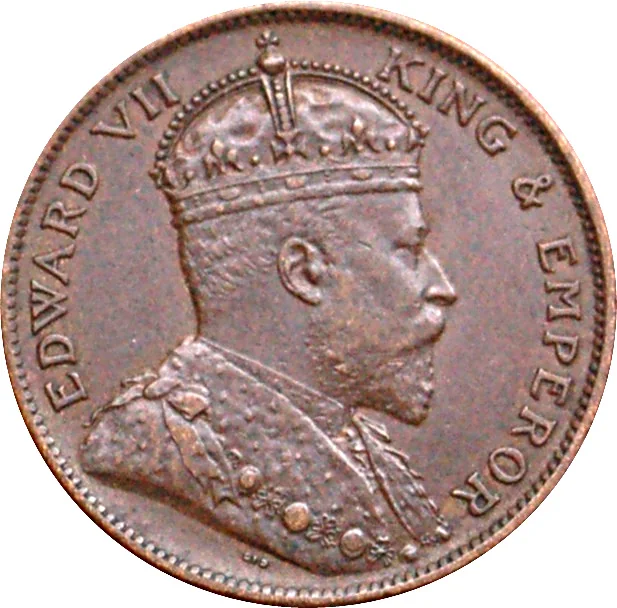
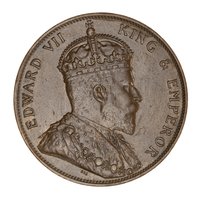
Edward VII crowned bust right, surrounded by legend.
Inscription:
EDWARD VII KING & EMPEROR
DES
DES
Translation:
Edward VII King and Emperor
God [is] with us
God [is] with us
Script: Latin
Engraver: George William de Saulles
Reverse
Description:
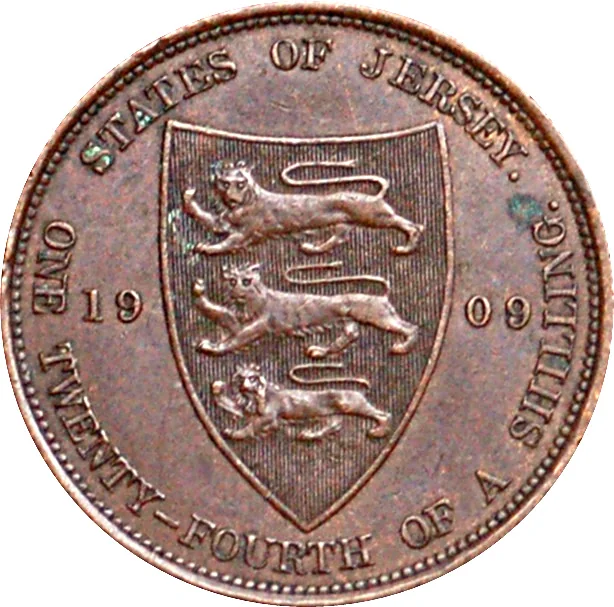
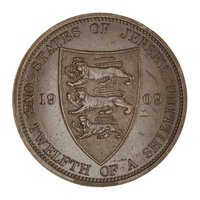
Arms divide date, legend above, denomination below.
Inscription:
STATES OF JERSEY.
19 09
ONE TWENTY-FOURTH OF A SHILLING.
19 09
ONE TWENTY-FOURTH OF A SHILLING.
Script: Latin
Engraver: Leonard Charles Wyon
Edge
Plain
Categories
| Symbols> Coat of Arms |
Mints
| Name | Mark |
|---|---|
| Royal Mint (Tower Hill) | — |
Mintings
| Year | Mint Mark | Mintage | Quality | Collection |
|---|---|---|---|---|
| 1909 | — | 120,000 |
Historical background
In 1909, the currency situation in Jersey was a complex and locally distinctive system, reflecting the island's unique constitutional position as a Crown Dependency, separate from the United Kingdom. While British coinage and Bank of England notes circulated, they did so alongside an array of French gold and silver coins, a legacy of centuries of trade with Normandy and continental Europe. Furthermore, a chronic shortage of small change was met by private token issues from local merchants and banks, leading to a fragmented and sometimes inconvenient monetary environment for daily transactions.
This period was one of transition and growing pressure for reform. The States of Jersey had already taken a significant step in 1834 by authorising the first States-backed paper currency, but the mix of currencies remained problematic. By the early 20th century, there was a strong movement, led by the Jersey Chamber of Commerce, to modernise and simplify the system. Their aim was to replace the heterogeneous assortment of coins and private tokens with an official, unified Jersey currency that would facilitate commerce and assert a clearer sense of island identity.
Consequently, 1909 stands as the final year of the old monetary order. The groundwork had been laid, and the following year, in 1910, the States would pass the foundational Currency Notes Law. This law authorised the first official Jersey pound notes, pegged at par with sterling, which began issuance in 1914. Thus, the background of 1909 is one of a community on the cusp of monetary consolidation, actively moving from a medieval-style mixed-currency system towards a modern, government-issued currency under the British pound sterling standard.
This period was one of transition and growing pressure for reform. The States of Jersey had already taken a significant step in 1834 by authorising the first States-backed paper currency, but the mix of currencies remained problematic. By the early 20th century, there was a strong movement, led by the Jersey Chamber of Commerce, to modernise and simplify the system. Their aim was to replace the heterogeneous assortment of coins and private tokens with an official, unified Jersey currency that would facilitate commerce and assert a clearer sense of island identity.
Consequently, 1909 stands as the final year of the old monetary order. The groundwork had been laid, and the following year, in 1910, the States would pass the foundational Currency Notes Law. This law authorised the first official Jersey pound notes, pegged at par with sterling, which began issuance in 1914. Thus, the background of 1909 is one of a community on the cusp of monetary consolidation, actively moving from a medieval-style mixed-currency system towards a modern, government-issued currency under the British pound sterling standard.
🌱 Fairly Common