

40 centésimos – Uruguay
Add to wishlist
Uruguay
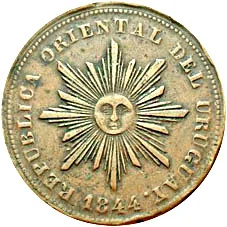
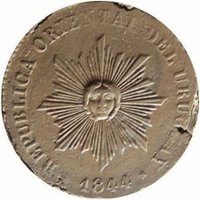
Obverse
Description:
Radiant sun with face, country name encircling, date below.
Inscription:
REPUBLICA ORIENTAL DEL URUGUAY
1844
1844
Translation:
EASTERN REPUBLIC OF URUGUAY
1844
1844
Script: Latin
Language: Spanish
Engraver: Agustin Jouve
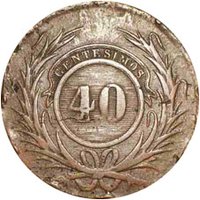
Reverse
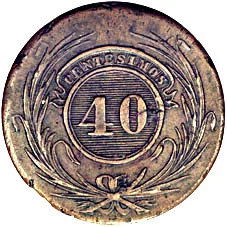
Description:
Value within a double wreath.
Inscription:
CENTÉSIMOS
40
40
Translation:
Forty Centésimos
Script: Latin
Language: Spanish
Engraver: Agustin Jouve
Edge
SmoothLiso
Mints
| Name | Mark |
|---|---|
| Casa de Moneda | — |
Mintings
| Year | Mint Mark | Mintage | Quality | Collection |
|---|---|---|---|---|
| 1844 | — | 65,000 |
Historical background
In 1844, Uruguay, then known as the Estado Oriental del Uruguay, was in a state of profound monetary chaos and scarcity. This was a direct consequence of the ongoing Guerra Grande (1839-1851), a devastating civil and international conflict that pitted the Colorado and Blanco political factions against each other, with intervention from neighboring Argentina and the Empire of Brazil. The protracted war drained the fledgling state's treasury, destroyed agricultural and commercial production, and led to the siege and blockade of Montevideo, severing vital economic links. The government, under President Joaquín Suárez, faced immense difficulty in collecting taxes and financing its military, creating a severe fiscal crisis that manifested most acutely in the currency system.
The monetary landscape was a complex and dysfunctional patchwork. The state lacked the resources to mint its own official coinage in sufficient quantity, leading to a severe shortage of sound money. Consequently, the economy relied heavily on a confusing mix of foreign coins, primarily from Brazil, Argentina, France, and Britain, all circulating at fluctuating and arbitrary values. To finance the war, successive governments resorted to issuing vast amounts of paper money, which was not backed by specie (gold or silver). This fiat currency, including notes known as "pesos fuertes" issued by the besieged government in Montevideo, depreciated rapidly as public confidence evaporated. By 1844, this paper money was trading at a steep discount to its face value, fueling inflation and crippling everyday commerce.
This monetary anarchy had severe socioeconomic consequences. Prices became unstable and unpredictable, harming merchants, wage earners, and the rural economy. The government's attempts to legitimize its paper currency by mandating its acceptance at par value were largely ignored, and a thriving black market for coinage emerged. The situation effectively created a dual system where precious metal coins were hoarded for their intrinsic value, while depreciating paper was used for necessary but distrusted transactions. Thus, in 1844, Uruguay's currency was not a tool of national unity and economic development but rather a stark symbol of its political fragmentation and the crippling cost of a war that had brought the young nation to the brink of collapse.
The monetary landscape was a complex and dysfunctional patchwork. The state lacked the resources to mint its own official coinage in sufficient quantity, leading to a severe shortage of sound money. Consequently, the economy relied heavily on a confusing mix of foreign coins, primarily from Brazil, Argentina, France, and Britain, all circulating at fluctuating and arbitrary values. To finance the war, successive governments resorted to issuing vast amounts of paper money, which was not backed by specie (gold or silver). This fiat currency, including notes known as "pesos fuertes" issued by the besieged government in Montevideo, depreciated rapidly as public confidence evaporated. By 1844, this paper money was trading at a steep discount to its face value, fueling inflation and crippling everyday commerce.
This monetary anarchy had severe socioeconomic consequences. Prices became unstable and unpredictable, harming merchants, wage earners, and the rural economy. The government's attempts to legitimize its paper currency by mandating its acceptance at par value were largely ignored, and a thriving black market for coinage emerged. The situation effectively created a dual system where precious metal coins were hoarded for their intrinsic value, while depreciating paper was used for necessary but distrusted transactions. Thus, in 1844, Uruguay's currency was not a tool of national unity and economic development but rather a stark symbol of its political fragmentation and the crippling cost of a war that had brought the young nation to the brink of collapse.
⭐ Rare